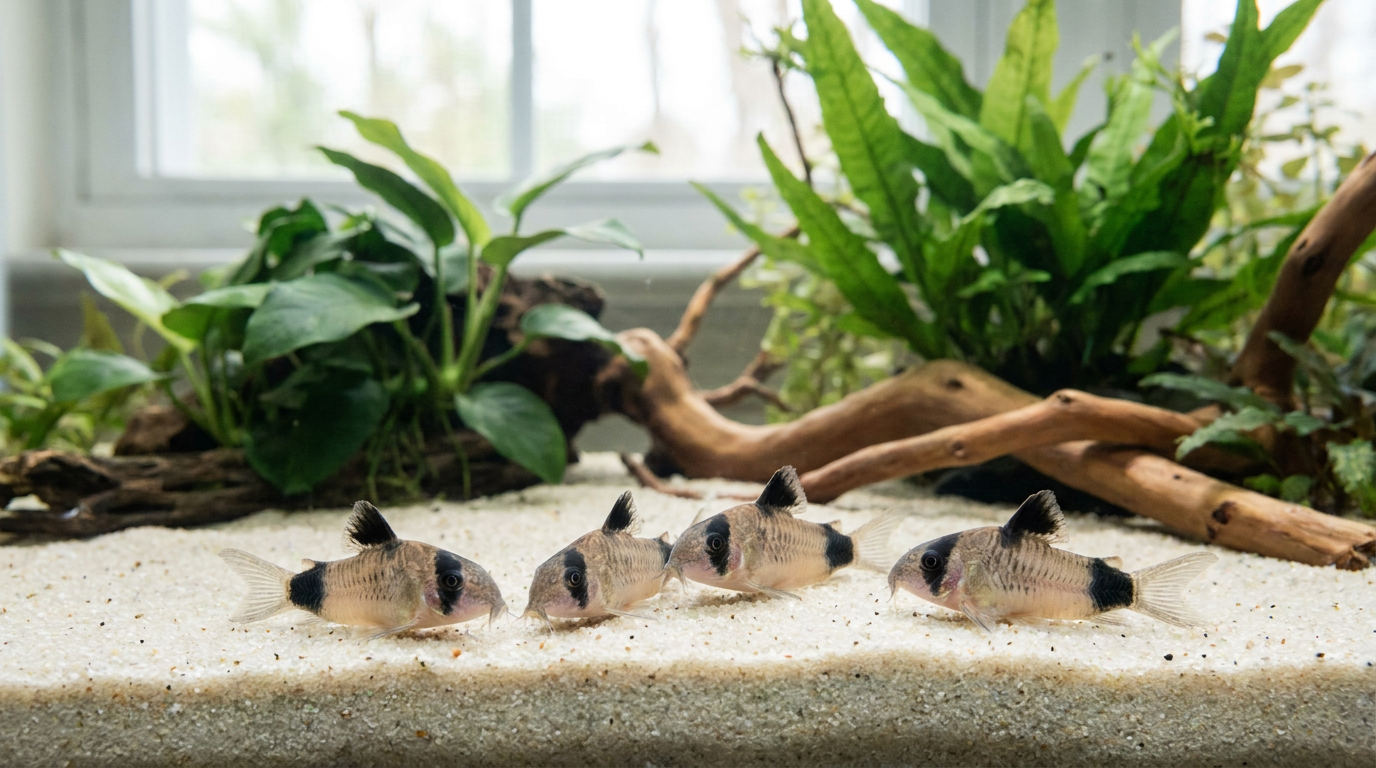
Panda cory catfish: care, tank size, and cool water range
Updated October 2026
Panda corys do best in a 20 gallon long with six or more of their own kind, a floor of fine sand, and water held between 22 and 25°C. That last number is the one most care pages bury: it runs cooler than a typical tropical community tank, and it decides whether you buy a heater at all.
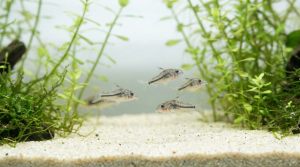
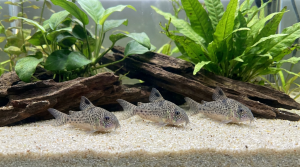
Adults reach about 5 cm and spend the day sifting substrate in a loose, rolling group.
How big do panda corys get?
Seriously Fish gives a maximum of 5 cm standard length, about 2 inches. FishBase lists a smaller 3.8 cm standard length for male or unsexed fish.
Standard length stops at the base of the tail, so a fish measured tip to tip looks a little longer. Females run slightly larger and rounder when you look down from above.
At that size the species suits tanks that would crowd a peppered cory, which reaches about 7 cm. Our peppered cory care guide and pygmy cory care guide cover the other two common small corys.
The cool water range changes your heater plan
Seriously Fish puts tank-bred panda corys at 22 to 25°C and warns that long-term warmth above that shortens lifespan. FishBase lists 20 to 25°C. A heated betta tank sits at 26 to 27°C, which is above both ranges.
Wild fish come from Peruvian streams fed by Andean meltwater, where the water drops to around 19°C at times. Breeders use that: Seriously Fish describes a large cool water change as the spawning trigger.
A room that holds 22°C across winter needs no heater for this species. At 20 or 21°C you are inside the FishBase range and under the Seriously Fish floor, so a small adjustable heater set near 23°C is cheap insurance.
Panda corys come from clear and blackwater streams, and a tannin-stained tank with leaf litter suits them. Our blackwater aquarium setup guide covers building one step by step.
Video: Fish Shop Matt
Numbers worth planning around
Figures below come from the Seriously Fish and FishBase species profiles. Treat the footprint as the hard constraint, because pandas patrol the floor rather than the water column.
| Parameter | Seriously Fish | FishBase | What it means for your tank |
|---|---|---|---|
| Adult size | 5 cm standard length | 3.8 cm standard length (male or unsexed) | fits small tanks without crowding |
| Temperature | 22 to 25°C | 20 to 25°C | no heater needed in a 22°C room |
| pH | 6.0 to 7.4 | 6.0 to 8.0 | most tap water works, soft and slightly acidic is safest |
| Hardness | 1 to 12 dGH | 2 to 25 dGH | keep it under 12 dGH if you can |
| Minimum group | at least 6 | not listed | single pandas hide and waste away |
| Minimum tank | 45 x 30 x 30 cm, about 11 gallons (41 liters) | not listed | our pick is a 20 gallon long, 76 cm of floor |
| Substrate | river sand | not listed | barbels wear down on sharp gravel |
What tank size do panda corys need?
Seriously Fish calls a 45 x 30 x 30 cm tank of about 11 gallons (41 liters) adequate for a small group. That is the floor for a small group.
A 20 gallon (76 liter) long gives you 76 cm of floor, which is why we open with it. Eight pandas, a school of small midwater fish and some wood fit without crowding. Our 20 gallon stocking guide shows the full community.
How many panda corys should you keep together?
Seriously Fish says a group of at least six is best, because corys are more confident and active around their own kind. We would go to eight, which is when the schooling behavior shows, and ten if the tank has room.
Fewer than six is where the trouble starts. A lone panda hides, eats poorly and fades.
Bioload is the part owners misread
Six fish sifting sand all day gets read as a cleanup crew. They still need food aimed at the floor: new shipments arrive lean, and pandas fed on leftovers alone go thin over a season.
Sinking foods are the fix, and the feeding section below covers what to buy.
What do panda corys eat?
Seriously Fish recommends a good quality sinking pellet or tablet as the staple, with live and frozen foods such as daphnia, artemia and bloodworm as a supplement. They are omnivores and accept most of it.
Target the feeding. Sinking wafers or frozen bloodworms two or three evenings a week, dropped where the current carries them down, covers it.
TanninLab earns a commission on qualifying Amazon purchases made through these links, at no extra cost to you.

Fragile imports, sharp gravel
Two failure points account for most panda cory losses. Farmed fish are hardier than wild ones, but shipping still stresses them, so a quarantine tank for three weeks beats medicating your display. Coarse gravel erodes their barbels over months, and fine sand fixes that for good.
Seriously Fish adds that pandas can lose their barbels on dirty substrate and are sensitive to deteriorating water. A gravel vacuum run over the sand at each water change keeps it clean.
Floor space matters more than rated volume here. Several tanks sold as nano picks run 30 cm of frontage, and a 45 cm minimum rules them out; our nano tanks for aquascaping roundup flags the footprints that actually work.

A 10 lb bag covers a small area, so a 20 long at a few centimeters deep takes several bags. Our substrate comparison covers depth and planting.
Best filter and heater for a panda cory tank
Seriously Fish suggests a filter turning the tank over four to five times an hour, which is about 165 to 205 liters per hour for 41 liters (11 gallons). In a 20 long, an air-driven sponge filter is the simplest way to get there.
It has no intake for a cory to get stuck in, it keeps flow gentle, and it is safe for fry if your group spawns. The mechanics are in our sponge filter explainer, and the pump side is covered in the air pumps and sponge filters roundup.

The heater is the optional piece. Seriously Fish estimates 25 to 50 watts for an 11 gallon (41 liter) tank in a 20°C room, and a 20 gallon (76 liter) tank needs more, so size by room temperature rather than by the box.
Whatever you buy, check it against a thermometer. Our hygger heater failure notes and thermometer accuracy test explain why.

Panda cory tank mates
Seriously Fish calls the panda very peaceful and suitable for many community tanks. Good tank mates are small characins, cyprinids, anabantoids, dwarf cichlids and other peaceful catfish. Avoid anything very large or aggressive.
Small tetras and rasboras share the water column without competing for the floor, and our neon tetra compatibility guide covers one popular pairing. Adult corys eat their own eggs, so do not count on fry surviving in a community tank.
Bettas are anabantoids, so they appear on the compatible list, but the temperature gap is real. Check the full list of betta tank mates before you commit.
How to breed panda corys
Seriously Fish says panda corys breed much like other corys. Use a 45 x 30 x 30 cm tank with a bare bottom, sand or fine gravel, an air-powered sponge filter, and clumps of java moss. Aim for about 24°C and a pH near 6.5.
Keep two males per female and condition the group on live, frozen and dried foods. When the females look full of eggs, change 50 to 70 percent of the water with cooler water and increase oxygenation and flow. Repeat daily until they spawn.
Eggs go on the glass, often where flow is strong.
The adults eat them, so move the adults or roll the eggs off the glass into a separate container. They hatch in three to five days, and the fry take microworm and brine shrimp nauplii once the yolk sac is gone.
Panda cory frequently asked questions
How big do panda corys get?
About 5 cm standard length, or 3.8 cm by the smaller FishBase figure.
How many panda corys should I keep together?
Six is the working minimum, and eight is when the schooling behavior actually shows.
What tank size do panda corys need?
45 x 30 x 30 cm (about 11 gallons, 41 liters) is the floor for a small group. A 20 gallon long is the better home for eight.
Do panda corys need a heater?
Not in a room that holds 22°C, since the species runs cool at 22 to 25°C.
Can panda corys live with bettas?
Only as a compromise. Bettas want 26 to 27°C and panda corys do best at 22 to 25°C, so the ranges do not overlap. The compromise is the top of the cory range at 25°C, just under the betta range.
The pairing works in a tank of 20 gallons (about 75 liters) or more held near the cool end of the betta range, and fails in anything warmer or smaller.
Do panda corys need sand?
Yes. Sharp gravel erodes their barbels over months, so use fine sand, pool filter sand included.