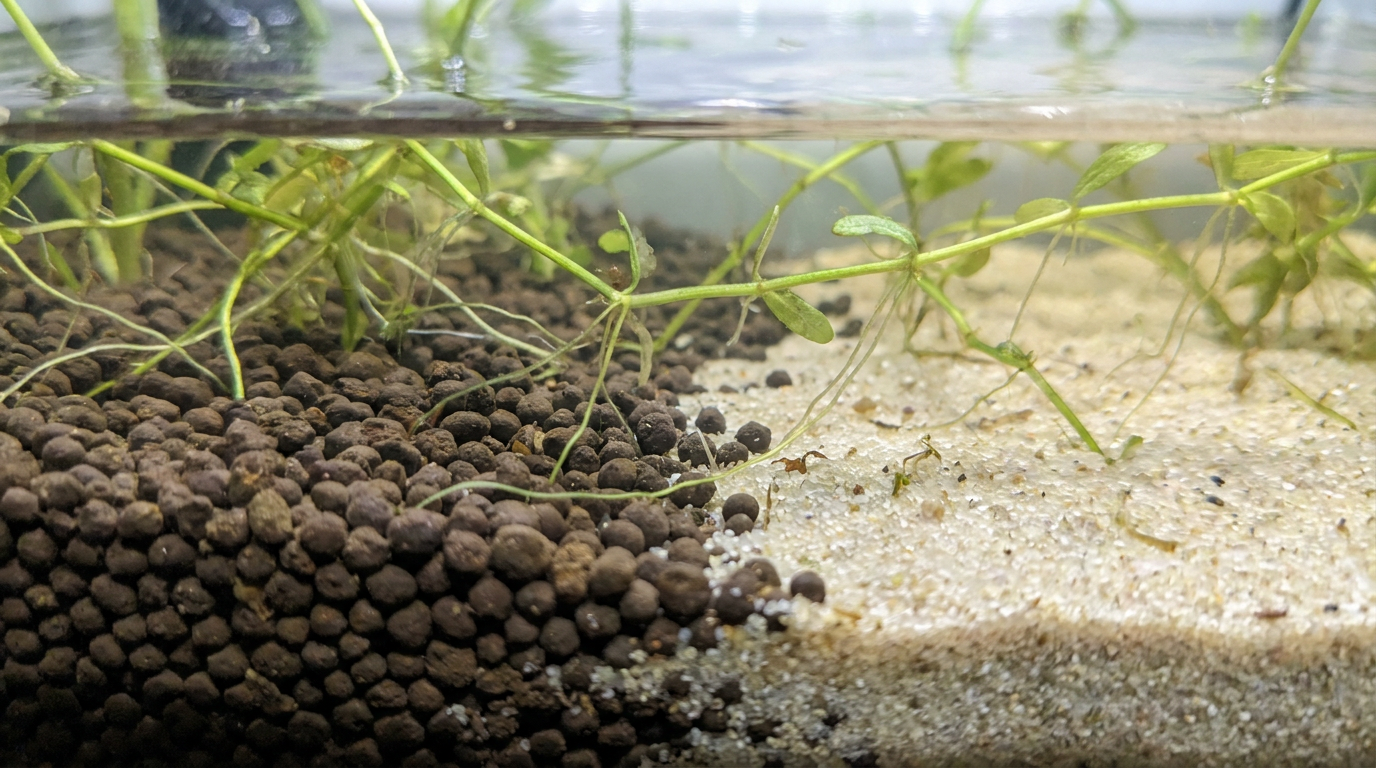
Planted Tank Substrate: Soil, Sand, or Gravel for Your Setup
Updated September 2026
Aquasoil for a tank where rooted stem plants and a carpet are the point, inert sand or gravel for a tank built around epiphytes and easy plants. That split settles most substrate decisions, because what you pour in on day one decides how you fertilize for years.
Active aquasoil
Aquasoil is baked clay granules loaded with nutrients. Brands such as ADA Amazonia, Tropica Aquarium Soil and UNS Controsoil feed root systems directly, so heavy root feeders like cryptocorynes and swords grow without root tabs at first.
These soils also buffer the water downward. They pull carbonate hardness out of the column and hold pH on the acidic side, which suits most Amazonian plants and Caridina shrimp. If your tap is hard, read how that interacts with your parameters in our guide to GH and KH in planted tanks.
The cost is a messy start. Many fresh soils leach ammonia for the first weeks, so you cycle before livestock and change water often. Granules also crumble when disturbed, so replanting the same spot repeatedly turns it to mud. And the nutrient charge is finite: once it fades, you are back to dosing.
Inert sand
Sand does nothing to your water chemistry, and that is the appeal. Your parameters stay whatever your tap and your dosing make them, so a hard-water shrimp tank or a low-tech betta setup stays predictable.
Plants still grow in sand, but you supply everything: root tabs under each heavy feeder and liquid ferts for the column. The tradeoff between the two is covered in root tabs vs liquid ferts.
Pick a coarser pool-filter grade over fine play sand. Fine sand packs tight, roots struggle to push through it, and it drifts into filters. Keep the sand bed shallow unless you have burrowing snails to keep it turned.
Gravel
Plain gravel is fine more often than forum wisdom admits. Anubias, Java fern, mosses and Bucephalandra grow attached to wood and rock rather than in the substrate, so a gravel bed under them is purely cosmetic.
Gravel also lets water and gas move freely, so it never compacts or sours. Where it fails is with carpeting plants and fine-rooted stems, which cannot anchor between large pebbles. Choose small, rounded, dark grain if you go this way.
Cap layers and dirted tanks
A soil base capped with sand or gravel gives you nutrient-rich roots and a clean surface. It works, but caps migrate. Every uprooting pulls dark soil to the top, and the cap gradually mixes down. Treat a capped tank as something you plant once and leave alone.
Matching substrate to your setup
- High-tech with CO2 and a carpet: aquasoil, without much debate.
- Low-tech with epiphytes and a betta: sand or gravel, plus root tabs where needed.
- Caridina shrimp: aquasoil, for the buffering.
- Neocaridina shrimp: inert sand, since they prefer harder water.
Specific bags and their street prices are in our best substrate for a planted tank roundup.
Marcus Chen
Aquarist & Founder, TanninLab
Marcus has been keeping planted tanks for 14 years. He tests every product recommendation in his own tanks and publishes the raw data.
Last updated: September 2026