Root Tabs vs Liquid Ferts: Which to Use When
Updated June 2026
Your Amazon sword is yellowing. You dose liquid ferts every week, your parameters look fine, and the rest of the tank seems healthy.
The problem is almost certainly not what you are adding but where you are adding it. Swords pull the bulk of their nutrition through their roots, so liquid ferts circulating in the water column largely pass them by.
That gap is exactly what separates root tabs from liquid fertilizers, and understanding it will save you a lot of frustration and a lot of dead plants.
This guide covers how each fertilizer type works, which plants belong in which camp, how to dose without burning anything, and the one ingredient you must watch if you keep shrimp or snails.
What Root Tabs Actually Do
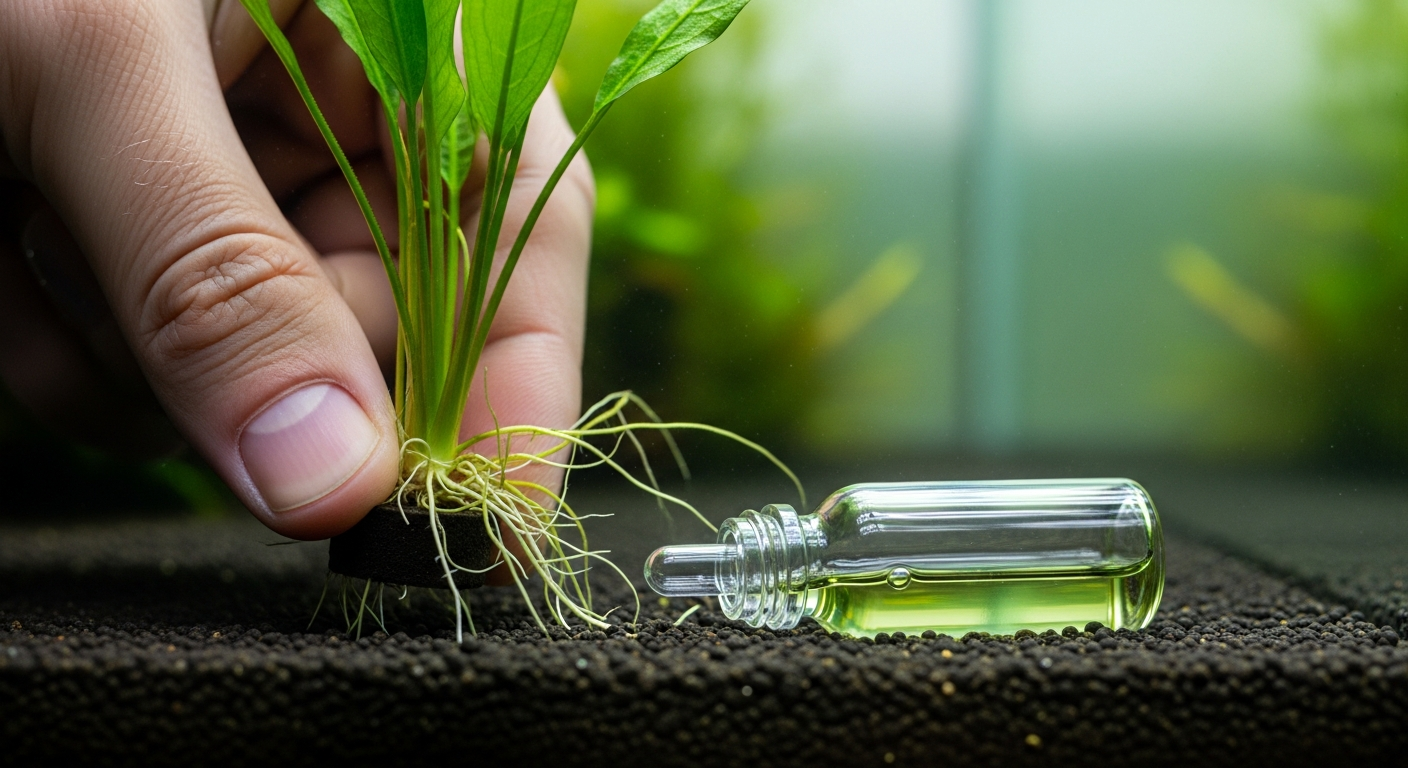
A root tab is a compressed fertilizer capsule you push into the substrate directly beneath or beside a plant’s root zone. As the tab breaks down over weeks to months, nutrients release into the substrate pore water where root hairs can absorb them immediately.
The key word is slow. Root tabs are not a quick fix. They work because they stay in place, concentrating a nutrient reservoir exactly where hungry roots are actively foraging.
A single tab placed 2 to 3 inches from a sword’s crown typically lasts six to eight weeks before needing replacement, though plain inert substrates burn through them faster than active plant substrates.
Root tabs are the right tool for any plant that grows a large, structured root system and does most of its feeding below the surface.
If you are building a tank around a planted substrate like a quality planted substrate, root tabs work alongside it to maintain nutrient depth over time, especially in older tanks where substrate nutrients have been depleted.
What Liquid Ferts Actually Do
Liquid fertilizer dissolves directly into the water column. Plants with leaves adapted for nutrient uptake, primarily stem plants with small, numerous leaves, absorb macros and micros through the leaf surface and stem tissue rather than exclusively through roots.
The trade-off is that liquid ferts require consistent dosing. They get used up or diluted with every water change, which is why most liquid fertilizer regimens are built around weekly dose schedules timed to partial water changes. Stop dosing for two or three weeks and deficiency signs appear fast in heavy-growth stem plant tanks.
Liquid ferts also give you more precise control. You can adjust individual macro and micro ratios, respond to specific deficiency symptoms, and scale dose up or down based on plant mass and lighting intensity. That flexibility is why most serious planted tank hobbyists end up running a liquid program regardless of whether they also use root tabs.
Root Feeders vs Water-Column Feeders
The plant category question is the one that actually drives your fertilizer choice. Not all aquatic plants behave the same way, and many will take nutrients from both pathways if given the option.
Heavy root feeders that respond best to root tabs include Amazon swords (Echinodorus species), all Cryptocoryne species, Vallisneria, Sagittaria, and most of the larger Aponogetons. These plants build dense, extensive root systems and will show yellowing and stunted growth when the substrate is nutrient-poor, even if your water column parameters are excellent.
Water-column feeders that thrive on liquid ferts include most fast-growing stem plants (Rotala, Ludwigia, Bacopa, Hygrophila), Java moss, Christmas moss, anubias, Java fern, and floating plants like frogbit or water lettuce. Anubias and Java fern in particular barely root into substrate at all, so root tabs accomplish almost nothing for them.
The plants that genuinely benefit from both include Dwarf sagittaria, Staurogyne repens, and most mid-ground carpeting species. They root moderately well and also have enough leaf surface to absorb water-column nutrients.
Root Tabs vs Liquid vs All-in-One: Side by Side
| Feature | Root Tabs | Liquid Fertilizer | All-in-One Liquid |
|---|---|---|---|
| How delivered | Pressed into substrate near roots; slow-release over 6-8 weeks | Dosed directly to water column; absorbed through leaves and stems | Dosed to water column; combined macro + micro formula in one bottle |
| Best for which plants | Amazon swords, Cryptocorynes, Vallisneria, Sagittaria, Aponogetons | Stem plants, mosses, floating plants, Anubias, Java fern | Mixed or low-tech tanks; beginner setups; tanks without strong demand on any single nutrient |
| Dosing cadence | Replace every 6-8 weeks per plant; add new tabs as plant mass grows | Weekly; often split into 2-3 smaller doses for high-light tanks; adjust after water changes | Weekly; fixed ratio means you cannot adjust individual nutrients independently |
| Shrimp safety | Generally safe; copper content is low and localized in substrate. Check label for copper sulfate concentration. | Copper is the risk factor; Neocaridina and Caridina are highly sensitive. Choose copper-free or explicitly shrimp-safe formulas. | Variable; all-in-one formulas often contain trace copper. Always verify the copper content before using in any shrimp tank. |
| Algae risk | Low; nutrients stay in substrate and are not available to water-column algae | Higher if overdosed or lighting is unbalanced; algae thrive on excess water-column phosphate and nitrate | Moderate; easier to overdose trace elements when macro and micro ratios are locked together |
| Cost structure | Lower ongoing cost in small tanks; scales with plant count, not tank volume | Scales with tank volume and change frequency; bulk options available for larger tanks | Mid-range; convenience premium over buying separate macro and micro bottles |
Dosing Basics: EI vs Lean Dosing
For liquid fertilizers, two philosophies dominate the planted tank hobby and they produce very different results depending on your lighting and CO2 setup.
Estimative Index (EI) dosing, developed by Tom Barr, works on the principle of flooding the water column with nutrients slightly above what plants can consume, then resetting with a large weekly water change. Plants always have access to everything they need, so growth rate becomes limited by light and CO2 rather than nutrients.
EI works well in high-light, injected-CO2 tanks with heavy plant mass and requires a 50 percent water change weekly to prevent salt and mineral buildup.
Lean dosing (sometimes called Perpetual Preservation System or PPS) doses only what plants can consume between water changes, keeping nutrients at low but nonzero levels. It suits low-tech tanks, low-light setups, and tanks where algae pressure is a constant concern. The downside is less margin for error. Miss a dose when plant demand spikes and deficiencies show up fast.
If you are running a low-tech blackwater setup with CO2 from fish respiration only, lean dosing paired with root tabs for your root feeders is almost always the better starting point. You get stable nutrition without flooding the column with phosphate and nitrate that algae will find before your slow-growing plants do.
When to Run Both Root Tabs and Liquid Ferts Together
The short answer: run both any time your tank includes a mix of plant species. That covers the majority of planted aquariums.
A good rule of thumb is to place root tabs under every heavy feeder at planting time, then build a liquid dosing schedule around your water-column species and lighting level. As the tank matures and root systems develop, you will usually find that root feeders become more forgiving while stem plants respond immediately to changes in liquid dose.
Tanks that genuinely do not need root tabs are rare. They include species-only setups built entirely around mosses, Java fern, and floating plants, or tanks using an active substrate like ADA Aqua Soil or Seachem Flourite that already contains substrate nutrition.
Even those tanks often benefit from root tabs after 12 to 18 months when the substrate’s initial nutrient charge is exhausted. Your planted tank setup guide should factor substrate lifespan into the long-term fertilization plan from day one.
Shrimp-Safe Dosing: Copper Is the Real Risk
Copper is present in many aquarium fertilizers because it is a legitimate trace element for plants. The problem is that invertebrates, including Neocaridina and Caridina shrimp, snails, and crayfish, are extremely sensitive to copper at concentrations that are harmless to fish.
With root tabs, the risk is relatively contained. Nutrients release into the substrate pore water and only leach into the water column slowly. In a tank with an active substrate and healthy bacterial colonies, most of that copper stays bound in the substrate and never reaches concentrations that stress shrimp.
That said, read the label of any root tab before using it in a shrimp tank. Some formulas contain copper sulfate at concentrations that can leach meaningfully in bare or inert substrate setups.
Liquid fertilizers are the larger concern. When you dose directly to the water column, copper is immediately bioavailable to every organism in the tank. For Neocaridina shrimp care, the non-negotiable rule is to use a formula explicitly labeled copper-free or shrimp-safe, or to verify the copper content against established invertebrate toxicity thresholds before dosing.
Some hobbyists run copper-free macros and micros separately, sourcing micro blends that omit copper entirely and relying on trace copper in their tap water to cover plant requirements.
If shrimp suddenly go inactive, lose color, or die within 24 hours of a fertilizer dose, copper toxicity is the first thing to investigate. Do a large water change immediately and check your fertilizer’s full ingredient list.
Shrimp Keeper’s Rule
Never add any fertilizer to a shrimp tank without first checking the copper content. Even trace amounts of copper sulfate at concentrations above 0.02 ppm can cause acute toxicity in cherry shrimp and crystal shrimp. Look for formulas that explicitly state “invertebrate safe” or “copper-free” on the label, and cross-reference with the full ingredient list, not just the marketing copy.
Reading Deficiency Signs by Fertilizer Type
Yellowing on older leaves typically signals a mobile nutrient deficiency, most often nitrogen or magnesium, that the plant is cannibalizing from older tissue to feed new growth. This pattern points to water-column nutrition being the bottleneck, so a liquid fert adjustment is usually the fix.
Yellowing or stunting on new growth often indicates an immobile nutrient problem such as calcium or iron deficiency. Both move poorly within plant tissue, so new leaves show symptoms first. This pattern is common in tanks with soft, low-mineral blackwater and can be addressed with targeted liquid micro supplementation or root tabs with a broader trace element profile.
If only your root-feeding plants are struggling while stem plants look healthy, the substrate is nutrient-depleted and root tabs are the direct solution. If stem plants are pale while your swords look fine, the water column is under-dosed and liquid ferts need adjustment.
Frequently Asked Questions
- Do I need root tabs if I have a planted substrate?
- For the first 12 to 18 months after setup, probably not, but it depends on the substrate. Active substrates like ADA Aqua Soil or UNS Controsoil come pre-loaded with nutrients that support heavy root feeders through the early growth phase. After that window, nutrients deplete and root tabs become necessary to maintain the same growth rates. Inert substrates like plain sand or gravel provide no nutrition at all and need root tabs from day one.
- How often should I replace root tabs?
- The standard recommendation is every six to eight weeks per plant, but the real answer depends on plant species, substrate type, and how aggressively the plant is growing. A large, fast-growing Amazon sword in an active substrate may need tabs every four weeks during a growth surge. A smaller Cryptocoryne in a fine-grain substrate might go ten weeks between replacements. Check new leaf color and root mass growth to calibrate your specific tank.
- Are all liquid fertilizers safe for shrimp?
- No. Many popular liquid fertilizer formulas contain copper sulfate or other copper compounds as part of the trace element mix. Neocaridina and Caridina shrimp can suffer acute toxicity at copper concentrations above 0.02 ppm. Always read the full ingredient list, not just the marketing label. If the formula lists copper sulfate without specifying a concentration, contact the manufacturer or choose a product explicitly labeled for use in invertebrate tanks.
Marcus Chen
Aquarist & Founder, TanninLab
Marcus has been keeping planted tanks for 14 years. He tests every product recommendation in his own tanks and publishes the raw data.
Last updated: June 2026