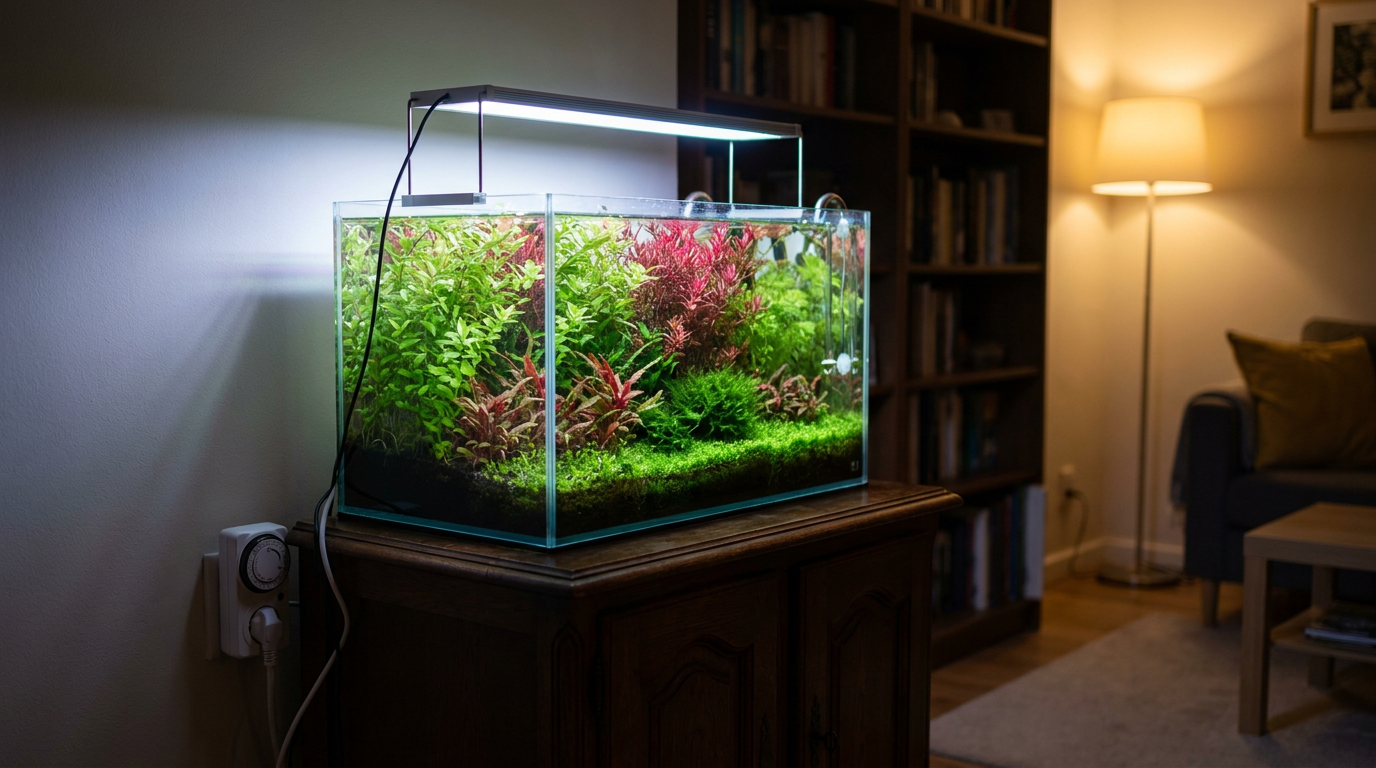
Aquarium Light Timer: Setting a Photoperiod That Keeps Algae Down
Updated October 2026
Put your aquarium light timer on 5 to 6 hours for a new planted tank, then step it up to 7 or 8 hours once the plants are rooted and growing. Stable CO2-injected tanks can run 8 to 9, the windows 2Hr Aquarist publishes. The timer matters more than the exact number, because the same window every day is what keeps algae from getting a foothold.
Most timer guides stop at outlet counts and app features. The setting you program into it is the part that decides whether you get clean glass or green water.
Published photoperiods by tank stage
Two widely read planted-tank sources give these windows. They overlap more than they disagree, and both start new tanks short.
| Tank stage | 2Hr Aquarist | Aquarium Co-Op |
|---|---|---|
| New tank (first 4 to 6 weeks) | 5 to 6 hours, raised gradually | 6 to 8 hours |
| Established low-tech | 7 to 8 hours | Raised slowly toward 8 to 12 hours as plants grow |
| Established CO2-injected | 8 to 9 hours | No separate figure |
| Algae outbreak | 5 to 6 hours | Cut the duration back |
| Midday siesta (split window) | Not recommended | Optional, some hobbyists use it |
| Upper limit | About 12 hours, beyond that only more algae risk | 12 hours, the top of its range |
Sources: 2hraquarist.com, “How Many Hours of Light Does a Planted Tank Need”; aquariumcoop.com, “How to Balance Aquarium Lighting”.
Video: Aquarium Co-Op
Hours only work if the intensity is right
A longer photoperiod cannot fix a weak light. If a plant needs far more PAR than your fixture delivers at the substrate, running it 12 hours instead of 8 just feeds algae on the older leaves. Check your fixture against the numbers in planted tank lights: PAR over watts before you touch the timer.
The reverse also bites. A strong fixture on a long window, with CO2 and fertiliser not dialed in, is the classic setup for hair algae. 2Hr Aquarist puts most carpets and common plants at 40 to 60 micromoles of PAR when CO2 is optimal, which many lights exceed at full power.
New tanks and the diatom phase
Brown dust on leaves and glass in the first weeks is normal. A short window, 5 to 6 hours, gives the plants time to settle without handing extra light to the bloom. The full picture is in diatom bloom in new planted tanks.
Pick one number and hold it for four weeks. Changing the schedule every few days means you never learn what the tank responds to.
Choosing the timer itself
You have three options, and all of them work.
- A mechanical plug-in timer with a dial. Cheap and simple, but most work in 15-minute steps and they stop during a power cut, so the schedule drifts until you reset the dial.
- A digital plug-in timer. Minute-level settings and multiple on/off programs, with a backup battery on most units.
- A smart plug or Wi-Fi timer such as the Kasa unit Aquarium Co-Op sells. Scheduled from your phone, useful if you adjust the window often.
Many current LEDs carry a built-in controller with sunrise and sunset ramps. If yours does, use it and skip the outlet timer, since cutting power at the wall can reset the ramp on some models. Check the controller before you buy from our best LED lights for planted tanks picks.
If you inject CO2, give the solenoid its own timer channel. A common practice is to start it about an hour before the lights so the gas has built up when photosynthesis starts.
Questions readers ask
How many hours should an aquarium light be on for plants?
Start a new planted tank at 5 to 6 hours. Once plants are established, 7 to 8 hours suits most low-tech tanks and 8 to 9 hours suits stable CO2-injected tanks. Going past about 12 hours adds algae risk without extra growth.
Is a lighting siesta good for a planted tank?
Sources disagree. Aquarium Co-Op mentions it as an option some hobbyists use, while 2Hr Aquarist advises against it because plants need time to ramp up CO2 fixation each time the lights come on. A single continuous window is the simpler choice.
Should I use an outlet timer if my LED has a built-in timer?
No. Use the fixture's own controller so its sunrise and sunset ramp runs properly. Cutting power at the wall can reset the light's settings on some models.