Best LED Lights for Planted Tanks
Updated August 2026
Most planted tank failures trace back to the same root cause: a light chosen by watts or looks rather than by what plants actually measure in photons. Lumens describe brightness for the human eye. Plants do not care about lumens.
They absorb specific wavelengths in the 400 to 700 nanometer range, and the only number that captures this is PAR, measured in micromoles of photons per square meter per second (µmol/m²/s). Once you understand that number, every other spec on the box becomes secondary.
This guide breaks down exactly how to match light output to your tank depth, your plant species, and your CO2 strategy, so you buy the right fixture once instead of cycling through three lights in a year.
Tannin Lab earns a commission on qualifying purchases through the Amazon links on this page, at no extra cost to you. Picks are chosen on performance and suitability, not on commission.
PAR vs. Watts vs. Lumens: The Metric That Actually Matters
Watts measure power draw. Lumens measure how bright a light appears to human vision, weighted toward the green-yellow spectrum where our eyes are most sensitive. Plants absorb light heaviest in red (630 to 680 nm) and blue (430 to 480 nm) bands, which happen to score poorly on the lumen scale.
A fixture can look dim to you while delivering excellent PAR to your plants, and a blindingly bright bulb can starve aquatic flora if its spectrum skews wrong.
PAR is the only cross-comparable metric across different brands and fixture types. When a manufacturer lists PAR values at multiple depths, that number tells you exactly what lands at substrate level in a tank of that height. If the manufacturer does not publish PAR data, that is itself useful information.
A useful secondary metric is PUR (photosynthetically usable radiation), which narrows PAR down to the wavelengths plants can actually use. A fixture with a tailored red-blue spectrum will have higher PUR relative to its PAR than a generic white LED strip. For planted tanks, look for lights that publish both numbers or at minimum show a spectral output chart.
Prices move, and stock does too. Each of these opens the product page on Amazon in a new tab.
Low, Medium, and High Light Plants: What Each Category Needs
The hobby has settled on a three-tier classification that maps reasonably well to PAR targets, though tank depth complicates things (covered in the next section).
Low-light plants (15 to 30 PAR at substrate): Java fern, anubias, bolbitis, most mosses, and cryptocorynes. These species evolved in shaded forest streams and river margins. Excess light does not make them grow faster. It gives algae a competitive advantage while the plant itself shows no benefit. This is the tier where beginners succeed without CO2 injection.
Medium-light plants (30 to 60 PAR at substrate): Stem plants like ludwigia, bacopa, hygrophila, and most echinodorus sword variants. Vallisneria also falls here. These plants respond to supplemental CO2 and fertilizer but can survive at the low end without it, just more slowly. A good all-around fixture running at 60 to 70% intensity covers this tier cleanly.
High-light plants (60 to 100+ PAR at substrate): Glossostigma elatinoides, HC Cuba (dwarf baby tears), most carpeting species, and demanding stem plants like rotala rotundifolia. You cannot grow these successfully without injected CO2 and a complete macro/micro fertilizer regime. Running high PAR without CO2 is the fastest path to a tank full of algae and melting plants.
| Light Tier | PAR at Substrate | Plant Examples | CO2 Required | Best Tank Depth |
|---|---|---|---|---|
| Low | 15 to 30 µmol/m²/s | Anubias, java fern, moss, crypts | No | Up to 18 inches |
| Medium | 30 to 60 µmol/m²/s | Ludwigia, bacopa, swords, val | Optional (recommended) | 12 to 20 inches |
| High | 60 to 100+ µmol/m²/s | Glosso, HC Cuba, rotala, carpets | Yes (mandatory) | Under 16 inches ideal |
| Blackwater / Low-Demand | 5 to 20 µmol/m²/s | Subwassertang, riccia (floating), bucephalandra | No | Any depth |
Tank Depth Changes Everything
PAR drops off fast as you go deeper. A fixture rated at 80 PAR at 12 inches may deliver only 35 PAR at 20 inches due to light diffusion and water absorption. This is why the tank depth column in the table above matters as much as the PAR number itself.
A shallow 10-gallon nano tank and a 40-gallon breeder (16 inches tall) behave completely differently under the same fixture.
As a working rule: for every 4 inches of additional water depth beyond the fixture’s test height, expect PAR to drop by roughly 30 to 40%.
If you have a 24-inch deep tank and want high-light carpeting plants at the substrate, you need a fixture that delivers 150+ PAR at the waterline. Most hobbyist LEDs cannot do that without supplemental side lighting or a second fixture.
For deep tanks (20 inches and over), prioritize fixtures with high-intensity point sources or tight beam angles over wide flood-style panels. Narrow beam angles push more photons to depth rather than scattering sideways where they waste energy and contribute to algae on the glass.
If you are planning a blackwater biotope with naturally tannin-stained water, PAR penetration is further reduced by the dissolved organics and coloring agents. Factor in an additional 20 to 30% PAR loss at depth if your water is visibly amber. You can read more about setting up this kind of environment in our planted tank setup guide.
Matching LED Type to Tank Size
The fixture format that works for a 5-gallon nano cube is not the right call for a 75-gallon display tank.
Nano tanks (under 10 gallons): Single-arm clip-on LEDs or small bar fixtures work well. The shallow water depth (usually 10 to 14 inches) means even moderate-output fixtures can hit medium PAR at substrate.
The bigger risk in nanos is hot spots: one point-source LED centered on a 6-gallon cube creates uneven coverage, so look for fixtures with diffused or spread optics.
10 to 20-gallon tanks: The standard 20-inch to 24-inch bar fixture category dominates here. These tanks usually run 12 to 16 inches of water depth, making medium-light plants achievable without CO2 and high-light plants doable with it. A quality fixture in this size range with adjustable intensity gives you the flexibility to grow into more demanding species.
40-gallon breeders and standard 30-gallon tanks: These are wide tanks (36 inches or more) that often need two fixtures to cover the footprint evenly, or a single long 36-inch bar with strong edge output.
The 40-breeder (36 x 18 x 16 inches) is one of the most popular planted tank sizes because 16 inches of depth is manageable for most plant categories.
75-gallon and above: At this scale, you are almost certainly running multiple fixtures, and PAR metering at multiple substrate points becomes necessary rather than optional. The footprint is too large for any single consumer LED to cover evenly. Many serious hobbyists in this size range move to T5 HO or high-end LED fixtures designed for reef or commercial aquatic applications.
Photoperiod and Algae: Getting the Duration Right
Running your light longer does not make plants grow faster. Plants hit a light saturation point where additional photons produce no additional photosynthesis. What extra hours do produce is more opportunity for algae, which has a lower light saturation threshold than most aquatic plants and will outcompete your flora if given the chance.
The standard recommendation, backed by planted tank hobbyist experience across thousands of tanks, is a 7 to 8 hour photoperiod for established tanks with CO2. For low-tech, low-light tanks without CO2, 6 to 7 hours is often safer still, because plants are processing photons more slowly without the carbon source and algae catches up faster.
A siesta period splits the photoperiod into two blocks with a gap, like 4 hours on, 3 hours off, 4 hours on. The theory is that CO2 builds up in the water during the dark gap and is ready for the second light period when plants need it most.
The evidence is anecdotal but the practice is widespread and low-risk, so it is worth trying if you are fighting algae in an otherwise healthy setup.
Use a timer. Manual photoperiod management is one of the most common ways planted tanks fail. Consistent on/off timing is more important than the exact hour length.
Algae Diagnostic
Green spot algae on glass with slow plant growth: your PAR is too low relative to your photoperiod. Raise intensity before extending hours. Green dust algae or hair algae in an otherwise healthy tank: shorten the photoperiod first before any other change. Most algae outbreaks in planted tanks are a photoperiod problem, not a fertilizer problem.
Spectrum, Color Temperature, and Plant Growth
Plants photosynthesize most efficiently in the red (630 to 680 nm) and blue (430 to 480 nm) ranges. This is established plant biology.
However, a purely red-blue LED (the purple-pink light associated with grow operations) renders poorly for viewing, and some evidence suggests the green-yellow wavelengths play a role in deeper tissue photosynthesis even if they are not the primary drivers.
For planted aquariums, a full-spectrum white LED in the 6500K to 8000K color temperature range covers both plant requirements and visual appeal. Fixtures in the 6500K to 7000K range have historically produced strong plant growth in hobbyist reports because this temperature naturally emphasizes the blue end of the spectrum while keeping rendering natural.
Some fixtures offer separate red channel control or a dedicated plant spectrum mode. This is genuinely useful for medium and high-light tanks because you can boost red output during peak photosynthesis hours and reduce it toward the end of the photoperiod to slow algae growth without impacting plant health significantly.
For blackwater tanks specifically, the amber and brown water tint shifts perceived color temperature. A 6500K fixture will look warmer and less blue-white over dark water, which suits the aesthetic well. Complement it with a higher-output fixture if you want to grow anything beyond shade-tolerant species.
CO2 and Light Are Not Independent Variables
This is the concept beginners most consistently miss. Light and CO2 are co-limiting factors. You cannot run high light without CO2 and expect good plant growth. The plants will be photosynthesizing rapidly, consuming CO2 faster than it can dissolve from the atmosphere, and slowing to a crawl within hours of light-on each day.
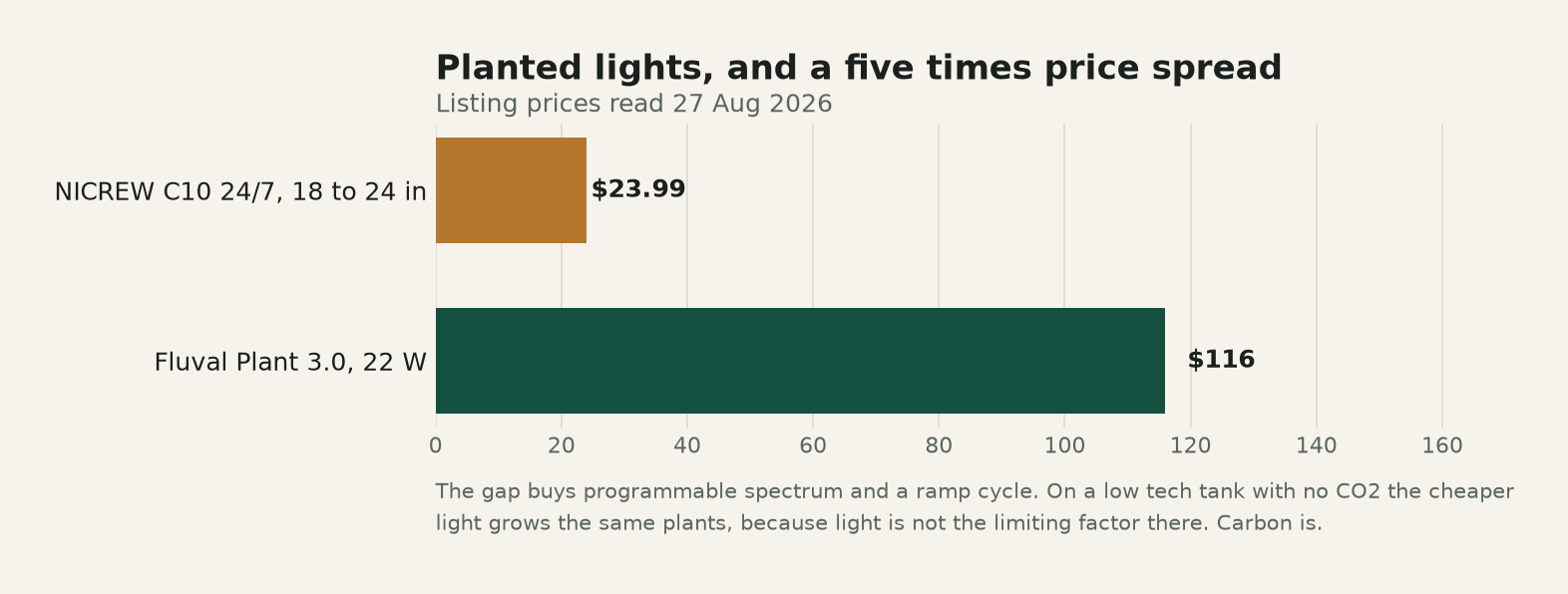
The result: a tank flooded with photons, starved of carbon, and full of algae that is less demanding in its CO2 requirements than your plants. Adding more light to a low-tech tank that is already showing algae is almost always the wrong call.
If you want to run a CO2-injected system, our guide to CO2 kits for beginners covers which systems are worth buying at each price point. If you plan to stay low-tech, design your tank around low-to-medium light plants and keep PAR under 40 at substrate. Those tanks can look stunning with the right plant selection and do not require the maintenance overhead of pressurized CO2.
Criteria That Hold Regardless of What Is on the Market
Specific brands and models cycle in and out of availability and pricing quickly enough that product-specific recommendations go stale. These criteria hold regardless of what is on the market when you are reading this:
Published PAR data at multiple depths, ideally at the distances that match your tank height. If the brand does not publish this, look for hobbyist PAR measurements from forum communities or YouTube reviews with a Seneye, Apogee, or similar PAR meter. User-reported data from the aquascaping community is generally reliable because the methods are standardized.
Controllable intensity. A dimmer lets you run lower PAR during algae fights, ramp up as plants establish, and run a gradual sunrise/sunset schedule that reduces fish stress. Most quality planted-tank LEDs now include this.
Programmable timer. Either built-in or compatible with a third-party smart plug. The built-in timer is more reliable because it does not depend on a separate device staying connected.
IP67 or equivalent splash rating for anything mounted directly over an open-top tank. Water evaporation and splashing from surface agitation will degrade electronics over time without this rating.
For a full overview of how to set up the rest of your planted tank around your light choice, the aquascaping for beginners guide walks through substrate, hardscape, and plant placement in the same framework used here.
Common Questions on Planted Tank Lighting
- How many hours should I run my planted tank light per day?
- Seven to eight hours is the standard for CO2-injected planted tanks. Low-tech tanks without CO2 benefit from six to seven hours. Longer photoperiods do not accelerate plant growth and create the conditions for algae outbreaks. Use an automatic timer from day one.
- Can I use any LED light for a planted tank, or does it need to be aquarium-specific?
- Aquarium-specific LEDs are engineered to deliver PAR in the wavelengths plants absorb, with waterproof ratings suitable for the humid environment. Generic LED panels and grow lights can work if they hit the right PAR numbers and have adequate water resistance, but you trade away spectrum optimization and manufacturer support. For nano tanks in particular, a purpose-built aquarium LED is almost always the better value.
- What is the minimum PAR for growing aquarium plants?
- Shade-tolerant species like anubias, java fern, and most mosses can survive at 10 to 15 PAR at substrate level, though growth will be very slow. The practical minimum for meaningful plant growth in most species is around 20 PAR. Below that, most plants will survive but not thrive, and taller stem plants will stretch toward the surface rather than developing compact growth.
Marcus Chen
Aquarist & Founder, TanninLab
Marcus has been keeping planted tanks for 14 years. He tests every product recommendation in his own tanks and publishes the raw data.
Last updated: August 2026