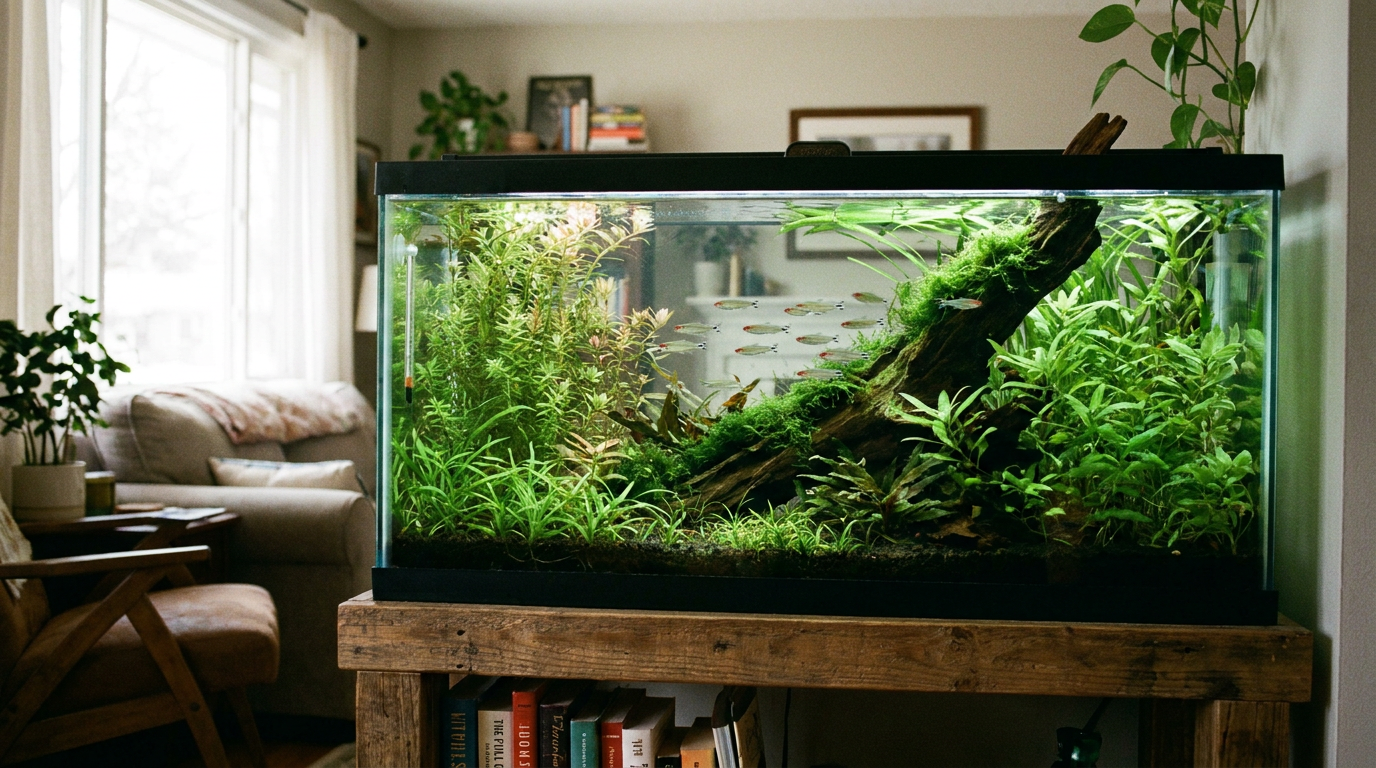
What fits in a 20 gallon fish tank (and what doesn’t)
Updated September 2026
A 20 gallon fish tank holds one small community: a school of ten nano fish, six corydoras on the bottom and a single centrepiece fish. That is the ceiling, not the starting point. What does not fit: anything past four inches at adult size, and every goldfish, pleco and angelfish the store will sell you for it.
Long or high changes the answer
The 20 gallon comes in two shapes and they stock differently. Aqueon lists the 20 Long at 30.25 by 12.5 by 12.75 inches and the 20 High at 24.25 by 12.5 by 16.75 inches. Both weigh 25 lb empty and 225 lb full (manufacturer figures).
The Long gives you six more inches of run, which schooling fish and bottom dwellers actually use. The High gives you four more inches of depth, useful only for tall plants. For fish, the Long wins.
Stage the hardware first. The planted tank setup guide covers equipment sequencing; this article stays on counts and footprints.
Video: AquaViva
Stocking table by size, bioload and swimming zone
Adult lengths are rounded from Seriously Fish profiles. Bioload is relative waste output for size. Counts assume a filter rated above the tank’s volume and weekly water changes.
| Fish | Adult length | Swimming zone | Bioload | 20 Long (30 in) | 20 High (24 in) |
|---|---|---|---|---|---|
| Neon tetra | 1.5 in | Mid-water | Low | School of 10 | School of 8 |
| Harlequin rasbora | 2 in | Mid to top | Low | School of 10 | School of 8 |
| Bronze corydoras | 2.75 in | Bottom | Low | Group of 6 | Group of 6 |
| Otocinclus | 1.5 in | Glass and bottom | Very low | Group of 6 | Group of 6 |
| Honey gourami | 2 in | Top | Low | One pair | One pair |
| Dwarf gourami | 3 in | Top | Medium | One | One |
| Angelfish | 6 in body | Mid-water | High | Does not fit | Outgrows it |
| Common pleco | 18 in | Bottom | Very high | Does not fit | Does not fit |
| Fancy goldfish | Up to 8 in | All levels | Very high | Does not fit | Does not fit |
Pick one row from the mid-water group, one from the bottom group and one centrepiece. Three rows is a full tank. Four rows is a nitrate problem by month three.
What does not fit, and why the store says otherwise
Angelfish are sold at quarter size. An adult carries six inches of body plus fins and wants the height of a 29 or 55 gallon. Common plecos reach 18 inches and foul a 20 within weeks. Fancy goldfish are cold-water fish that want 20 gallons for the first fish alone.
Small fish can fail here too. Zebra danios and tiger barbs pace the glass in the 24 inch High. Only the Long suits them, and even there a six-fish group is the limit.
Bioload is the real limit, not inches
The inch-per-gallon rule fails because a three inch dwarf gourami and two neons of the same total length are not the same load. Stock by waste and filtration. A filter rated for a 40 gallon tank running on a 20 gives you the margin for the full stocking above; the best aquarium filters roundup lists which units do that without blasting the fish around.
Live plants absorb part of that load. Rooted stems need the right base, which we compare in planted tank substrate: soil, sand or gravel. Substrate also eats volume: two inches of aquasoil across the Long’s footprint displaces about three gallons of water, so your 20 is really a 17.
Add fish in this order
Cycle first, then the bottom group, then the school, then the centrepiece. Leave two weeks between groups so the filter bacteria catch up.
Shrimp count as near-zero bioload and slot into any version of this plan, but a dwarf gourami or a betta centrepiece will pick off shrimplets. If shrimp matter, make the honey gourami pair your centrepiece instead.
Start with the Long, the corydoras and the school. Add the centrepiece a month in, once you know your nitrate stays under 20 ppm between water changes.
Marcus Chen
Aquarist & Founder, TanninLab
Marcus has been keeping planted tanks for 14 years. He tests every product recommendation in his own tanks and publishes the raw data.
Last updated: September 2026