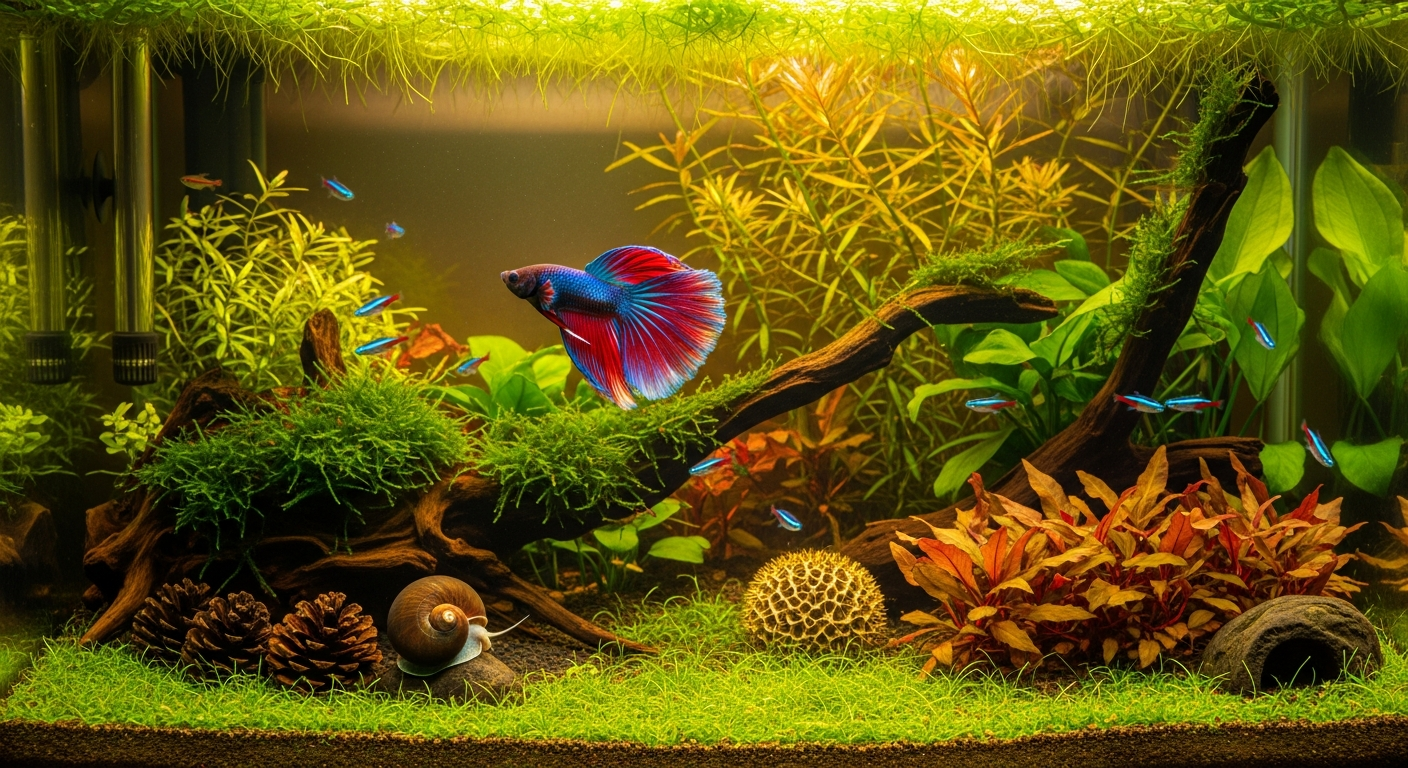
Betta Tank Mates That Work
Updated June 2026
The betta tank mates question trips up a lot of hobbyists because the answer keeps changing depending on the individual fish. One betta ignores his corydoras neighbors completely. The next one treats every new addition like a territorial challenge. That variability is real, it is not something you can breed or condition out, and any guide that glosses over it is setting you up for a stressful return trip to the fish store.
What you can do is stack the odds. Choose species that check the right boxes, set up the tank before the betta goes in, and know exactly what warning signs to watch before something goes wrong.
Can Bettas Actually Live With Other Fish
Yes, but with conditions. The Betta splendens sold in most pet stores is a domesticated line selectively bred for fin length, color, and male-to-male aggression. That aggression is directed primarily at other bettas and at anything the fish reads as a rival: long-finned species, brightly colored fish, anything that resembles a betta’s silhouette.
Bottom-dwelling, dull-colored, fast-moving species fall outside that threat profile for most bettas. They share the tank without incident because the betta simply does not register them as competition. That logic is the foundation for every good compatibility decision you will make.
Tank size is the other major variable. In a cramped 5-gallon, a betta cannot avoid other fish even if it wants to. Visual and territorial stress compounds fast in small volumes. A 10-gallon gives you a workable minimum; a 20-gallon long gives you genuine buffer zones that make community keeping significantly more reliable.
The Best Betta Tank Mates by Category
Species compatibility is not random. The fish that work best share a few traits: they stay near the bottom or mid-column (leaving the top to the betta), they are not fin nippers, and their coloration does not read as betta-rival to most individuals.
| Species | Min. Tank Size | Compatibility Notes |
|---|---|---|
| Kuhli Loach (Pangio kuhlii) | 15 gal | Peaceful bottom dwellers, nocturnal, occupy a completely different niche. Keep in groups of 3+. One of the most reliable choices. |
| Pygmy Corydoras (Corydoras pygmaeus) | 10 gal | Schooling bottom catfish, stay out of the betta’s territory. Need groups of 6+. Standard Corydoras work at 20 gal. Both prefer softer, slightly acidic water. |
| Ember Tetras (Hyphessobrycon amandae) | 10 gal | Small, muted orange tone, non-nippy. Mid-column schoolers. Keep 8+ for natural schooling behavior. Thrive in blackwater setups. |
| Harlequin Rasboras (Trigonostigma heteromorpha) | 10 gal | Fast, schooling, orange-black coloration rarely triggers aggression. Keep 6+. One of the classic betta community species. |
| Chili Rasboras (Boraras brigittae) | 10 gal | Tiny, soft red, love the same blackwater parameters as bettas. Keep 10+. Their small size and speed reduce conflict significantly. |
| Otocinclus Catfish | 20 gal | Algae grazers that stay on glass and hardscape. Ignored by virtually all bettas. Need established algae growth and groups of 4+. |
| Mystery Snails (Pomacea bridgesii) | 5 gal | Most bettas ignore them. Some bettas nip at antennae; watch the first 48 hours. Hardy and useful for cleanup. |
| Nerite Snails | 5 gal | Lower profile than mystery snails, slightly less likely to draw attention. Cannot reproduce in freshwater, which keeps populations in check. |
You will notice shrimp are absent from that table. That deserves its own section.
Shrimp: A Conditional Relationship
The shrimp situation is genuinely complicated. Neocaridina shrimp (cherry shrimp and their color variants) can coexist with bettas, but the success rate is lower than most beginners expect. A heavily planted 10-gallon or larger with dense foreground moss gives shrimp refuge the betta cannot efficiently patrol. In that environment, some keepers maintain thriving colonies.
In open tanks, or with bettas that show any history of hunting behavior, shrimp become expensive snacks. Amano shrimp have a size advantage and survive more often than cherries, but they are not immune. Larger ghost shrimp have a mixed track record.
The honest answer: shrimp are a calculated risk, not a safe bet. If you want a blackwater nano setup with shrimp, consider building a species-only shrimp tank rather than forcing the combination.
Species to Avoid Entirely
Some fish look like they should work and do not. Others are obvious mismatches that still end up in betta community tanks because the store employee was guessing.
- Male bettas with any other male betta. No exceptions, no workarounds.
- Guppies (especially fancy males). Long fins, bright colors, slow swimmers. They check every aggression trigger a betta has.
- Tiger Barbs. Dedicated fin nippers. They will shred a betta’s fins within days.
- Serpae Tetras. Same problem as tiger barbs; known fin nippers in most setups.
- Paradise Fish. Close relative of bettas, similarly aggressive, same threat response.
- Red-tailed sharks. Bottom-territory aggression that competes directly with betta space claims.
- Any species with long, flowing fins or intense red-blue coloration: Siamese fighters, some gouramis, male endlers in large numbers.
The pattern holds: anything that looks like a rival, moves slowly enough to be caught, or occupies the surface zone is a bad fit.
Minimum Tank Size for a Betta Community
Ten gallons is the working minimum for one betta plus a small school of compatible fish. At that volume, you can establish visual breaks with plants and hardscape, and the betta has enough territory that a mid-column school of rasboras does not feel like a constant intrusion.
A 20-gallon long is where community keeping becomes genuinely comfortable. The extra footprint matters more than volume: longer tanks give you zones the betta can claim while leaving substantial open water for tank mates. Taller tanks do not give you the same benefit.
For anyone considering a sorority tank (multiple female bettas together), the minimum jumps to 40 gallons with dense planting, and even then it requires careful monitoring and a willingness to separate individuals. Female bettas are less aggressive than males but still capable of serious harm in cramped conditions. It is an advanced setup, not a beginner shortcut.
How to Introduce Tank Mates Without a Crisis
Before You Add Anyone New
Rearrange the hardscape and plants before adding tank mates. This disrupts the betta’s established territory, which reduces the chance he treats the new fish as intruders in his space. Add tank mates first, then reintroduce the betta, if the tank setup allows it. Always have a backup plan: a spare cycled tank or divider you can deploy if the betta becomes dangerously aggressive.
Quarantine new fish for two weeks before adding them to the betta’s tank. This protects your betta from ich, velvet, and bacterial infections more than any compatibility concern.
When you do add new fish, watch the first 30 minutes closely. Some flaring is normal and usually settles. Sustained chasing, pinned-down fish, or torn fins within the first hour tells you the match is not working. Do not wait to see if it calms down overnight; remove the target fish and reassess.
Reading Your Betta’s Aggression Signals
Signs the Tank Mate Situation Is Failing
Flaring at tank mates constantly (beyond the first hour of introduction) is a stress signal, not just display. Chasing that prevents tank mates from eating or resting means injury is coming. Tank mates hiding continuously and showing clamped fins are stressed to the point of immune suppression. A betta with fin damage is being targeted. Any of these sustained past 24 hours means separation, not patience.
Some bettas simply will not tolerate company, and that is not a failure on your part. A well-kept solo betta in a planted 10-gallon lives a better life than a stressed betta sharing 20 gallons with fish it cannot stop hunting. Individual temperament is real; work with it rather than against it.
Matching Water Parameters for Tank Mates
Compatibility is not only behavioral. Tank mates need to share the betta’s preferred water chemistry: temperature between 76-82°F, pH 6.5-7.5, soft to moderately hard water. Most of the species listed above fall within that range.
This is where blackwater setups get interesting. Tanks conditioned with botanicals and tannins pull pH toward the slightly acidic end (6.0-6.8), which suits bettas beautifully alongside ember tetras, chili rasboras, and corydoras from South American soft-water rivers. The shared origin means the chemistry works for every resident, not just the betta.
Frequently Asked Questions
Can a betta live with goldfish?
No. Goldfish require cooler water (60-72°F) and produce significantly more ammonia than most aquarium fish. A betta at 76-82°F and a goldfish share almost no environmental overlap. Beyond temperature, goldfish grow large enough to harass or eat small bettas. The combination fails on parameters alone, before aggression enters the picture.
Are neon tetras safe with bettas?
With caution. Neon tetras are nippy in smaller groups and have enough blue-red coloration to draw attention from some bettas. Hobbyist results are mixed. Cardinal tetras and ember tetras are generally safer choices in the same niche. If you try neons, keep a school of 10+ in a planted 20-gallon and watch the first week closely.
Do bettas eat snails?
Bettas sometimes nip at snail antennae, particularly mystery snails with their more exposed soft tissue. Nerite snails, with their tighter shell profile, attract less attention. Most bettas ignore snails entirely after the novelty wears off. Snails remain one of the safest additions to any betta tank, with the caveat that you watch the first 48 hours after introduction.
Marcus Chen
Aquarist & Founder, TanninLab
Marcus has been keeping planted tanks for 14 years. He tests every product recommendation in his own tanks and publishes the raw data.
Last updated: June 2026