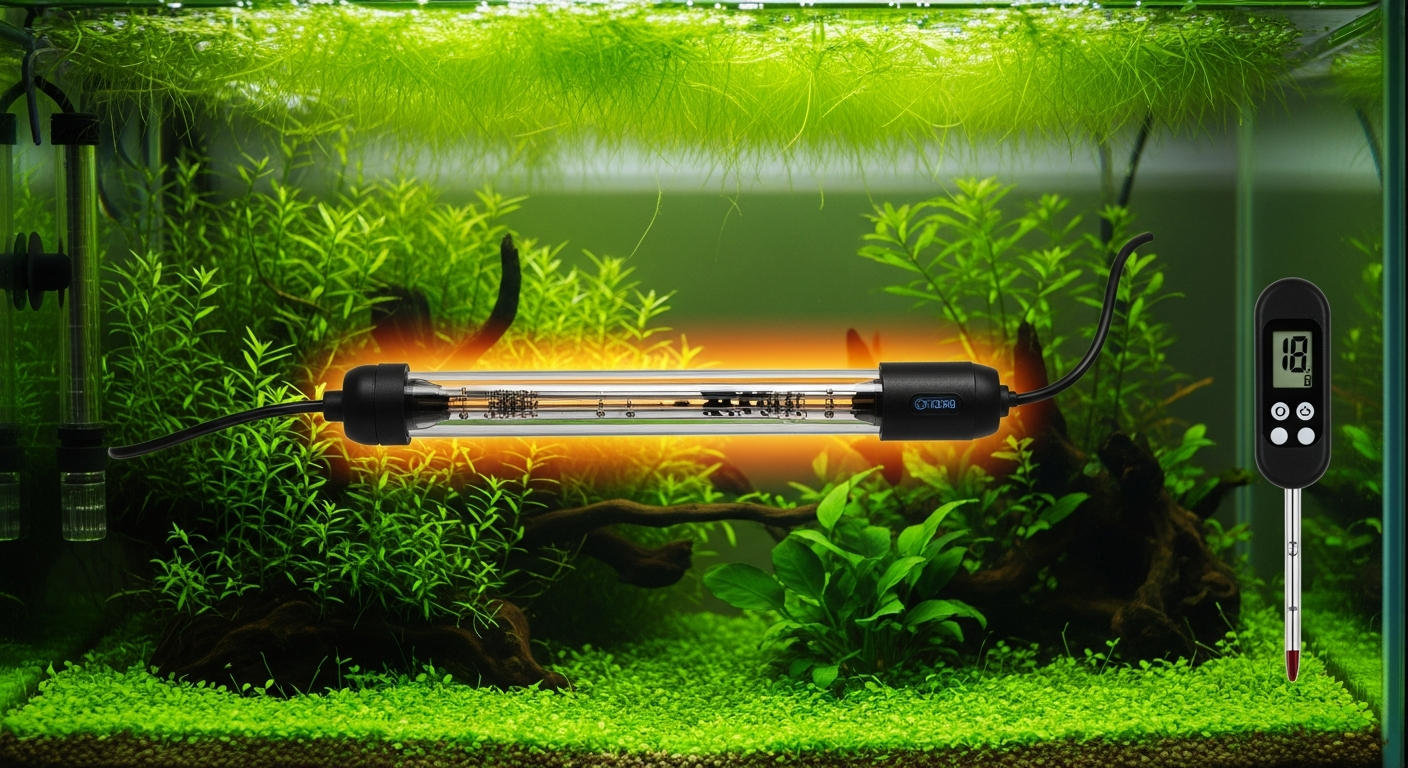
Best Heaters for Small Betta Tanks
Updated August 2026
Temperature is not a comfort perk for bettas. It is a survival condition. A betta kept below 72°F becomes lethargic, stops eating, and is highly susceptible to bacterial infections. Kept above 86°F, dissolved oxygen drops, metabolism spikes, and lifespan shortens measurably. The 76-82°F window is where your fish eats, moves, and behaves the way a healthy betta is supposed to. Getting there requires a heater that actually holds the setpoint, not one that swings 5 degrees in either direction.
Most failures in betta keeping trace back to temperature instability, not chemistry. This guide covers how to size a heater correctly for your tank, what separates a reliable unit from a fire hazard, and why the type of heater matters more than the brand name on the label.
Tannin Lab earns a commission on qualifying purchases through the Amazon links on this page, at no extra cost to you. Picks are chosen on performance and suitability, not on commission.
Why bettas always need a heater
Bettas are tropical fish from Southeast Asia, primarily Thailand and Cambodia. Their native habitat sits in shallow rice paddies and slow-moving streams where water temperatures rarely dip below 75°F year-round. Room temperature in most North American homes averages 68-72°F, which is already below the safe floor for a betta.
During winter, rooms near exterior walls or with forced air cooling can drop to 65°F at night. Without a heater, your tank follows. That daily cycle of cooling and rewarming stresses the immune system more than a steady low temperature would.
If you run your betta fish tank setup without a heater and the fish seems fine, check an actual thermometer. Bettas survive poorly regulated temperatures for weeks before symptoms appear, which makes the problem easy to miss until it escalates.
Prices move, and stock does too. Each of these opens the product page on Amazon in a new tab.
Wattage by tank size: the actual math
The standard guideline is 3-5 watts per gallon for tanks in a normally heated room. In colder rooms or climates, move toward the upper end. The table below lays out practical wattage ranges and whether an adjustable heater is worth the extra few dollars at each size.
| Tank Size | Recommended Wattage | Heater Type | Notes |
|---|---|---|---|
| 2.5 gallon | 10-15W | Preset or adjustable nano | Room temp swings matter most here; a nano adjustable gives you margin |
| 5 gallon | 25W | Adjustable preferred | The most common betta tank; 25W adjustable hits the sweet spot for control |
| 10 gallon | 50W | Adjustable | Preset 50W units exist but adjustable gives you seasonal flexibility |
| 20 gallon | 75-100W | Adjustable | Two 50W heaters run at lower wattage each offer more redundancy than one 100W |
Oversizing slightly is generally fine. A 50W heater in a 10-gallon tank does not cook the water; it simply cycles on less frequently. Undersizing is the real problem: a heater running at 100% duty cycle to maintain setpoint will burn out faster and will still fall short on cold nights.
Adjustable vs preset: which one to buy
Preset heaters are factory-calibrated to a fixed temperature, typically 78°F. They are smaller, simpler, and often cheaper. For a betta in a 5-gallon tank in a climate-controlled apartment, a quality preset unit gets the job done.
The problem is manufacturing variance. Two preset heaters from the same box can hold different actual temperatures. One might hit 78°F reliably. Another might settle at 76°F or 80°F depending on where it is mounted and how the tank circulates water. Without the ability to dial in a correction, you accept whatever the unit decides.
Adjustable heaters give you control over the setpoint, usually via a dial or a digital controller. They cost a few dollars more, but that extra margin lets you compensate for placement issues, seasonal temperature shifts, or a tank in a room that runs cool. If you are choosing between the two and the price difference is small, go adjustable.
For tanks under 2.5 gallons, look specifically for nano heaters rated at 7.5-10W. Standard 25W heaters in very small tanks can spike water temperature between cycles fast enough to stress fish, particularly in tanks with limited thermal mass.
Heater safety and auto shutoff
Auto shutoff is a non-negotiable feature for any heater you put in a betta tank. The thermal protection circuit cuts power when the heater exceeds a threshold temperature, typically triggered by running dry during a water change or getting buried under substrate. Without it, an exposed element can crack the glass, warp plastic components, or start a fire.
Look for heaters with a reset indicator light so you can see at a glance whether the unit is actively heating or in standby. Inline heating elements made of borosilicate glass or quartz are more durable than standard glass. Titanium-sheathed heaters cost more but are shatter-proof, a real advantage if you have a particularly curious betta that headbutts equipment.
Never rely solely on a heater’s built-in thermostat to tell you the temperature. See the callout below.
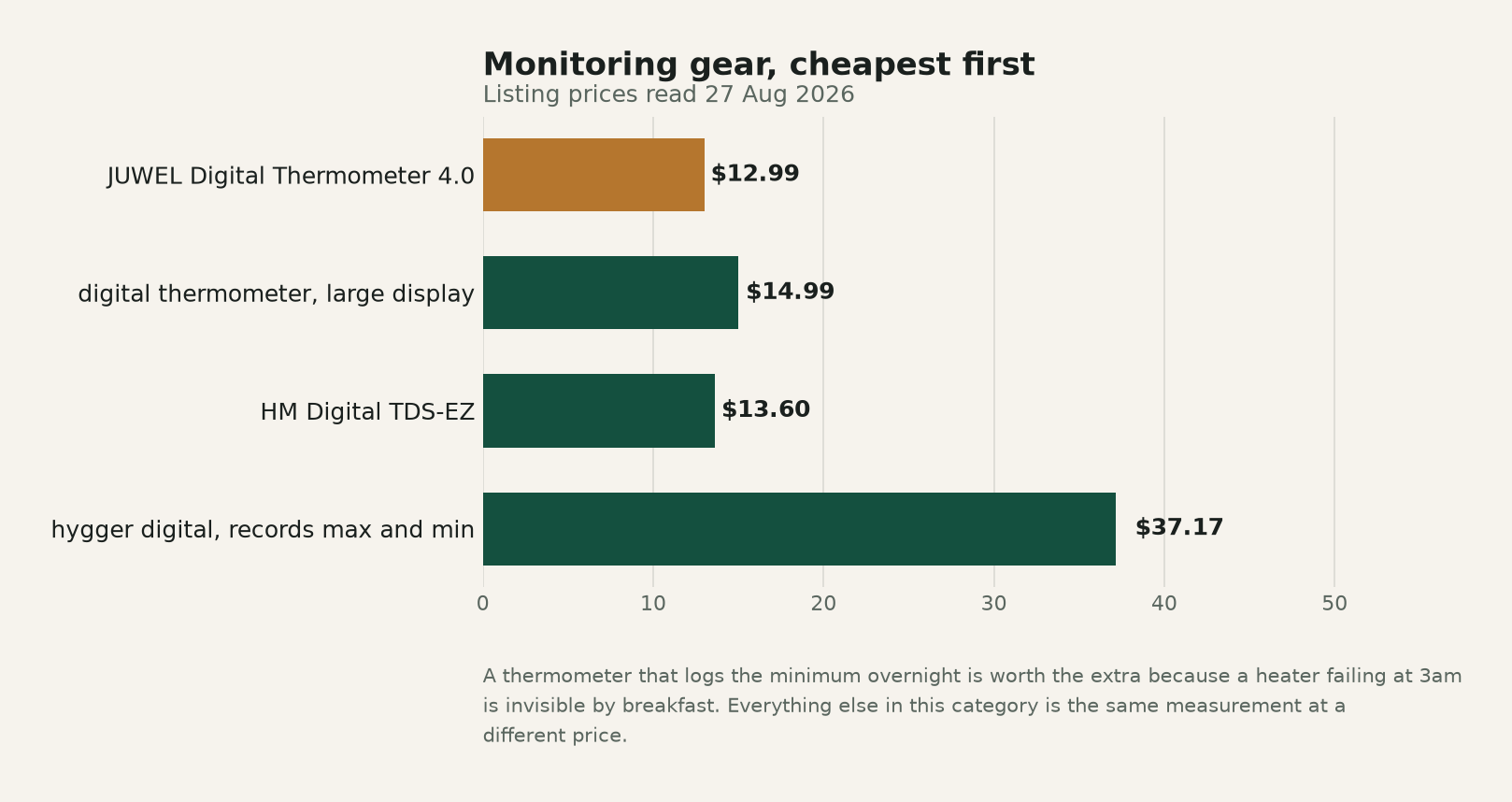
Use a separate thermometer. Always.
The sensor on a submersible heater measures temperature at the heater body, not at the center of the tank. Flow patterns, heater placement, and sensor drift all create discrepancies. A basic digital thermometer with a suction-cup probe placed on the opposite side of the tank from your heater gives you a true reading. Strip thermometers taped to the glass are less accurate but still better than trusting the heater dial alone. If your adjustable heater dial reads 78°F but your separate thermometer reads 75°F, trust the thermometer and adjust accordingly.
Where to place the heater in a betta tank
Placement affects how evenly heat distributes and how accurately the internal thermostat reads actual water temperature. The general rule: position the heater near your filter outlet, horizontally or at a 45-degree angle, so the flow carries warm water across the full tank.
Mounting a heater vertically in the corner of a small tank concentrates warmth near the sensor and can cause the unit to cycle off while the far end of the tank is still cool. In a betta tank of 5 gallons or smaller, that temperature gradient matters. Bettas will often avoid the cold zone and crowd near the heater, which is not natural behavior.
Keep at least 1 inch of water above the top of the heater element at all times. Partial exposure during water changes is the leading cause of element failure. Turn the heater off 15 minutes before a water change and back on only after you have refilled the tank.
Three heater types compared
Submersible heaters
The standard for most betta tanks. These sit fully underwater and can be positioned horizontally, giving you flexibility in a shallow tank. Most current adjustable heaters in the 25-50W range are submersible. They are the most common, best-supported category, with the widest range of quality and price points.
Inline heaters
These connect to your filter tubing and heat water before it re-enters the tank. No equipment is visible inside the tank, which appeals to planted-tank and blackwater setups where you want a clean aesthetic. They require an external canister or hang-on-back filter with accessible tubing. For a 5-gallon betta tank, the setup cost usually does not justify the aesthetic benefit unless you are already running external filtration. If you are building a planted betta filter system around a canister, they are worth considering.
Preset and nano heaters
As covered above, preset heaters are fixed-temperature units suited to small, temperature-stable environments. Nano heaters are their low-wattage counterpart for tanks under 3 gallons. Both categories work fine in the right context. The tradeoff is simplicity for control.
What to look for when buying a betta heater
Prioritize these four things in order:
- Auto shutoff / thermal protection built in
- Wattage appropriate for your tank size (3-5W per gallon)
- Adjustable thermostat for tanks 5 gallons and up
- Shatterproof or quartz element material for longevity
Avoid heaters with no visible indicator light. If you cannot tell at a glance whether the unit is heating or in standby, diagnosing a malfunction becomes a guessing game. Clear LED indicators, especially color-coded ones that differentiate heating from maintenance mode, save significant headaches.
Plan to replace any budget heater after 12-18 months of continuous use. The thermostat calibration degrades over time, and a heater running out of calibration in a small tank is worse than no heater at all because it gives you false confidence in a reading that is no longer accurate.
Why stability beats the target number
A betta held at a steady 77°F will be healthier than one averaging 79°F with daily swings of plus or minus 4 degrees. The stress response to thermal fluctuation suppresses immune function and increases cortisol-analog hormone production in fish, which accelerates disease susceptibility. Ich, velvet, and bacterial fin rot all become more likely in thermally unstable tanks.
This is why a quality heater with a narrow hysteresis (the difference between the on-temperature and off-temperature) matters. Cheaper heaters cycle on and off with a 3-5 degree swing. Better units hold within 1 degree. In a 5-gallon tank, that 4-degree swing is a meaningful percentage of the entire thermal mass. Your fish feels it.
Frequently asked questions
What temperature should a betta tank be?
The target range is 76-82°F, with 78-80°F being the most commonly recommended middle ground. Outside this window in either direction, bettas show measurable declines in activity, appetite, and immune response. A separate digital thermometer placed on the opposite side of the tank from your heater gives you the most accurate reading of actual water temperature.
Do I need a heater for a 5-gallon betta tank?
Yes. Unless your room consistently stays between 76 and 82°F year-round, which almost no North American household does, you need a heater. A 25-watt adjustable submersible heater is the standard choice for a 5-gallon tank. Pair it with a separate thermometer to verify the setpoint is holding accurately.
Adjustable or preset heater for a betta tank?
Adjustable heaters give you the ability to compensate for sensor drift and seasonal temperature changes. Preset heaters are simpler and cheaper, but their factory calibration varies enough that two identical units can hold noticeably different actual temperatures. For any tank 5 gallons or larger, adjustable is the better buy. Preset units work fine in very small nano tanks where a low-wattage option is the priority.
Marcus Chen
Aquarist & Founder, TanninLab
Marcus has been keeping planted tanks for 14 years. He tests every product recommendation in his own tanks and publishes the raw data.
Last updated: August 2026