Best Nano Tanks for Aquascaping
Updated August 2026
Nano tanks changed aquascaping for most hobbyists because they made the craft financially survivable. A 10-gallon build costs a fraction of a 75-gallon hardscape, and the smaller footprint forces compositional discipline that actually produces better-looking results. If you are new to aquascaping, starting small is not a compromise. It is the right call.
That said, not every small tank is a good aquascaping vessel. The glass type, proportions, and filtration constraints matter more in a nano than they do in a larger tank where you have margin for error. This guide covers what actually separates a capable nano from a mediocre one, and which tank formats consistently work well for the scape styles most keepers want to build. For broader context on getting started, read our aquascaping for beginners guide first.
Why Nano Tanks Suit Aquascaping Better Than You Might Think
The argument against going small is water stability. Less water volume means temperature swings happen faster, ammonia spikes hit harder, and there is less buffer if you miss a water change. All of that is true and worth taking seriously.
The argument for going small is everything else. Hardscape material for a 10-gallon tank costs a quarter of what you would spend for a 40-gallon. Substrate and soil fill faster. CO2 diffusion is more efficient. And critically, you can see the entire scape from a seated position without the foreground disappearing into distance.
Professional aquascapers frequently use tanks in the 10 to 20-gallon range for competition entries precisely because the constraints force better composition. A 12-inch aquascape with one strong focal stone beats a 36-inch layout with scattered hardscape every time. Nano format makes that focal discipline unavoidable.
Tannin Lab earns a commission on qualifying purchases through the Amazon links on this page, at no extra cost to you. Picks are chosen on performance and suitability, not on commission.
Rimless Tanks and Low-Iron Glass: Why They Are Not Optional for Serious Scapes
Standard float glass has a greenish tint from iron content in the silica. You can see it clearly on the edge of any glass pane held at an angle. In a standard pet-store aquarium, that tint is barely noticeable. In a scape with deliberate lighting and a clean substrate, it shifts every color in the tank toward green and muddies the visual clarity you are working to achieve.
Low-iron glass (also sold under trade names like Optiwhite, StarPhire, or Ultra Clear) removes most of that iron content, producing a near-optically-neutral pane. Greens look green instead of grey-green. Reds on plants and shrimp read true. The water looks cleaner. The jump in visual quality versus a standard glass tank is immediately obvious side by side.
Rimless construction matters for a different reason. A rimless tank eliminates the plastic brace that runs across the top of most standard aquariums, which means your aquascape light sits directly over open water with no obstruction. It also means you can photograph the tank from above without a plastic frame cutting across the composition, which matters more than most beginners expect once they start caring about the result.
The trade-off is structural. Rimless tanks rely on glass thickness and clean silicone seams for rigidity instead of a plastic frame. Most quality rimless nanos use 6mm to 8mm glass. Below 5mm on a tank larger than 5 gallons is a warning sign worth checking before you buy.
Cube vs. Long Proportions: Which Shape Fits Which Scape
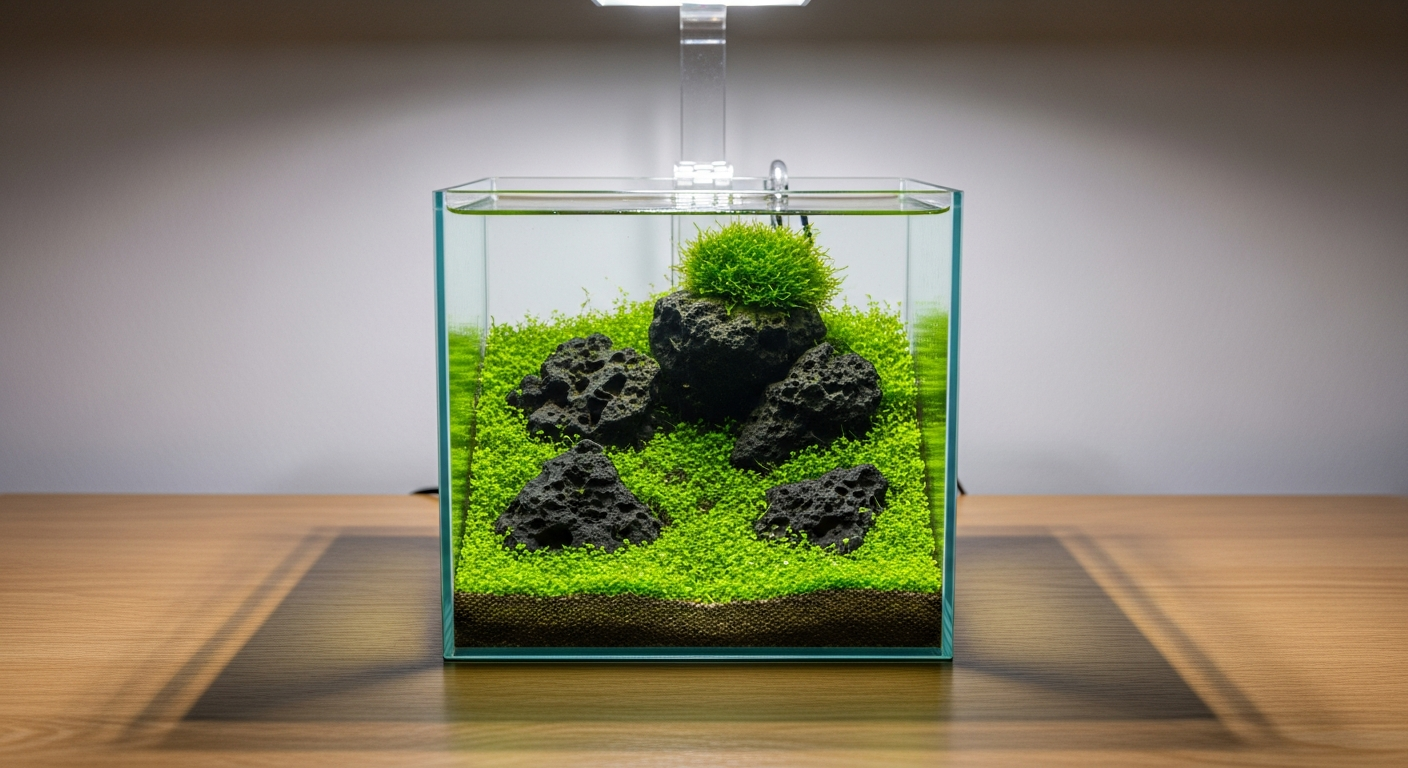
Cube tanks (equal or near-equal width, depth, and height) suit compositions that want vertical drama. Moss columns, tall Anubias groupings, and iwagumi-adjacent designs with a single dominant stone all read well in cube format because the equal dimensions let you use the full front-to-back depth without the composition feeling cramped.
Longer rectangular tanks suit horizontal compositions. An Iwagumi scape with a primary stone and two secondary stones placed in the golden ratio works better in a tank where width exceeds height, typically in a 2:1 or 3:2 width-to-height ratio. The Dutch style, with regimented rows of contrasting plant species, also reads better across horizontal width than compressed into a cube.
A practical split: if your target scape style involves a single striking focal element, go cube. If you want multiple plant species arranged in visible sections, go long. Most beginners do better with a longer format because the composition is more forgiving and easier to photograph without a tripod.
Nano Tank Options by Size and Type
| Format | Typical Capacity | Best For | Pros | Watch Out For |
|---|---|---|---|---|
| Rimless cube, low-iron glass | 5 to 10 gal (19 to 38 L) | Focal-point scapes, moss columns, shrimp display | Equal depth and height maximizes hardscape drama; optically clean glass shows true color | Horizontal compositions feel cramped; evaporation matters more in smaller volume |
| Rimless long rectangle, low-iron glass | 10 to 20 gal (38 to 76 L) | Iwagumi, Dutch-style, multi-species planted layouts | Best proportions for golden-ratio hardscape; easier to photograph; roomier for fish | Needs a dedicated scape light matched to tank length; harder to source in low-iron format |
| All-in-one kit (AIO), standard glass | 5 to 15 gal (19 to 57 L) | Low-tech planted tanks, low-light moss and fern setups | Filter and light included; faster to set up; better value for beginners not ready to invest in separate equipment | Built-in lights rarely hit PAR needed for carpeting plants; standard glass mutes colors; plastic rim limits overhead photography |
| Rimless cube, standard glass | 3 to 7 gal (11 to 26 L) | Budget entry point, desktop displays, species-only shrimp tanks | Lower cost than low-iron; rimless construction still allows direct lighting | Green glass tint is visible in photos; not competitive for contest-grade scapes |
| Rimless low-iron, shallow/wide format | 10 to 25 gal (38 to 95 L) | Wabi-kusa, emersed scapes, shallow-water nature style | Low water column means CO2 diffuses efficiently; excellent for plants grown partially emersed | Evaporation is constant and rapid; requires a lid or regular top-off; harder to find in retail |
Lighting Nano Tanks for Planted Aquascapes
The single most common failure mode in a nano aquascape is inadequate light. Carpeting plants like Hemianthus callitrichoides (HC Cuba), Eleocharis acicularis, and Marsilea hirsuta require sustained PAR values of 50 to 80 at the substrate level to grow horizontally rather than reaching upward. Most all-in-one kit lights do not come close.
A purpose-built planted tank light mounted directly over a rimless tank changes the equation. For nanos under 10 gallons, compact LED fixtures designed for planted tanks deliver the PAR and color spectrum needed without overheating the water column. For 10 to 20-gallon tanks, a fixture with adjustable intensity is worth the extra cost because you can reduce output during the first few weeks while the tank cycles.
The best options to search for in the planted tank LED category are covered in detail in our best LED planted tanks guide, which includes measured PAR data by tank depth for several popular fixtures.
Aquascaper’s Note
For carpet plants in a nano under 10 gallons, a photoperiod of 6 to 7 hours at moderate intensity outperforms 10 hours at low intensity. Algae loves long photoperiods. Plants care more about intensity. Start conservative and add time incrementally after week 3 once you can see how the tank responds.
Prices move, and stock does too. Each of these opens the product page on Amazon in a new tab.
Filtration in a Nano Aquascape: Flow Rate and Intake Safety
Filtration in a nano aquascape has two constraints that do not apply to most fish-only tanks. First, the flow rate has to be gentle enough not to uproot carpeting plants or blow light substrate around. Second, the filter intake must be shrimp-safe if you plan to keep any inverts alongside your fish.
For most nano aquascapes, a small hang-on-back (HOB) filter or an internal sponge filter is the practical choice. HOB filters running at their minimum flow setting on a 5 to 10-gallon tank produce surface agitation for gas exchange without disturbing foreground plants. Sponge filters are completely safe for shrimp and shrimplets, and the sponge surface grows beneficial bacteria fast in a heavily planted setup.
Canister filters are overkill for nanos under 15 gallons in most planted builds. The plumbing adds complexity, the flow is harder to restrict, and the benefit over a well-placed HOB is minimal when the tank already has a dense plant mass doing biological filtration work. Save the canister for when you scale up.
If you are pairing your aquascape with a shrimp colony, pair it with the right tools to keep those shrimp in top condition. Our best aquascaping tools guide covers the trimming scissors, tweezers, and substrate spatulas that make working inside a small tank actually manageable.
The Real Challenges: Evaporation, Parameters, and Patience
Water volume is the core variable that makes nano tank management harder than it looks in YouTube build videos. A 10-gallon tank with a rimless top can lose 10 to 15% of its water to evaporation in a single week during summer, especially with a high-output light generating heat near the surface. That evaporation concentrates minerals, raises TDS, and can shift pH enough to stress sensitive species.
A lidded nano eliminates most evaporation but cuts light penetration and makes trimming more awkward. The practical middle ground is an auto top-off (ATO) system: a small reservoir feeding the tank via a float valve or optical sensor keeps water level constant without daily intervention. For a tank under 10 gallons, even a simple gravity-fed reservoir works.
Parameter swings hit harder at nano scale. A single decaying stem plant or an uneaten shrimp wafer can measurably spike ammonia in 5 gallons where it would be diluted in 40. Weekly water changes of 20 to 30% are the standard for nano aquascapes running moderate fish loads. For shrimp-only tanks with a heavy plant mass, every-other-week changes at 15 to 20% often work better because you avoid disrupting the mineral balance.
The patience part: a newly set-up nano aquascape looks nothing like the inspiration photos for the first four to six weeks. The plants are not rooted. The substrate is not colonized. The carpeting species have not filled in. Every experienced aquascaper knows this phase and has learned to leave the tank alone instead of intervening. The builds that fail in the first month usually fail because of over-tinkering, not because of the tank choice or the plants.
What to Check Before You Buy a Nano Aquascape Tank
Glass thickness is the first check. For a cube up to 10 gallons, 5mm is acceptable. Above 10 gallons, look for 6mm minimum. Below 5mm on any tank over 5 gallons is a seam-stress risk that some budget imports fail to meet.
Silicone bead quality comes next. Neat, even, fully sealed silicone at every corner joint indicates quality control. Lumpy, uneven, or partially applied beads are worth photographing and asking about before the tank is filled. A silicone failure in a nano is not catastrophic the way it would be in a 75-gallon, but it still means a flooded surface and a lost scape.
For low-iron glass, verify the claim by looking at the edge of the glass panel directly at an angle before purchasing. Standard glass shows a green edge. True low-iron glass shows a pale grey or near-clear edge. If you are ordering online, search for tanks explicitly marketed as Optiwhite, StarPhire, or Ultra Clear glass, and read recent review photos to confirm the edge color.
A lid option matters more than it seems at setup. Even if you plan to run rimless open-top, check whether the manufacturer sells a matching glass lid. Fish jump from nanos more than from large tanks. The jumping risk increases during the first few weeks before a tank is fully cycled and the fish are stressed.
Common Questions About Nano Aquascaping Tanks
- What is the best nano tank size for a beginner aquascape?
- A 10-gallon rimless long rectangle is the most forgiving entry point. It gives you enough water volume to absorb beginner mistakes, proportions that suit multiple scape styles, and a price point low enough to rebuild if the first attempt does not go as planned.
- Can you use CO2 injection in a nano aquarium?
- Yes, and it makes a significant difference for carpeting plants. A small pressurized CO2 system with a needle valve and a nano diffuser runs efficiently in tanks under 15 gallons. Target 20 to 30 ppm CO2 concentration, measure with a drop checker, and always run the CO2 on a timer set to turn on 1 hour before your lights and off 1 hour before lights-out.
- Is a 5-gallon tank too small for aquascaping?
- It is not too small, but it is less forgiving. A 5-gallon scape requires daily evaporation top-off, precise feeding, and faster response to parameter shifts. Planted nano tanks in the 5-gallon range work best as shrimp displays or single-focal-point moss scapes, not as densely planted multi-species setups.
Marcus Chen
Aquarist & Founder, TanninLab
Marcus has been keeping planted tanks for 14 years. He tests every product recommendation in his own tanks and publishes the raw data.
Last updated: August 2026