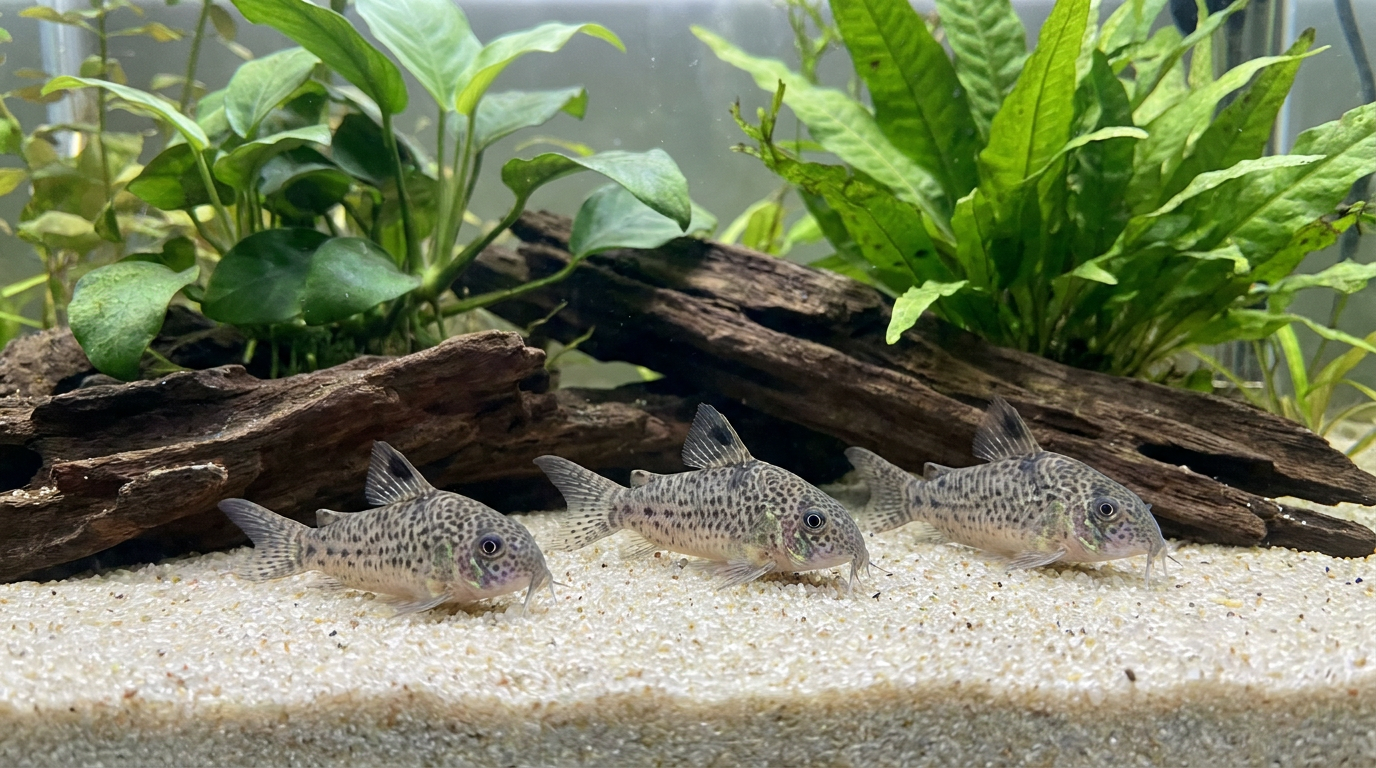
Peppered cory catfish: the hardiest cory for beginners
Updated September 2026
The peppered cory catfish is the cory to start with if you are new to the hobby. It accepts the widest hardness band of the three common small corys, comes from subtropical southern South America, and has been bred in captivity for so long that most shop fish are tank raised.
Give a group of six a tank with a 61 x 38 cm footprint, fine sand, and water between 22 and 26°C, and you have covered the essentials.
How peppered corys compare with panda and pygmy corys
The figures below come from the Seriously Fish species profiles for each fish. Read them as a keeper’s working range, not a hard limit.
| Parameter | Peppered cory (Corydoras paleatus) | Panda cory (Corydoras panda) | Pygmy cory (Corydoras pygmaeus) |
|---|---|---|---|
| Standard length | 70 mm | 50 mm | 30 mm |
| Temperature | 22 to 26°C | 22 to 25°C | 22 to 26°C |
| pH | 6.0 to 7.0 | 6.0 to 7.4 | 6.4 to 7.4 |
| Hardness | 0 to 12 dGH | 1 to 12 dGH | 0 to 8 dGH |
| Suggested tank | 61 x 38 x 30 cm, about 70 litres | 45 x 30 x 30 cm, about 41 litres | 45 x 30 x 30 cm, about 41 litres |
| Native range | Southern Brazil, Uruguay, Paraguay, Argentina | Upper Amazon, Peru | Rio Madeira basin, Brazil |
Two rows do the work here. Hardness runs from 0 to 12 dGH, so moderately hard tap water that would stress pygmy corys suits peppered corys fine. The temperature ceiling of 26°C sits one degree above the panda range, which gives you slack in a warm summer room.
If your water runs cool and you want a smaller, flashier fish, the panda cory is the better pick, and we cover it on its own page.
Video: Droeks on Fishkeeping
Why beginners get away with more
Hardy does not mean indestructible. It means the fish tolerates the swings a new tank throws at you while you learn.
Captive breeding is the bigger factor. Generations raised in farm water have made peppered corys far less fussy than wild-caught fish, which Seriously Fish notes are rarer and more vividly coloured.
New fish still carry whatever the supplier tank carried. Two weeks in a quarantine tank for fish and plants costs you far less than treating a whole display tank later.
Setting up the tank
- Fine sand, because corys sift it for food and dirty gravel is linked to barbel infections.
- A group of six or more, since they are social and hide when kept alone.
- Sinking pellets or wafers, plus frozen bloodworm a few times a week.
- Cover from wood, rocks, or plants so they can rest out of the light.
Peppered corys also do well in stained water. A blackwater aquarium setup with leaf litter keeps them busy foraging, as long as the pH stays inside the 6.0 to 7.0 band.
Good and bad tank mates
Pair them with small, peaceful midwater fish such as tetras, rasboras, and dwarf cichlids. Skip anything big enough to swallow a 7 cm fish.
A betta works only at the top of the cory range, around 26°C, and only with a calm individual. Check the full list of betta tank mates before you commit.
Corys gulp air at the surface now and then. That is normal behaviour for the genus, so leave a gap under the lid.
Marcus Chen
Aquarist & Founder, TanninLab
Marcus has been keeping planted tanks for 14 years. He tests every product recommendation in his own tanks and publishes the raw data.
Last updated: September 2026