Seiryu Stone: Why It Raises pH and How to Use It Safely
Updated July 2026
Seiryu stone raises pH because it contains calcium carbonate. The carbonate dissolves slowly into the water column, adds carbonate hardness, and that KH buffers pH upward. The effect is real, but it is also slow and controllable, and plenty of scapes run on seiryu with no trouble at all.
Whether it matters comes down entirely to what you keep.
What is actually happening in the tank
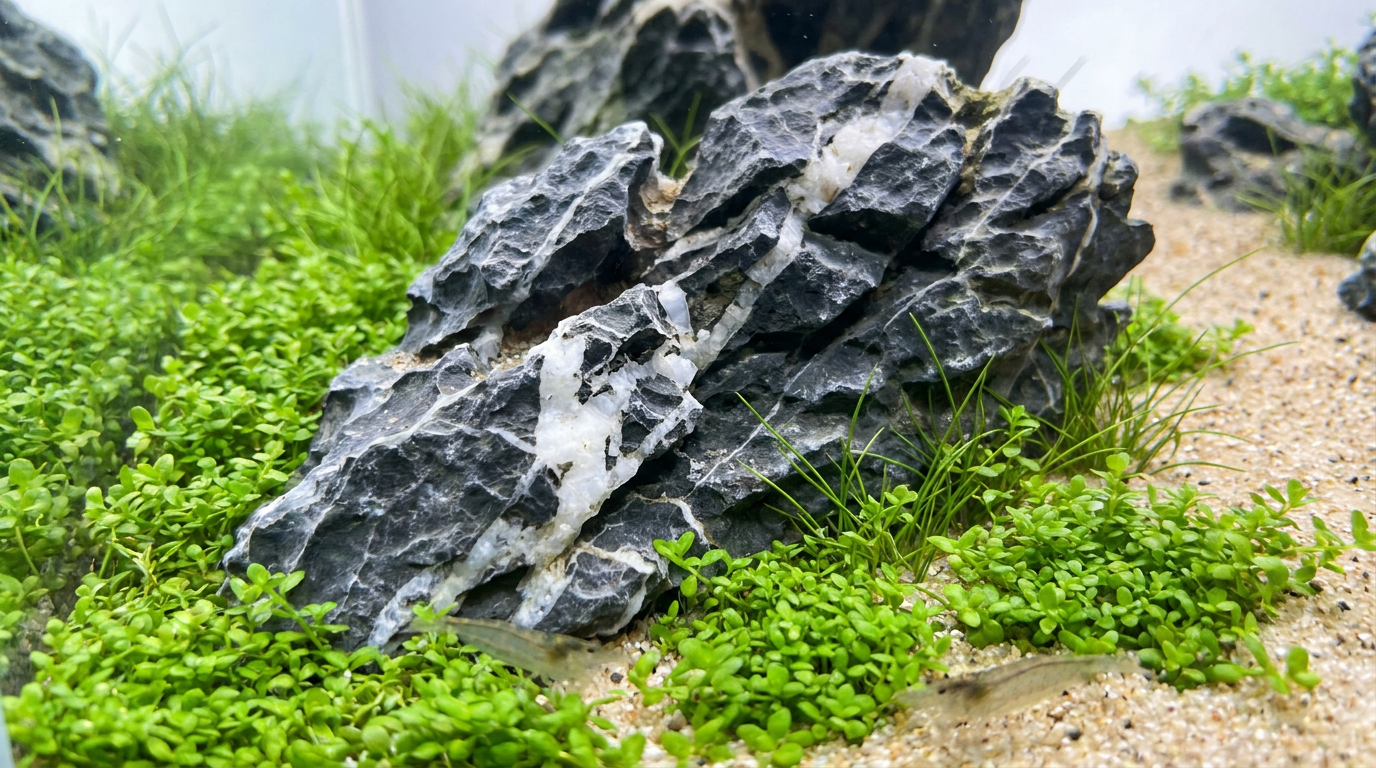
Seiryu sits in the limestone family, cut through with the pale calcite veins that give it its look. Those veins are the reactive part.
Calcium carbonate breaks down into calcium and bicarbonate ions. KH climbs, GH climbs with it, and pH follows because carbonate resists being acidified.
The softer and more acidic your source water, the faster it leaches. In already hard tap water the shift is often barely measurable.
The vinegar test
Put a drop of household vinegar on a dry piece and watch closely. Visible fizzing means carbonate, and a more vigorous reaction means more effect on your water.
Seiryu fizzes. So does most pale grey rock sold for aquascaping. Our guide to safe and unsafe rocks sorts what reacts from what stays inert.
Who should skip it
Caridina shrimp are the clear no. Crystal reds and taiwan bees want soft, low-KH water with a remineralized GH target, and seiryu works against that setup every day. Caridina vs neocaridina lays out which species tolerates what.
Blackwater tanks are the other mismatch, since the whole point is a low pH driven by tannins and carbonate cancels that out.
Wild-caught soft water fish belong in the same column.
Who can use it freely
Neocaridina shrimp, most livebearers, African cichlids, and hard water community fish either do fine or actively prefer the harder water.
Ordinary planted tanks on tap water are usually fine too, especially with regular water changes diluting the buildup.
Test KH before you add the stone and again a month later, using GH and KH for planted tanks as your reference for target ranges.
Keeping the effect small
Use less stone. Two or three focal pieces move your parameters far less than a full iwagumi wall does.
Prefer larger single pieces over many small ones, since exposed surface area drives the dissolution rate.
Sealing with an aquarium-safe clear coat does work, though it reads as artificial and chips eventually.
Bigger water changes with soft or RO-blended water hold the line if you want the look and the low numbers. Test weekly for the first month so you know your actual rate rather than guessing at it.
Marcus Chen
Aquarist & Founder, TanninLab
Marcus has been keeping planted tanks for 14 years. He tests every product recommendation in his own tanks and publishes the raw data.
Last updated: July 2026