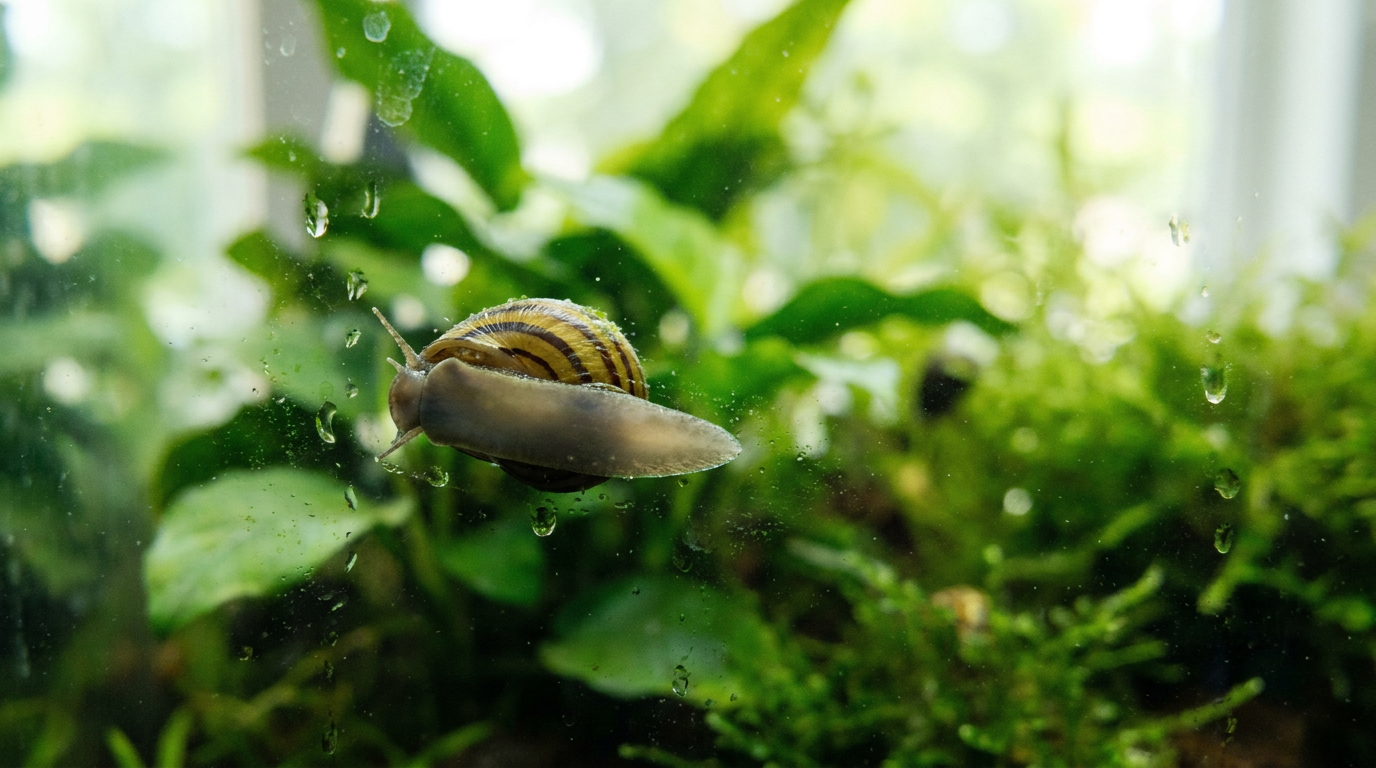
Nerite Snails for Algae Control: Care and Tank Compatibility
Updated July 2026
Nerite snails are the most reliable algae eaters you can put in a freshwater tank, and they need three things: water at or above roughly 7.0 pH, moderate to hard water for shell health, and a lid. Give them that and they clean glass, hardscape, and slow-growing leaves for two to three years.
They also will not breed in fresh water, which is why they stay popular in nano tanks.
Water Parameters That Keep Shells Intact
Nerites pull calcium and carbonate from the water column to build shell. Soft, acidic water strips it back faster than they can replace it, and pitting shows up at the spire within months.
Aim for a GH in the moderate range and a KH high enough to hold pH steady between water changes. If you run a blackwater or soft-water scape, nerites are a poor fit, so read up on water hardness for planted tanks before you buy one.
Temperature range is wide, roughly 22 to 28C. Copper is the hard limit. Even trace copper from some fertilizers and most invertebrate-unsafe medications will kill them.
What They Actually Eat
Nerites are excellent on green spot algae, diatoms, and soft green film. They are mediocre on hair algae and useless on black beard algae.
Matching the snail to the algae is the whole game. Identify what is growing before you add livestock, because the wrong cleanup crew just adds bioload. A guide to the types of aquarium algae is a better first step than a snail order.
In a mature, low-algae tank they run out of food. Supplement with blanched zucchini, spinach, or a sinking algae wafer twice a week.
Tank Compatibility
Nerites are peaceful and coexist with shrimp, most tetras, rasboras, and a single betta in most setups. The animals to avoid are the ones that eat snails: loaches, most pufferfish, assassin snails, and large cichlids.
Crayfish and larger crabs will crack the shell outright. Bettas occasionally pick at the antennae, which usually stops once the novelty wears off.
For a full invertebrate cleanup team they pair well. Amano shrimp take the hair algae nerites ignore and the two rarely compete, so the amano shrimp care basics carry over cleanly.
The Egg Problem
Female nerites lay hard white eggs on glass, wood, and equipment even with no male present. Those eggs will not hatch in fresh water, but they are stubbornly glued down.
A razor blade lifts them off glass. On driftwood, most keepers leave them and let them wear away.
Stocking and Species
One nerite per 5 gallons is the usual starting point in a tank with visible algae. Go lighter in a clean tank.
Zebra and tiger nerites stay around an inch. Horned nerites are smaller and tuck into tight crevices. Olive nerites are the plain workhorse and usually the cheapest.
Flipping and Escapes
A nerite stranded on its back on sand can die if it cannot right itself. Flip it over when you see it.
They also climb out. A lid or a tight rim gap is not optional in an open-top scape.
Marcus Chen
Aquarist & Founder, TanninLab
Marcus has been keeping planted tanks for 14 years. He tests every product recommendation in his own tanks and publishes the raw data.
Last updated: July 2026