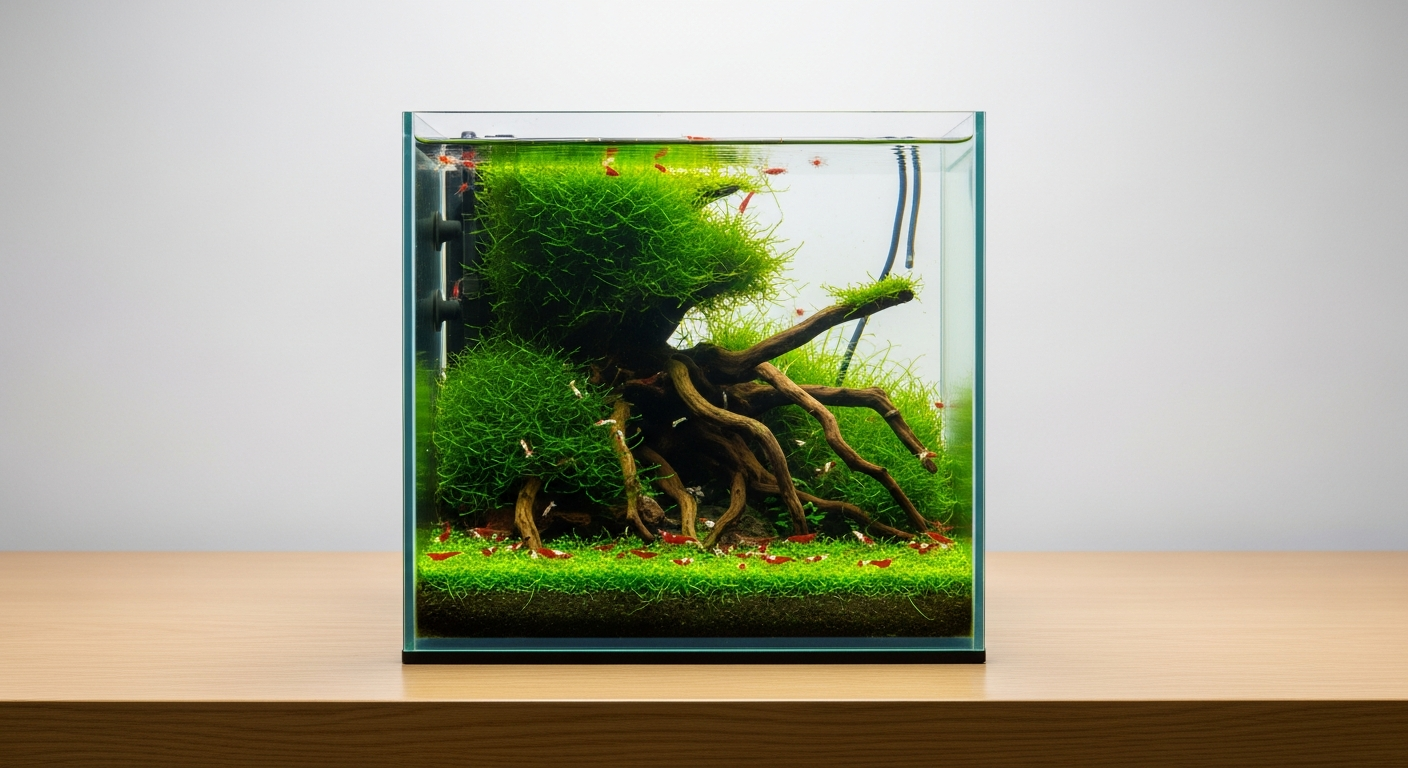
Best Nano Tanks for Shrimp Colonies
Updated August 2026
Shrimp are not forgiving of bad water. A parameter crash that a fish might survive will wipe a colony overnight, and most crashes trace back to one thing: not enough water volume to absorb the mistake. Choosing the right tank size is the single highest-leverage decision you make before adding a single shrimp.
This guide covers every size from 5 to 20 gallons, the rimless versus all-in-one kit debate, what to actually look for when buying, and how to set up a nano shrimp tank that stays stable month after month.
Shrimp Tank Size: 5, 10, and 20 Gallons Compared
The three sizes you will see recommended most often are 5, 10, and 20 gallons. Each has a real use case. None of them is wrong if matched to the right keeper.
| Tank Size | Colony Capacity | Parameter Stability | Rimless Option | Best For |
|---|---|---|---|---|
| 5 gallon | 15 to 25 adults | Low buffer; swings happen fast | Yes, widely available | Experienced keepers, single-species display |
| 10 gallon | 30 to 60 adults | Strong buffer; forgiving of small errors | Yes, best value segment | First shrimp tank, breeding colony, planted builds |
| 20 gallon | 80 to 150+ adults | Excellent; slowest to change | Yes, premium rimless segment | Multi-species, serious breeders, blackwater builds |
The capacity figures above assume a planted tank with a sponge filter and no aggressive trimming. A bare-bottom tank with heavy feeding will hit those ceiling numbers faster and require more frequent thinning.
Tannin Lab earns a commission on qualifying purchases through the Amazon links on this page, at no extra cost to you. Picks are chosen on performance and suitability, not on commission.
Why 10 Gallons Is the Sweet Spot for Most Shrimp Keepers
A 10-gallon tank holds roughly 8 gallons of actual water after substrate, hardscape, and plants displace volume. That margin matters. When ammonia spikes during a feeding overshoot or a plant melts, the dilution effect in 8 gallons is four times greater than in a 2-gallon pico tank.
Temperature stability follows the same logic. A 10-gallon near a window that catches afternoon sun will climb maybe 2 degrees Fahrenheit. A 5-gallon in the same spot can climb 5 to 6 degrees in an hour, which is lethal territory for Caridina species. Water mass is thermal mass.
The 10-gallon footprint (20×10 inches standard) also accepts every major sponge filter for shrimp tanks without blocking the aquascape. You get space for a proper hardscape, a meaningful carpet of plants, and still have sightlines to watch the colony behave.
Rimless vs. All-in-One Kit: Which Should You Buy
Rimless tanks win on aesthetics. The open top and frameless edges make the aquascape look like a floating slice of water, which is why the aquascaping community defaults to them. Brands like ADA, Ultum Nature Systems, and various budget-oriented alternatives have all pushed rimless into the mainstream.
The trade-off is that rimless tanks require you to source a lid separately, and that matters with shrimp. Shrimp escape. Not often, but a colony with 50 adults will eventually send scouts over the rim at night. A tight-fitting mesh or glass lid is not optional.
All-in-one kits like the Fluval Spec V or Aqueon Evolve come with filtration compartments built into the back panel. For beginners, the integrated pump and media chamber removes one variable. The downside is that the filtration chambers are sized for fish, not shrimp, so you will still want to add a pre-filter sponge over the intake to prevent juveniles from being pulled through.
If you are building a planted aquascape from scratch, a bare rimless tank gives you full control over substrate depth, hardscape placement, and filtration choice. If you want something ready to cycle within an afternoon, the all-in-one kit removes friction from the setup process.
Prices move, and stock does too. Each of these opens the product page on Amazon in a new tab.
What to Look for When Buying a Nano Shrimp Tank
Glass quality is the first filter. Tempered glass resists scratching from substrate gravel but cannot be drilled for an overflow; standard float glass can be drilled but scratches more easily. For a nano shrimp tank sitting on a desk, float glass at 5mm or thicker is fine.
Check the footprint dimensions against your planned light. Most quality nano plant lights (the kind that actually grow a carpet of Eleocharis or Hemianthus callitrichoides) are designed for tank widths between 12 and 24 inches. Measure before you buy.
Look at the lid situation before you finalize a purchase. Some rimless tanks are sold as a system with a matching glass cover; others leave you improvising with cut acrylic. If the product listing does not mention a lid, budget an extra $10 to $20 for one.
Finally, consider how the tank will drain for water changes. A siphon into a bucket is fine at 10 gallons. At 20 gallons, a bottom drain or a dedicated Python-style water changer saves real time every week. Shrimp tanks need consistent 10 to 15 percent weekly changes, so the friction of that chore matters.
Cycle before shrimp, every time. A new tank needs a full nitrogen cycle before any shrimp go in. This means running the filter with an ammonia source (pure ammonia drops, a small piece of fish food, or a bacterial starter culture) for 4 to 6 weeks minimum until you can add 2 ppm ammonia and read 0 ammonia and 0 nitrite within 24 hours. Shrimp cannot survive even trace ammonia; fish can tolerate levels that will kill a colony in hours. Do not shortcut the cycle. See our guide on Neocaridina shrimp care for the full parameter targets by species.
Setting Up Your Nano Shrimp Tank: Substrate, Plants, and Botanicals
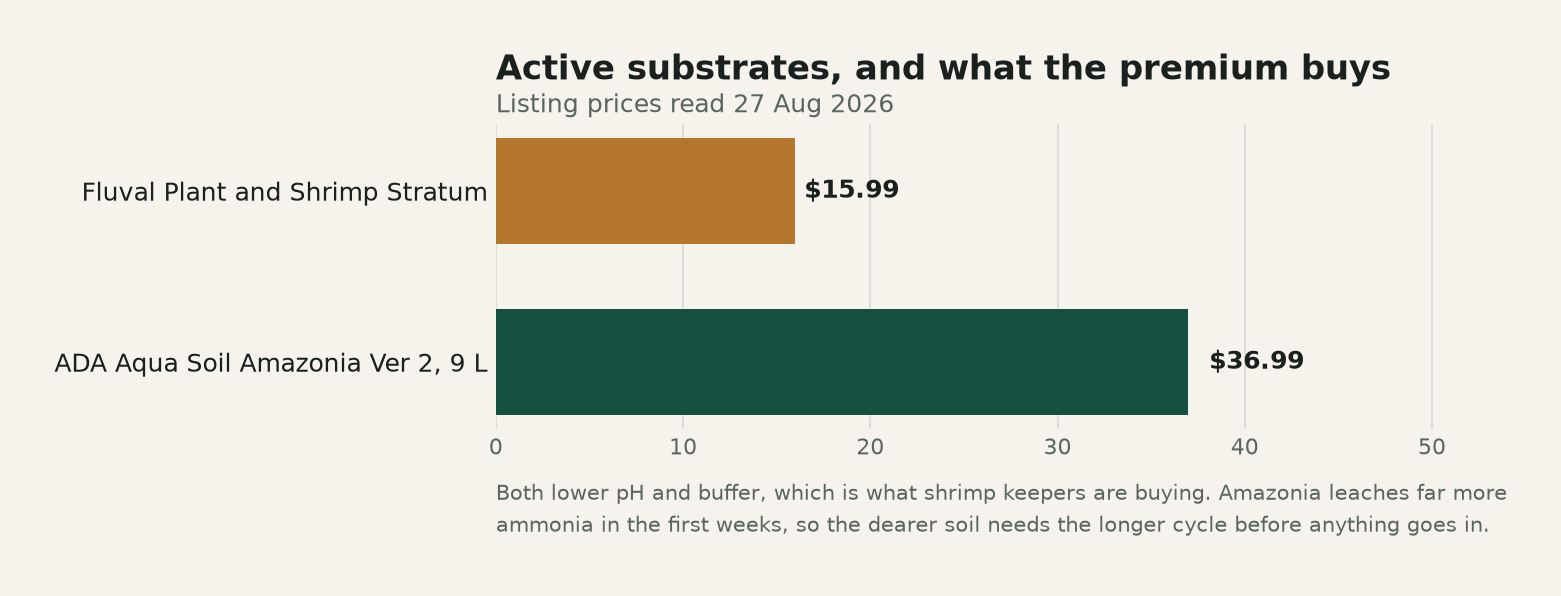
Substrate choice splits along species lines. Neocaridina shrimp (cherry reds, blue velvets, yellows) are flexible and do well in inert substrates like natural sand, coarse quartz, or buffered soils. Caridina shrimp (crystal reds, Taiwan bees, tigers) need a buffered substrate that holds pH between 6.0 and 6.8 and general hardness below 6 dGH. Active soils like ADA Amazonia, SL-Aqua More Soil, or similar products do this automatically, though they also leach ammonia for the first few weeks, which is why cycling becomes even more critical.
Plants serve three purposes in a shrimp tank: biofilm surface area, oxygen production, and cover. Mosses like Java moss, Christmas moss, and Fissidens fontanus are the gold standard because shrimp graze on the biofilm that colonizes every frond. Dense foreground plants give juveniles hiding spots that improve colony survival rates measurably.
Botanicals bring the blackwater dimension. Adding a few catappa (Indian almond) leaves, some cholla wood, or dried pods to a shrimp nano lowers pH slightly, releases tannins with mild antimicrobial properties, and creates yet another biofilm surface. Many serious Caridina breeders credit botanicals as a key factor in reducing molting failures. Start with two or three leaves per 10 gallons and adjust based on the tannin stain you are comfortable with.
How a Shrimp Colony Grows (and When to Expect It)
A healthy Neocaridina colony follows a roughly predictable arc. You start with 10 to 15 adult shrimp. After the first successful berrying cycle (females carrying eggs, typically 3 to 4 weeks gestation), you see juveniles appear. By month three, assuming zero predation and stable parameters, the colony doubles.
Growth rate plateaus when the tank reaches carrying capacity. In a 10-gallon planted tank, that ceiling tends to be 50 to 70 adults before intraspecies stress and resource competition slow breeding. At that point, selling or trading surplus shrimp is part of the hobby’s natural rhythm.
Caridina colonies grow slower. The species’ narrow parameter tolerance means any deviation during breeding stalls reproduction immediately. Breeders working with crystal reds at a serious level typically use 20-gallon or larger systems for exactly this reason: more water volume means more time to catch and correct a drift before it affects breeding behavior. Feeding both genus types well matters too; the shrimp food guide covers which foods support breeding specifically versus just maintenance feeding.
Frequently Asked Questions
What is the minimum tank size for shrimp?
The practical minimum for a beginner is 5 gallons. Below that, water chemistry changes too fast between top-offs and water changes for most keepers to manage safely. Experienced hobbyists do keep pico tanks under 3 gallons, but those require daily parameter checks and near-obsessive maintenance discipline.
What is the best tank for cherry shrimp specifically?
A 10-gallon rimless or standard tank is the best option for cherry shrimp for most people. Red Cherry Shrimp and grade variants like Sakura and Fire Red are hardy Neocaridina that tolerate a pH range of 6.5 to 7.8 and general hardness of 6 to 12 dGH. The 10-gallon gives them room to establish a self-sustaining colony without requiring constant intervention.
How many shrimp can you keep per gallon?
A reasonable starting figure is 2 to 3 adult Neocaridina per gallon in a planted, filtered tank. For a 10-gallon tank, that puts your starter colony at 20 to 30 shrimp with room for natural growth. Caridina species are typically stocked more conservatively, around 1 to 2 per gallon, given their sensitivity to parameter drift.
Marcus Chen
Aquarist & Founder, TanninLab
Marcus has been keeping planted tanks for 14 years. He tests every product recommendation in his own tanks and publishes the raw data.
Last updated: August 2026