How to Breed Shrimp
Updated June 2026
Cherry shrimp are one of the most rewarding invertebrates you can keep, and breeding them is less about active intervention and more about setting conditions the shrimp control themselves. Get the environment right and they breed without any prompting from you.
This guide covers everything from sexing your shrimp to protecting newborns and maintaining color quality as your colony grows. Whether you have six shrimp or sixty, the same principles apply.
How Cherry Shrimp Actually Reproduce
Neocaridina davidi — the species behind cherry shrimp and all their color variants — follows a clear reproductive cycle once the female reaches sexual maturity at around four to six months old.
It starts with the saddle. You will notice a yellowish or greenish patch behind the female’s head, between the shoulder and the top of the carapace. That is an unfertilized egg clutch sitting in the ovaries. When the female is ready to breed, she releases pheromones into the water, and males go into a frantic swimming frenzy searching for her.
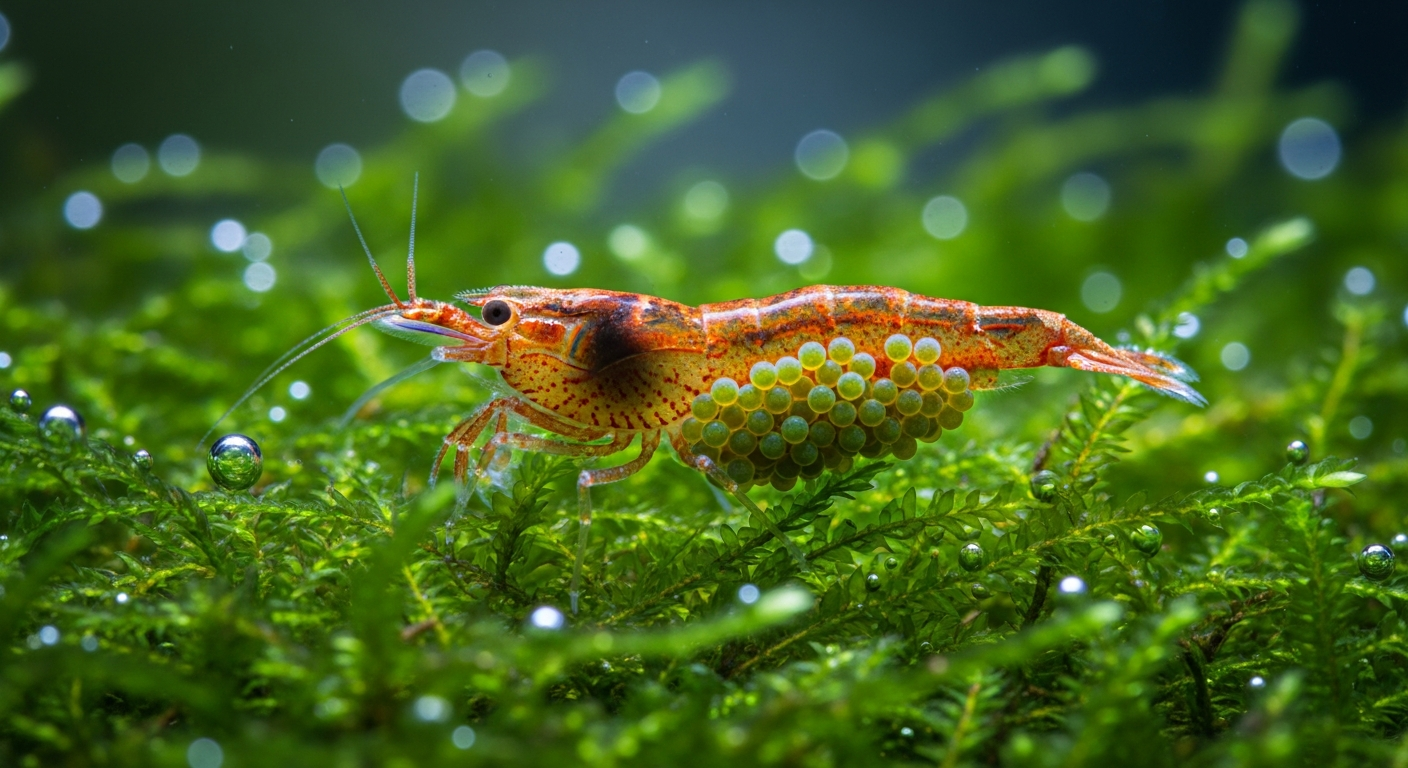
Mating takes a few seconds. Afterward, the eggs move from the saddle to the underside of the female’s tail, where she fans and carries them until they hatch. At that point she is described as berried, because the egg cluster looks like a tiny bunch of grapes clinging to her pleopods.
Sexing Cherry Shrimp: Males vs. Females
You need at least a few of both sexes before any breeding can happen, and telling them apart is genuinely easy once you know what to look for.
Females are larger, deeper in color, and show a more pronounced curve to the belly. The saddle is usually visible through the shell when the tank is well-lit and the shrimp is not hiding. Sexually mature females also develop a rounder, wider body shape compared to males of the same age.
Males are slimmer and often paler, even in high-grade lines. They are smaller throughout their lives and tend to be more active, especially when a female is ready to molt and breed. A group with a roughly 2:1 female-to-male ratio gives you enough competition among males without overcrowding.
Water Parameters That Trigger Breeding
Cherry shrimp are Neocaridina shrimp, which means they prefer harder, more alkaline water than their Caridina cousins. Hitting the right range matters more than hitting a precise target number.
| Factor | Target Range | Why It Matters |
|---|---|---|
| Temperature | 68 to 76°F (20 to 24°C) | Cooler temps slow metabolism and reduce molting stress; above 80°F females drop eggs |
| pH | 6.8 to 7.8 | Neocaridina tolerate a wide range; stability matters more than exact value |
| GH (general hardness) | 6 to 12 dGH | Calcium and magnesium in the water are required for successful molts and shell formation |
| KH (carbonate hardness) | 2 to 8 dKH | Buffers pH swings; sudden pH drops crash colonies |
| TDS | 150 to 300 ppm | Loose proxy for mineral content; very low TDS starves the shrimp of minerals |
| Ammonia / Nitrite | 0 ppm | Any detectable spike kills eggs or causes females to drop clutches |
| Nitrate | Below 20 ppm | Elevated nitrates stress shrimp and suppress breeding; consistent water changes keep this stable |
| Food sources | Algae, biofilm, blanched vegetables, quality pellets | A well-fed female produces larger clutches and carries eggs to term more reliably |
| Plants or biofilm surfaces | Moss, java fern, anubias, or any textured surface | Biofilm on leaves is the primary food source for baby shrimp in the first weeks of life |
| Colony size | Minimum 10, ideally 20 to start | Small groups have limited genetic diversity and too few males to reliably find receptive females |
The single most common breeding failure is not bad parameters, it is parameter swings. Shrimp that lived through ammonia spikes or sudden pH shifts often stop breeding for weeks. A mature, stable tank is worth more than a perfect-looking water test taken once.
Setting Up a Tank That Produces Babies
You do not need a dedicated breeding tank, though a species-only setup makes protecting newborns much easier. Any tank from 5 gallons up works. Smaller volumes fluctuate faster, so 10 gallons is a comfortable starting point.
The filter choice is critical. A standard hang-on-back or canister filter will suck up newborn shrimp, which are roughly 2 to 3 millimeters long at birth. A sponge filter powered by an air pump is the standard solution for shrimp tanks. The sponge provides surface area for biofilm to grow on, and babies can graze it safely without being pulled into the intake.
For neocaridina shrimp care in general, substrate matters for the buffering it provides. Inert substrates like gravel or plain sand work fine for cherry shrimp since they prefer slightly harder water. Shrimp-specific buffering substrates designed for Caridina can actually drop your pH too far for Neocaridina.
Plants serve two functions: biological filtration (they consume nitrates) and surface area for biofilm. Java moss, Christmas moss, subwassertang, and hornwort are all reliable choices. Dense moss also gives shrimplets hiding spots during the first vulnerable weeks. Adding a catappa leaf or two provides an extra biofilm surface; see the catappa leaves guide for how much to use without pushing pH too low for Neocaridina.
Breeding Readiness Checklist
- Tank cycled and running for at least six weeks with zero ammonia and zero nitrite
- Sponge filter in place (no unguarded intakes)
- Temperature steady between 68 and 76°F with no swings over 2°F in 24 hours
- GH confirmed between 6 and 12 dGH with a drop test kit
- Visible biofilm on plants, wood, or glass surfaces
- At least 10 shrimp with a clear female majority
- Feeding schedule established: once or twice daily, light enough that food is consumed within two to three hours
- No fish, assassin snails, or other shrimp predators in the same water
Food and Biofilm: What Actually Feeds a Colony
Adult cherry shrimp eat almost anything: blanched zucchini, spinach, spirulina wafers, high-quality shrimp food pellets, and whatever biofilm grows naturally in the tank. Variety matters. A diet of one pellet type only tends to produce smaller clutches over time.
Biofilm is the invisible ecosystem that makes shrimp breeding work. It forms on any surface that sits undisturbed in water for a few weeks, including plant leaves, driftwood, and the sponge filter itself. The film consists of bacteria, algae, fungi, and protozoa. It looks like nothing, but it is dense in nutrition and small enough for shrimplets to eat from their first day of life.
Newly hatched cherry shrimp cannot compete with adults for food dropped into the tank. Their survival in the first two weeks depends almost entirely on biofilm grazing. This is why planted tanks with mature hardscape outperform bare-bottom tanks for breeding yields.
Feed adults enough to keep them active and well-colored, but do not overfeed. Uneaten food spikes ammonia fast in a small tank.
Berried Shrimp: Reading the Egg Clutch
When you spot a berried female, she will fan her eggs constantly with small leg movements to oxygenate them. This is normal behavior and a good sign. A female that abandons fanning or drops her eggs early is usually responding to a parameter problem, stress from aggressive males, or poor water quality.
The eggs change color as they develop. Most cherry shrimp eggs start bright yellow or green and gradually darken over the course of the incubation period. When you can see tiny black dots (the eyes of developing shrimp) through the eggs, hatching is close.
Incubation takes approximately 28 to 35 days at typical temperatures. Warmer water shortens the cycle; cooler water lengthens it slightly. Do not move a berried female to another tank. The stress often causes her to drop the clutch.
Protecting Newborn Shrimp (Shrimplets)
Shrimplets hatch as fully formed miniature shrimp, not larvae. They immediately start foraging for biofilm and do not need special food if the tank has mature surfaces. They are, however, extremely small and vulnerable.
The main risks are filtration intake suction and predation. If your filter has any unguarded intake, cover it with a fine mesh or pre-filter sponge. A shrimplet pulled into a canister filter does not survive.
If you have other tank inhabitants, even small fish or large snails, the survival rate of babies drops significantly. Dense moss gives shrimplets refuge and also concentrates biofilm in areas where they can graze without being exposed in open water.
For the first two to four weeks, the shrimplets are nearly invisible. You will see flickers of movement near the moss or substrate. Their survival rate correlates directly with how mature the tank is and how much biofilm surface area exists.
Colony Timeline: What to Expect Month by Month
Starting from 10 adult shrimp with a reasonable sex ratio, a typical colony timeline looks like this. In weeks one through two, the adults settle and the males begin chasing receptive females. You may see your first berried female within two to three weeks of setup if the tank is mature. Weeks four through six bring the first hatch, and the shrimplets are invisible for most of this period. By month three, the first generation starts reaching breeding age and your numbers begin compounding noticeably.
After six months, a well-maintained colony of 10 starter shrimp often grows to 80 to 150 animals. The growth rate depends heavily on feeding, tank size, and whether you have predation from other inhabitants.
Managing shrimp molting problems becomes increasingly relevant as the colony density rises. Overcrowding and mineral deficiency are the two leading causes of failed molts, and both become more common in mature colonies that have never had a water parameter review.
Culling for Color: Keeping Your Line Clean
Cherry shrimp color is not a fixed trait. Without selective breeding, subsequent generations drift toward wild-type brown coloration over time. This happens because the wild-type gene is dominant, and crossbreeding between color grades accelerates the regression.
Culling does not mean killing. It means removing shrimp that do not meet your color standard from the breeding population. Lower-grade shrimp can go into a separate tank, be traded to other hobbyists, or used as feeders. The animals you keep for breeding should represent your best coloration.
If you are mixing red cherry shrimp with other Neocaridina color variants, keep them in separate tanks. Different Neocaridina variants interbreed freely, and the offspring typically show worse coloration than either parent line within a few generations.
Cherry Shrimp Breeding: Common Questions
- How many eggs does a cherry shrimp carry?
- Most females carry between 20 and 30 eggs per clutch, though well-fed older females sometimes carry more. The exact number depends on the female’s size, age, and nutritional status. Larger females generally produce larger clutches.
- Why did my berried shrimp drop her eggs?
- Egg dropping is almost always a stress response. The most common triggers are ammonia spikes, sudden temperature changes, aggressive males harassing the female, a failed molt, or being moved to a new tank. Check your water parameters immediately and give the female a quiet period to recover.
- Do cherry shrimp need a mate to breed?
- Yes. Cherry shrimp require sexual reproduction and need both males and females present. A single female will develop a saddle but cannot fertilize the eggs without a male. You need at least a small group of mixed sexes for breeding to occur.
Marcus Chen
Aquarist & Founder, TanninLab
Marcus has been keeping planted tanks for 14 years. He tests every product recommendation in his own tanks and publishes the raw data.
Last updated: June 2026