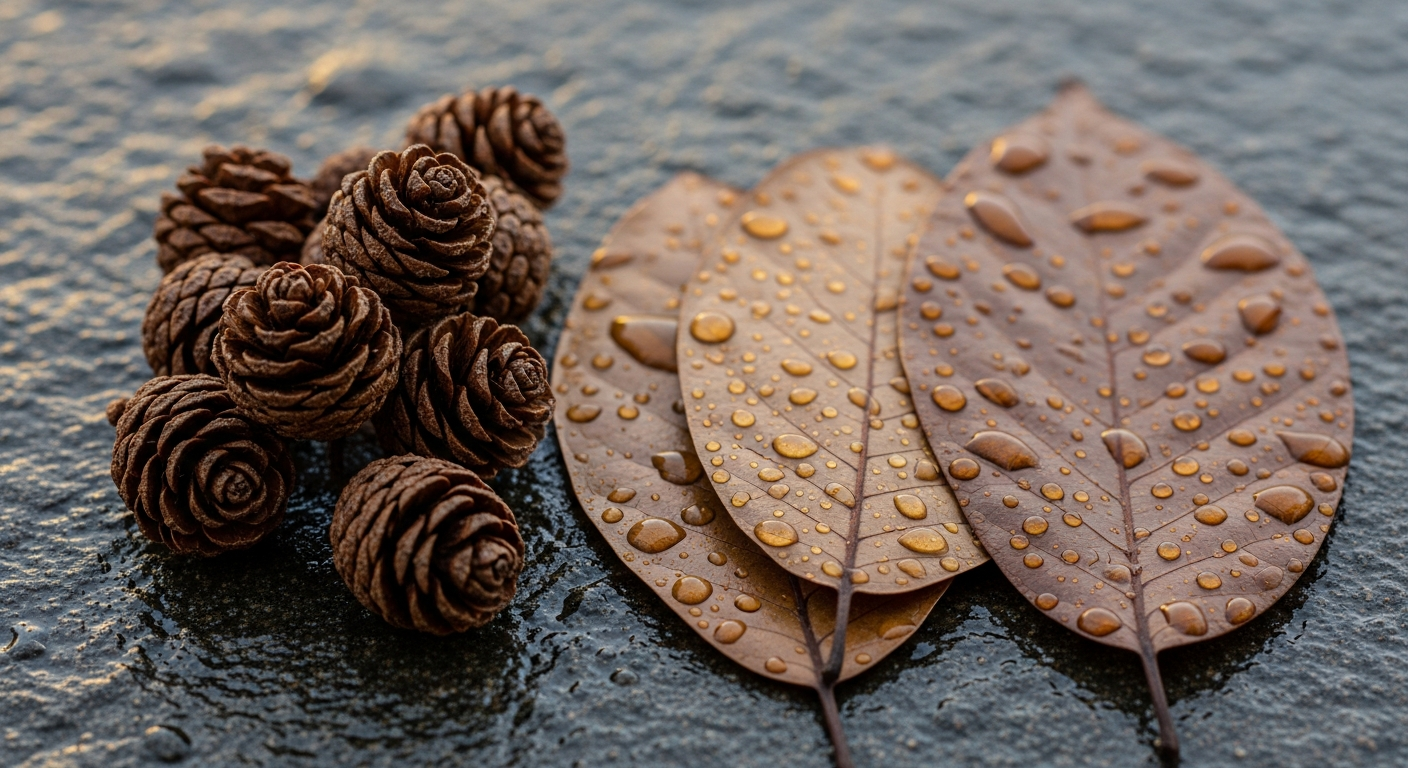
Alder Cones vs Catappa Leaves: A Comparison
Updated June 2026
Two botanicals. Different jobs. The debate between alder cones and catappa leaves (also sold as Indian almond leaves or IAL) comes up constantly in blackwater communities, and the confusion is understandable. Both release tannins, both soften and acidify water, and both are widely credited with improving fish health and breeding behavior. But they work through different mechanisms, at different speeds, and produce noticeably different results in the tank. Getting the wrong one for your setup costs you weeks of waiting for water chemistry that never quite lands.
Here is the full picture, side by side.
What Each Botanical Actually Is
Alder cones are the seed structures of Alnus glutinosa (common European alder) or Alnus incana, harvested after they drop in autumn. They are small, dense, woody structures, typically 1-2 cm long. That density is key: the cell structure releases compounds slowly and resists breakdown in water for weeks to months.
The primary active compounds are tannins (specifically ellagitannins and condensed tannins), along with lignin-derived polyphenols and a measurable concentration of betulinic acid. The result is moderate, sustained tannin release with a gentle acidifying effect. Water color stays relatively light amber rather than deep mahogany.
Catappa leaves come from Terminalia catappa, the Indian or tropical almond tree, and are the most-studied botanical in the aquarium hobby. A single large leaf contains significantly higher concentrations of gallic acid, ellagic acid, and flavonoids than an equivalent dry weight of alder cones. They break down fully over 4-8 weeks, meaning you get a pronounced initial tannin surge followed by gradual depletion. Water color is darker, often golden to amber-brown. If you want to understand the full range of what catappa can do in a planted or naturalistic setup, the catappa leaves guide covers conditioning protocols in detail.
Tannin Chemistry: What the Difference Means for Your Fish
Not all tannins behave identically in an aquarium, and this is where hobbyist guides often gloss over something worth understanding.
Catappa’s dominant compounds, particularly ellagic acid and gallic acid, have been studied for their antimicrobial and antifungal properties. Research conducted on Betta splendens in aquaculture settings has shown that water conditioned with catappa extract reduces bacterial load in ways consistent with improved wound healing and egg survival rates. The mechanism appears to be partly direct antimicrobial activity and partly the lower pH reducing pathogen viability.
Alder cones release a similar family of compounds but at lower peak concentrations, extending over a longer window. This matters if you keep sensitive shrimp species like Caridina cantonensis or Neocaridina davidi: a sudden tannin surge from fresh catappa can temporarily stress animals that prefer chemical stability. Alder cones introduce the same beneficial compounds without the spike.
Both botanicals also release humic substances, which bind heavy metals and help buffer against pH swings. You get that benefit regardless of which you choose. Building a complete blackwater aquarium setup typically uses both in combination, with catappa for the initial conditioning phase and alder cones for ongoing maintenance.
Head-to-Head: Alder Cones vs Catappa Leaves
| Factor | Alder Cones | Catappa Leaves |
|---|---|---|
| Tannin potency (initial) | Moderate, gradual release | High, pronounced initial surge |
| Duration in tank | 4-12+ weeks before breakdown | 4-8 weeks, full decomposition |
| Water tint | Light amber, subtle | Golden to deep amber-brown |
| pH effect | Consistent mild acidification | Faster initial drop, then levels |
| Dosing (soft water, 10 gal) | 4-6 cones, replenish monthly | 1-2 large leaves, replace at 6-8 wks |
| Cost per gallon | Lower (cones are dense, many per bag) | Slightly higher per leaf, but fewer needed |
| Best primary use | Shrimp tanks, breeding, pH stability | Betta conditioning, biotope, spawning |
| Substrate interaction | Stays intact, good foreground detail | Softens, becomes leaf litter habitat |
How Long Each Lasts, and When to Replace
Duration depends heavily on tank temperature, bacterial populations, and how much surface area is exposed. A cone sitting on top of substrate lasts longer than one buried in sand. A leaf in a high-flow area breaks down faster than one resting in a quiet corner.
As a general guide: alder cones in most tropical tanks (76-82F) hold their structural integrity for 6-10 weeks and release tannins across most of that window. The visible sign they are spent is when they turn pale, crack apart, and the individual scales separate. At that point, replace rather than supplement.
Catappa leaves typically show visible breakdown at the 5-6 week mark, often sooner in tanks with active microfauna or cleanup crews. When you see the leaf becoming translucent and skeletal, it is providing less chemical conditioning and more physical habitat. Some keepers intentionally leave spent leaves for shrimp grazing and biofilm, which is a legitimate choice. For water chemistry purposes, though, fresh leaf introduction should happen by week 6 at the latest.
Dosing Note
Start conservative and observe. For a 10-gallon soft-water tank, begin with 3-4 alder cones or 1 medium catappa leaf, watch your pH and TDS over 72 hours, then add more if needed. Heavily buffered tap water will absorb the impact without much measurable change; RO or rain-water-based tanks respond faster and more dramatically. If you are running an active substrate (ADA Amazonia, SL-Aqua), botanicals layer on top of what the substrate is already doing, so dose lower initially.
Betta vs Shrimp vs Biotope: Which Botanical Fits Each
For betta tanks, catappa is the traditional and well-supported choice. The higher initial tannin release creates the water conditions bettas come from, accelerates fin healing after fin rot or aggression injuries, and has been associated with increased spawning activity in conditioning pairs. A single large leaf per 5-10 gallons is a starting point most experienced keepers use.
For shrimp tanks, alder cones win on stability. Neocaridina species tolerate a wider range of parameters, but Caridina shrimp breeding particularly benefits from the predictable, low-variance acidification that alder cones provide. The humic acids released also appear to support molting success, though controlled hobbyist data on this is anecdotal rather than peer-reviewed. Alder cones also integrate aesthetically with carpeted tanks and rimless setups in a way that large leaves sometimes do not.
For a true blackwater biotope, both belong in the tank. Leaf litter from catappa replicates Amazonian or Southeast Asian igarape environments. Alder is not geographically accurate for a South American biotope, but hobbyist realism rarely demands that level of precision. If accuracy matters, use tannin-releasing driftwood alongside catappa for a more regionally coherent setup.
Can You Use Alder Cones and Catappa Leaves Together
Yes, and many experienced keepers do exactly that. The combination works because they complement rather than duplicate each other.
Catappa handles the front-loaded conditioning and water tinting. Alder cones sustain the tannin environment between leaf replacements and provide consistent pH support. In a 20-gallon betta tank, a reasonable starting combination is 1 large catappa leaf plus 4-6 alder cones, with cones remaining in the tank permanently and the leaf replaced every 5-6 weeks.
Watch total water color as your guide. If your tank runs darker than a light tea color and you have sensitive fish or plants that need moderate light penetration, scale back one botanical at a time rather than both simultaneously. That way you know which is doing more of the heavy lifting in your specific water chemistry.
Where to Buy and What to Look For
Both botanicals are widely available, but quality varies more than the price gap suggests.
For alder cones, look for suppliers who sell them loose or in measured quantities rather than in decorative mixed bags with unspecified other cones. Betula or alder mix bags sometimes contain decorative cones from non-Alnus species with unpredictable chemistry. Aquarium-specific vendors who state the species and collection method are worth the small premium. Typical sources include specialty aquatic plant and botanical retailers, as well as a few reliable Amazon Marketplace sellers with verifiable sourcing details in their listings. The guide to the best catappa leaf sources also covers several vendors who sell alder cones alongside their leaf inventory.
For catappa leaves, size and drying method matter. Leaves dried at high temperatures lose some volatile polyphenol content. Sun-dried or air-dried leaves from reputable aquatic botanical suppliers outperform bulk bags sourced from agricultural suppliers, which are often treated or collected without aquarium use in mind. Look for leaves that are brown to dark brown, not black (over-ripened) or pale yellow-green (under-mature). Consistency of color across a batch indicates controlled drying. The full catappa guide covers sourcing criteria in detail.
In both cases: rinse thoroughly before use, and consider a brief boil if you want to accelerate initial tannin release and reduce the risk of introducing unwanted organisms from field-collected botanicals.
Verdict by Use Case
Choose catappa leaves if your priority is fast water conditioning, betta breeding, fin recovery, or replicating the aesthetic of an Amazonian or Southeast Asian environment. They are also the better option when you want visible leaf litter as a structural element of the aquascape.
Choose alder cones if you keep shrimp, run a high-mineral RO build that needs consistent acidification, or want to maintain a tannin-rich environment between leaf changes without dramatic parameter swings.
Use both if you are building a serious blackwater system and want to cover both the conditioning and the stability angle without compromising either.
Common Questions
Do alder cones lower pH as much as catappa leaves?
In most tap water conditions, catappa leaves produce a more pronounced initial pH drop than the equivalent number of alder cones. Both effects are modest in hard, buffered water. In soft water or RO builds, both can meaningfully acidify the tank, but catappa’s impact arrives faster. For sustained acidification over weeks, alder cones are more consistent.
Are alder cones safe for all fish?
Alder cones are considered safe for the vast majority of freshwater fish and invertebrates in normal doses. Fish from neutral to alkaline environments (African cichlids, many livebearers) do not benefit and may experience unnecessary stress from the acidification. Stick to botanicals for soft-water, blackwater-adapted species where the chemistry shift is appropriate to the animal’s native range.
Can you use alder cones in a planted tank?
Yes, with one caveat: heavy tannin load from any botanical reduces light penetration, which can affect plants in low-light zones of a densely planted tank. Most stem plants and low-light species (anubias, Java fern, crypts) tolerate blackwater conditions well. High-light carpeting plants and demanding foreground species benefit from lighter tannin doses and careful placement of botanicals toward the back or sides of the tank.
Marcus Chen
Aquarist & Founder, TanninLab
Marcus has been keeping planted tanks for 14 years. He tests every product recommendation in his own tanks and publishes the raw data.
Last updated: June 2026