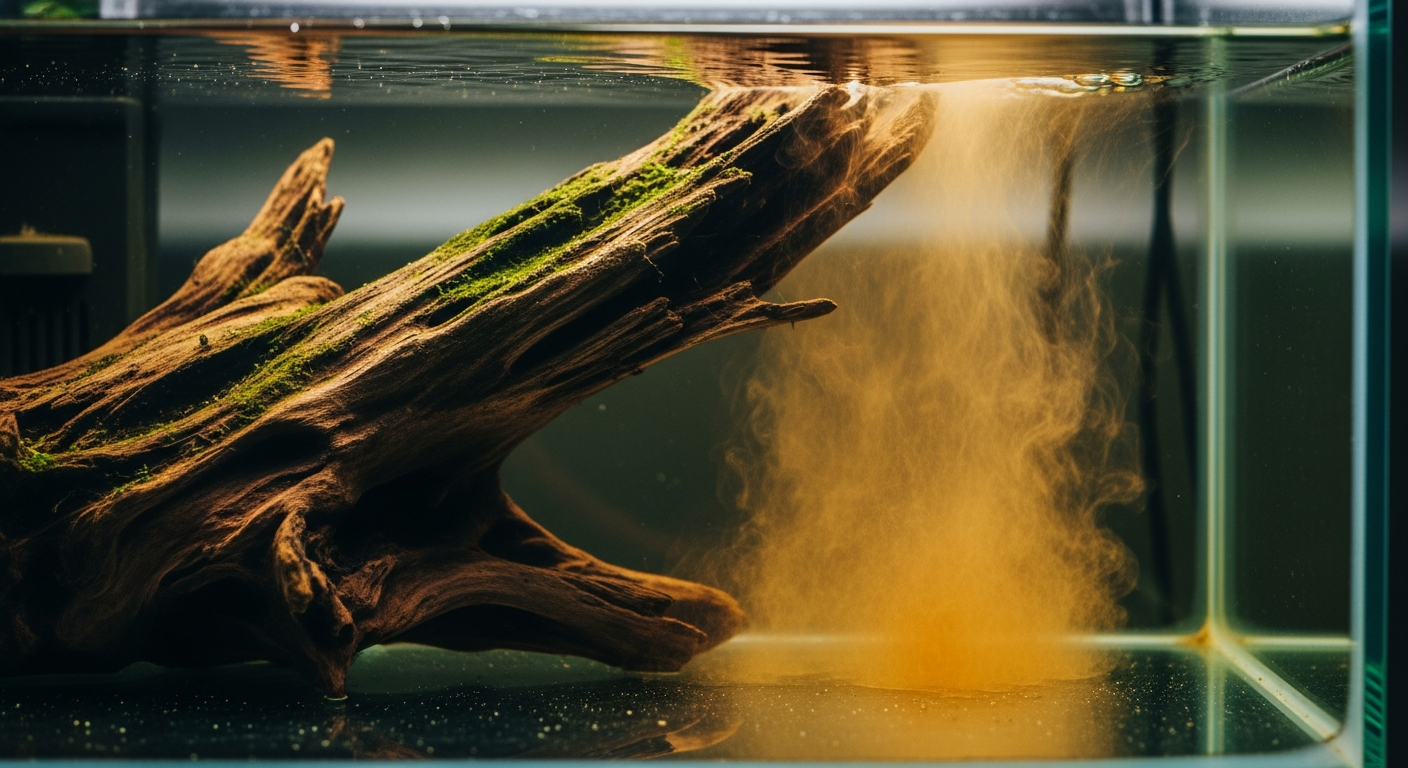
Driftwood Tannins: How Much Is Too Much
Updated June 2026
Put a piece of Malaysian driftwood in your tank and within 48 hours the water turns the color of weak tea. That is not rot, not contamination, and not a sign of failure. It is tannins doing exactly what they have done in the wild for millennia. Whether you want to remove them, manage them, or build your entire aquascape around them depends on what you are trying to keep and what you understand about how they work.
What Are Driftwood Tannins and Why Does Wood Release Them
Tannins are polyphenolic compounds found in plant tissue. In living wood, they serve as a defense against bacteria, fungi, and insects. When wood enters water, those compounds leach out through the grain and into solution. The process is passive and continuous, slowing gradually over months as surface concentrations deplete.
The rate of release depends on three variables: wood density, surface area, and water temperature. Softer, more porous woods like spider wood release tannins fast and dramatically in the first two weeks, then taper off. Dense woods like mopani release at a steadier, lower rate and can continue for a year or more. Water above 78°F (26°C) accelerates leaching noticeably compared to cooler setups.
The amber color you see comes primarily from humic acids and tannins binding to dissolved oxygen in the water column. The visual effect is real. The chemistry behind it is working in your favor even when it looks alarming.
How Tannins Affect pH and Water Chemistry
Tannins are mildly acidic. In a softwater tank with low alkalinity (KH below 4 dKH), a single large piece of driftwood can pull pH down by 0.5 to 1.5 units over several weeks. In a heavily buffered tank with high KH, the effect is minimal because carbonate hardness neutralizes the acids before they can shift pH.
This means driftwood tannins give you real pH control only when your KH is low. If you are running a high-KH setup targeting 7.5–8.0 for cichlids or livebearers, adding driftwood will color your water but barely touch pH. If you are building a soft-acid biotope for wild-type tetras, discus, or apistos, the same piece of wood becomes a legitimate acidification tool.
Measuring the actual impact
Test pH and KH before adding driftwood and again at 48 hours, 1 week, and 2 weeks. Use a calibrated liquid test kit rather than strips. If pH drops more than 0.2 units per day, your KH is very low and the wood is hitting an unbuffered system. Slow the drop with a small water change rather than removing the wood.
Humic acids released alongside tannins also chelate heavy metals like copper and zinc, binding them before fish can absorb them. This is a genuine benefit in tap water with moderate copper. The tradeoff is that chelated minerals become less bioavailable, which matters more in planted tanks than fish-only setups.
Driftwood Types: Tannin Output and Duration Compared
| Driftwood Type | Tannin Release Rate | Stain Intensity | Duration | Best For |
|---|---|---|---|---|
| Spider Wood | High initial burst | Deep amber | 2–6 months heavy, fades | Blackwater builds, fast setup |
| Malaysian Driftwood | Moderate, sustained | Medium amber | 12+ months | Community tanks, long-term biotope |
| Mopani | Low-moderate, slow | Lighter tan | 1–2 years | Hardscape focal pieces |
| Manzanita | Low | Minimal | 3–6 months | Planted tanks where color is unwanted |
Spider wood and Malaysian driftwood are the workhorses of blackwater aquascaping. If you want color fast, spider wood delivers. If you want a consistent, long-running tannin source, Malaysian driftwood is the more reliable choice. Manzanita is popular in planted setups precisely because it releases very little over a short window, giving you the hardscape without the persistent stain.
For a deeper look at sourcing and selecting each type, the best driftwood for blackwater tanks guide covers density testing, sourcing safety, and the wood types that work best in Amazon and Southeast Asian biotopes.
How Much Is Too Much: Reading Your Tank
There is no universal tannin threshold expressed in milligrams per liter for home aquariums. What matters is the combination of visible color, pH stability, and fish behavior. Use these as your actual gauges.
Water that is pale amber with pH stable in an appropriate range for your fish is not a problem. Water that is opaque brown and dropping more than 0.3 pH units per week in a tank with no KH buffer is a problem, especially if you are not keeping acid-adapted species.
Watch fish for clamped fins, respiratory distress, or unusual surface hovering. If fish are behaving normally, eating, and showing good color, the tannin concentration is almost certainly fine regardless of what the water looks like. Tetras, rasboras, corydoras, and most catfish species are genuinely indifferent to moderate tannin levels and often thrive in them.
How to Reduce Tannins From Driftwood
When you want clear water or are keeping fish that prefer neutral to alkaline conditions, you have several effective options. None of them require removing the wood permanently.
Pre-Soaking and Boiling
Boiling driftwood for 1–2 hours and then soaking it in a bucket with daily water changes for 1–2 weeks removes the bulk of surface tannins before the wood enters your tank. This front-loads the leaching process outside your aquarium.
The limitation is wood size. Large pieces of Malaysian driftwood or mopani that do not fit a stockpot need the soak-only method, which takes 2–4 weeks to achieve comparable results. Use a large plastic storage bin and change water every 24–48 hours. The water will run clear well before the wood stops releasing entirely, but the staining in your tank will be dramatically reduced.
Activated Carbon
Running activated carbon in your filter is the fastest in-tank solution. Fresh carbon removes humic acids and tannin compounds within 24–48 hours and keeps water visually clear. The tradeoff is that it needs replacing every 3–4 weeks because it saturates and can release adsorbed compounds back into the water.
Do not run carbon continuously if you are also dosing medications or plant fertilizers. It will adsorb those alongside the tannins.
Seachem Purigen
Purigen is a synthetic polymer adsorbent that targets dissolved organic compounds including tannins more selectively than carbon. Its main advantage is regenerability: when it turns dark brown, you soak it in diluted bleach, then dechlorinate it, and reuse it. Over a year, it is more economical than replacing activated carbon monthly.
For tanks where you want structural clarity but still want mild tannin softening of the water, running Purigen at half the recommended dose gives a middle-ground result.
Water Changes
Regular water changes dilute tannins mechanically. A 25–30% weekly change in a heavily tannic tank will keep concentrations manageable without eliminating the chemistry entirely. This is the approach most blackwater keepers use when they want color but not opacity.
When to Embrace Tannins Instead
If you are keeping wild-type Amazonian fish, Southeast Asian stream species, or soft-acid adapted tetras and killies, tannins are not a management problem. They are the target condition.
A mature blackwater aquarium setup combines driftwood with supplemental tannin sources for a more complete biotope. Catappa leaves add surface tannins and create microhabitats for fry and shy bottom dwellers. Alder cones vs catappa leaves is worth reading if you want to compare the acidity profiles and decomposition rates of the two most common botanical supplements.
The combination of wood-sourced humic acids, leaf tannins, and botanical compounds creates a chemistry that is genuinely hard to replicate with pH-adjusting chemicals. Wild-caught apistos, wild discus, and most wild-type small tetras show markedly better color, behavior, and spawning readiness in properly tannin-conditioned water versus chemically adjusted but botanically sterile tanks.
Building a Sustained Tannin Profile
Rotate botanicals rather than adding everything at once. Start with a large piece of driftwood as the anchor. Add catappa leaves in batches of 3–5, replacing them as they decompose (usually every 3–6 weeks). Introduce alder cones gradually if you want to push pH lower without large water changes. Test pH weekly until you find a stable endpoint your fish clearly prefer.
Common Tannin Troubleshooting Situations
| Situation | Likely Cause | What to Do |
|---|---|---|
| Water too dark after 1 week | High-tannin wood, no carbon | 30% water change, add activated carbon for 2–3 weeks |
| pH dropping fast (0.5+ per week) | Very low KH, tannin acidity unchecked | Test KH; if below 2 dKH, add crushed coral or increase water change frequency |
| pH not moving at all despite visible color | High KH buffering the acid | Normal in hard water. Tannins are present but neutralized. No action needed. |
| Fish showing stress despite normal pH | Other water quality issue, not tannins | Test ammonia, nitrite, nitrate, dissolved oxygen first |
| Carbon not clearing water | Carbon exhausted or insufficient quantity | Double the carbon volume or replace with fresh batch |
Frequently Asked Questions
Are driftwood tannins harmful to fish?
At the concentrations produced by standard aquarium driftwood, no. Tannins are mildly antibacterial and anti-fungal, and most freshwater fish tolerate them well. Fish adapted to acid blackwater conditions actively benefit from them. The only real risk is rapid pH instability in an unbuffered tank, which is a secondary effect to manage, not a toxicity issue with tannins themselves.
How long does driftwood release tannins?
It varies considerably by wood type. Dense hardwoods like mopani and Malaysian driftwood release detectable tannins for 12–24 months. Softer woods like spider wood produce a strong initial burst over 2–6 months then taper significantly. Boiling and extended pre-soaking reduce the active release window by removing surface concentrations before the wood enters the tank.
Can I use activated carbon and driftwood at the same time?
Yes. Running activated carbon alongside driftwood lets you keep the wood for its structure, texture, and bacterial colonies while controlling how much tannin color builds up in the water. You will still see some amber tinting because carbon is not 100% efficient, but it keeps the tank visually clearer. Replace the carbon every 3–4 weeks or when you notice color returning faster than usual.
Marcus Chen
Aquarist & Founder, TanninLab
Marcus has been keeping planted tanks for 14 years. He tests every product recommendation in his own tanks and publishes the raw data.
Last updated: June 2026