How Long Do Catappa Leaves Last Before You Replace Them
Updated August 2026
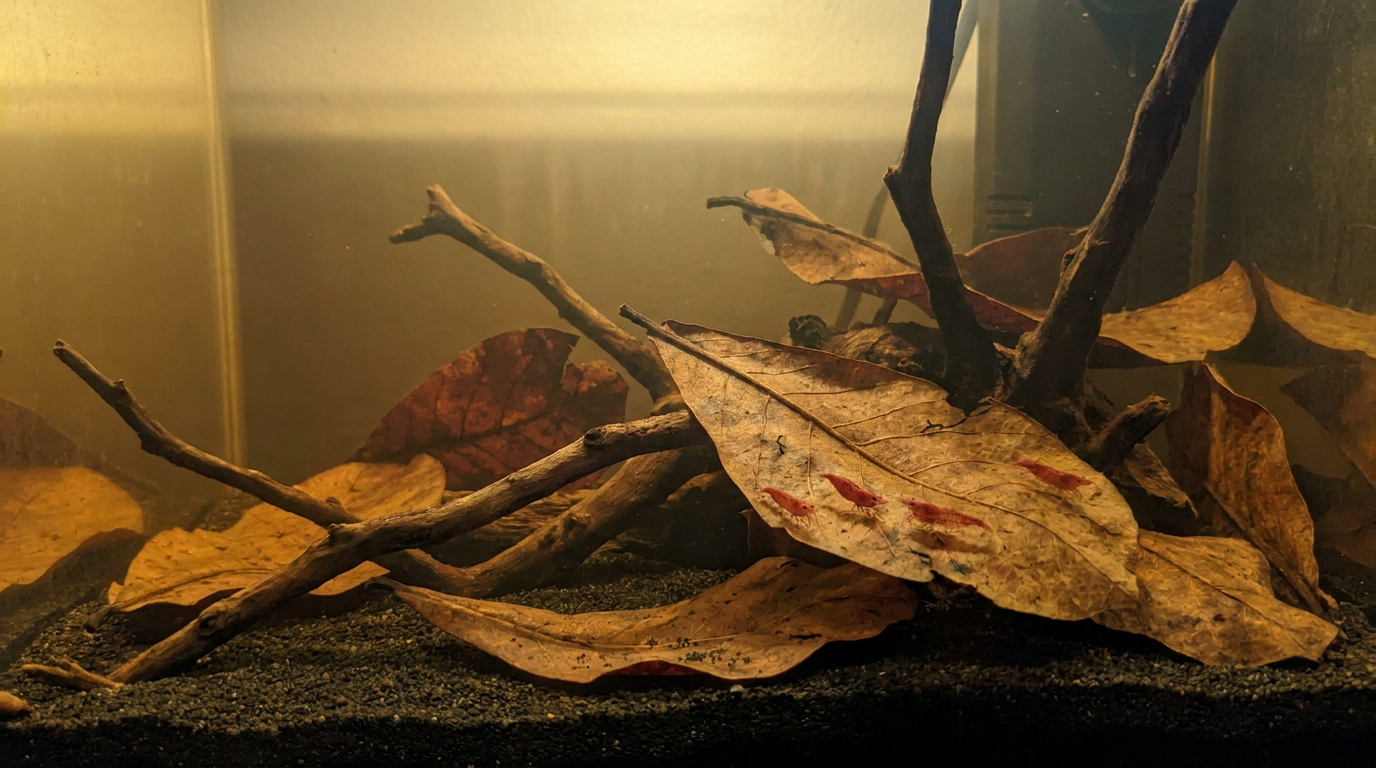
Catappa leaves last about two to four weeks in a typical tropical tank before they break down. Large leaves in cooler, softer water with light stocking can hold six weeks or more, while small leaves in a warm shrimp tank with busy grazers can vanish in ten days.
You do not replace them on a calendar. You replace them when the tannin release stops and the leaf has gone to a skeleton.
What actually breaks the leaf down
Three things drive the timeline: temperature, water movement, and how many animals graze the biofilm. Warmer water speeds bacterial decay, flow tears softened tissue, and shrimp and snails strip the surface faster than most people expect.
Leaf size and thickness matter too. A thick, mature Terminalia catappa leaf holds structure far longer than a thin one picked early in the season.
Signs it is time to swap
Watch for the leaf turning translucent and losing its ribs until only the vein skeleton is left. By then most of the soluble tannins are gone and it is contributing structure rather than water chemistry.
The other signal is the water. If your tint has faded back toward clear over a week or two, the leaves have given up what they had. Tint is only a rough gauge, though, since whether botanicals lower pH depends far more on your carbonate hardness than on leaf count.
Do you have to remove old leaves
No, and in a shrimp tank you probably should not. Skeletonized leaves are prime biofilm real estate, and shrimplets graze them for weeks after the tint is gone.
Pull them if they are trapping waste in a low-flow corner, if you are fighting high nitrate, or if the look bothers you. Otherwise let them finish on their own.
White fuzz on a softening leaf is normal in the first week and shrimp eat it. If you are unsure what you are looking at, compare it against mold on botanicals before you take anything out.
A replacement rhythm that works
Add one medium leaf per five to ten gallons, then top up with a single fresh leaf every two weeks instead of swapping the whole batch at once. Staggering keeps tannin levels steady and avoids a sudden swing in a shrimp tank.
Keep dry stock on hand so you are never tempted to skip a cycle, and prep each leaf before it goes in. The soak and boil routine in our catappa leaves guide also shortens how long they float.
Marcus Chen
Aquarist & Founder, TanninLab
Marcus has been keeping planted tanks for 14 years. He tests every product recommendation in his own tanks and publishes the raw data.
Last updated: August 2026