Best Driftwood for Blackwater Tanks
Updated August 2026
Choosing aquarium driftwood sounds simple until you realize the piece you ordered online floats, leaches so aggressively it turns your water opaque, or looks completely wrong for the tank you had in mind. Every wood type behaves differently, and for a blackwater build in particular, the species you pick shapes both the visual and the chemistry of the whole setup.
This guide covers the five types you will actually find for sale, what each one does in the water, and how to match them to your tank without guessing.
What Makes Driftwood Good for Blackwater Tanks
Blackwater aquariums run on tannins. Those organic acids soften water, lower pH, and give you that amber tea color that signals a healthy, botanically rich environment. Not all driftwood contributes tannins equally, and some pieces barely release any at all.
Beyond tannins, you want wood that is actually safe, meaning free of toxins, resins, and mold. Softwoods like pine, cedar, and most conifers are off the table entirely because they leach compounds that harm fish. Stick to hardwoods and species sold specifically for aquarium use.
Sink behavior matters more than most people expect. A piece that floats for six weeks while you wait for it to waterlog is frustrating at best, and at worst it shifts position and damages plants or equipment. If you want to understand the full chemistry behind what tannins actually do to water parameters, the driftwood tannins guide covers it in detail.
Tannin Lab earns a commission on qualifying purchases through the Amazon links on this page, at no extra cost to you. Picks are chosen on performance and suitability, not on commission.
Aquarium Driftwood Types: Head-to-Head Comparison
Here is how the five most common types compare across the dimensions that matter for a blackwater tank.
| Type | Tannin Output | Sinks or Floats | Look | Best Tank Size | Prep Effort |
|---|---|---|---|---|---|
| Spider Wood / Manzanita | Low to moderate | Floats (weeks to months) | Branchy, intricate, pale tan | 10 gal and up | High (long soak or anchoring required) |
| Malaysian Driftwood | High, long duration | Sinks within days | Dense, gnarly, dark brown | 20 gal and up | Low to moderate (boil or soak) |
| Mopani Wood | Very high initial | Sinks fairly quickly | Two-tone, smooth and knotted | Any size | High (extended boiling reduces initial dump) |
| Cholla Wood | Very low | Floats initially, sinks over time | Tubular, skeleton-like, hollow | 5 gal and up | Low |
| Mangrove Root | Moderate to high | Sinks reliably | Arching, root-complex, dark | 30 gal and up | Moderate (good boiling recommended) |
Spider Wood and Manzanita
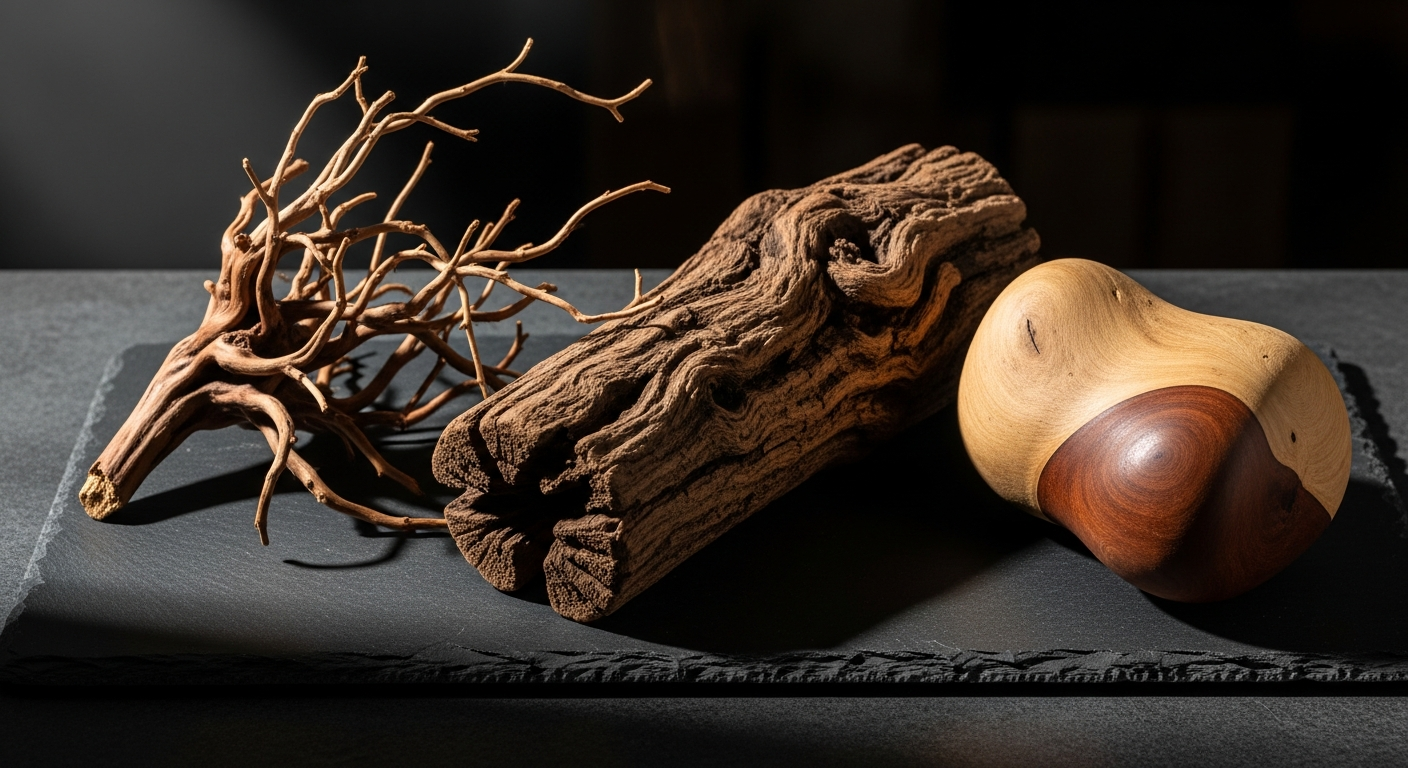
Spider wood (also called azalea root in some markets) and manzanita are closely related in appearance and behavior. Both produce fine, branching structures that look like submerged root systems or bare winter trees.
The visual payoff is real. For a forest floor scape or a Borneo-style blackwater setup, nothing creates that tangled root feel as well. Smaller nano tanks benefit here too because a single branch-heavy piece can fill the frame without overwhelming the space.
The catch is buoyancy. Spider wood is notoriously reluctant to sink. Expect to soak it for several weeks or weigh it down with rocks while it waterlogged fully. Tannin contribution is lower than Malaysian or mopani, so if you want aggressive water coloring, pair it with catappa leaves or other botanicals to make up the difference.
Malaysian Driftwood
Malaysian driftwood is the workhorse of blackwater aquascaping. It sinks fast, stays put, and releases tannins consistently over a long period, often six months to a year of meaningful output depending on piece size.
The density that makes it sink is also what gives it weight and durability. Pieces do not shift once placed, which matters if you are building a scape you want stable. The appearance is darker and more irregular than spider wood, with a chunky, organic quality that looks natural in low-light blackwater setups.
Larger pieces can weigh significantly more than you expect. For tanks under 20 gallons, smaller cuts or fragments work better than full branches. For a deeper look at setting up the full environment around your wood, the blackwater aquarium setup guide covers substrate, filtration, and lighting in context.
Mopani Wood
Mopani wood comes from southern Africa and is one of the densest options you will find. The two-tone appearance, pale sand on one side and dark espresso on the other, makes it visually distinctive and popular with aquascapers who want contrast.
The tannin dump on mopani is the highest of any wood type in its first weeks. Without proper preparation, it will turn even a large tank dark brown within days. That is not necessarily a problem for a blackwater build, but the degree of color change surprises people who did not boil thoroughly first.
Boil mopani for at least an hour, change the water, and boil again. The water coming off it during prep will look like strong tea. Accept that some tannin coloring will still occur after you place it, and treat that as a feature rather than a failure.
Cholla Wood
Cholla wood is the skeleton of a dried cactus, which makes it structurally unlike anything else on this list. The hollow tube structure with its lattice of interconnected holes creates surfaces that shrimp, small catfish, and fry use heavily for grazing and shelter.
Tannin contribution is minimal. If water coloring and pH impact are your primary goals, cholla alone will not get you there. Where it earns its place is as a secondary element, adding texture, biofilm surface area, and visual complexity to a setup that already has tannin-heavy wood or botanicals doing the chemistry work.
It also breaks down faster than hardwoods, softening over several months before eventually disintegrating. For some setups that is actually desirable since it adds decomposing wood to the substrate layer.
Prices move, and stock does too. Each of these opens the product page on Amazon in a new tab.
Mangrove Root
Mangrove root arrives from Southeast Asian aquaculture zones and has the most architecturally complex shape of any type commonly available. The arching, intertwined root structures can create genuinely dramatic aquascapes in larger tanks.
Tannin output sits between mopani and spider wood, consistent but not overwhelming. It sinks reliably once soaked. The main limitation is size: meaningful mangrove pieces tend to be large, and placing them well requires a tank with enough horizontal space to let the structure breathe visually.
For tanks under 30 gallons, individual root fragments work better than full structures. Compatibility with most fish and shrimp species is good, though as with all wood types, boiling before placement is non-negotiable.
Pre-Soak and Sinking Tips
For any wood that floats: fill a clean container with dechlorinated or RO water, fully submerge the piece using a weight or rock, and change the water every two to three days. Warm water accelerates the process. Spider wood may need two to four weeks; Malaysian typically sinks within three to seven days. Once the piece holds itself down unweighted for 24 hours, it is ready for the tank.
For mopani specifically: boil in a large pot rather than soaking. Two rounds of boiling at one hour each pulls out the bulk of surface tannins and reduces the initial water discoloration significantly. The wood will still color your water, just at a pace that is easier to manage.
How to Choose by Tank Size and Scape Style
Tank size is the first filter. In a 10-gallon blackwater setup, a single piece of spider wood or a few smaller mopani fragments will fill the space without crowding. Malaysian driftwood at full size belongs in a 20-gallon or larger.
For a Walstad or jungle-style tank with dense planting, cholla and spider wood work well because their open structure lets plant roots and stems pass through without blocking light to the substrate. In a minimalist single-specimen scape, mopani or a well-chosen mangrove root provides enough visual weight to anchor the whole design.
If you are keeping species with specific habitat preferences, matching the wood to origin matters. Altum angelfish, cardinal tetras, and most South American dwarf cichlids come from blackwater rivers where submerged roots are the dominant hardscape element. Malaysian and spider wood both evoke that environment accurately. For Southeast Asian species like chili rasboras or Boraras brigittae, mangrove root is the better match.
Matching Wood to Fish Origin
For South American species (cardinal tetras, apistogramma, wild bettas), Malaysian driftwood and spider wood give you the submerged root aesthetic of Amazonian igarapes. For Southeast Asian fish (chili rasboras, chocolate gouramis, Boraras species), mangrove root replicates the peat-stream and flooded forest environments more accurately. Geography is not required for a functional blackwater tank, but matching it does tend to produce more settled fish behavior.
Wood to Avoid Entirely
Any wood collected from outdoors that you cannot positively identify is a risk. Softwoods, most fruit tree woods, and anything treated with pesticides or preservatives can release compounds that stress or kill fish even at low concentrations.
Painted, varnished, or lacquered wood is always off limits. Some aquarists use driftwood from craft stores, but unless it is sold explicitly as aquarium-safe and untreated, assume it has a chemical finish.
Mold on recently soaked wood is not automatically disqualifying. A light white fuzz is usually bacterial film or harmless mold that clears up once the wood is in a cycled tank with biological filtration running. Heavy black mold or persistent surface slime after boiling suggests the piece should be discarded.
For a full toolkit on safe hardscape handling, plant trimming around wood, and flow positioning, the aquascaping tools guide covers what you actually need versus what is marketing.
Where to Buy Each Type
For Malaysian and mopani wood, large online retailers and Amazon carry consistent stock at reasonable prices, though piece quality varies by seller. Buying from specialty aquascaping shops, even online, usually means better curation and less likelihood of receiving a piece with surface mold or poor structure.
Spider wood and mangrove root are more reliably sourced from aquarium-specific retailers. General pet store chains stock them occasionally, but turnover is slow and pieces often sit in dry conditions too long.
Cholla wood is widely available because it is popular with shrimp keepers. Look for it from shrimp-focused online stores where it will typically be sold in packs of shorter tubes rather than single long pieces.
When buying online for blackwater builds, look for sellers who describe their wood as aquarium-cured or aquarium-safe rather than just decorative. The distinction matters because aquarium-cured wood has been processed specifically to remove surface contaminants.
Frequently Asked Questions
Does driftwood lower pH in a blackwater tank?
Yes, tannin-releasing driftwood does lower pH, but how much depends on your starting water chemistry and the wood type. Malaysian and mopani have the strongest effect. In soft, low-alkalinity water with no buffering substrate, a large piece of Malaysian driftwood can drop pH by half a point to a full point over several weeks. In harder water with crushed coral or aragonite in the substrate, the buffering capacity will largely cancel the pH effect even with heavy tannin output.
How long do I need to soak driftwood before putting it in my tank?
Malaysian driftwood typically sinks and is ready in three to seven days of soaking with regular water changes. Spider wood and manzanita can take two to four weeks or longer before they stop floating. Mopani benefits most from boiling rather than soaking; two boiling sessions of about an hour each, with fresh water for the second round, gets the surface tannin load to a manageable level. After boiling, a brief soak to confirm sinking behavior is enough.
Is it safe to mix different types of driftwood in one tank?
Mixing types is fine and often produces more natural-looking results than a single-type setup. The main consideration is cumulative tannin load. If you pair high-output mopani with Malaysian driftwood and add catappa leaves, you are stacking tannin sources and the water color and pH drop will be more pronounced than with any single element alone. That can be exactly what you want in a dedicated blackwater build, but it is worth testing water parameters weekly in the first month to see where chemistry stabilizes.
Marcus Chen
Aquarist & Founder, TanninLab
Marcus has been keeping planted tanks for 14 years. He tests every product recommendation in his own tanks and publishes the raw data.
Last updated: August 2026