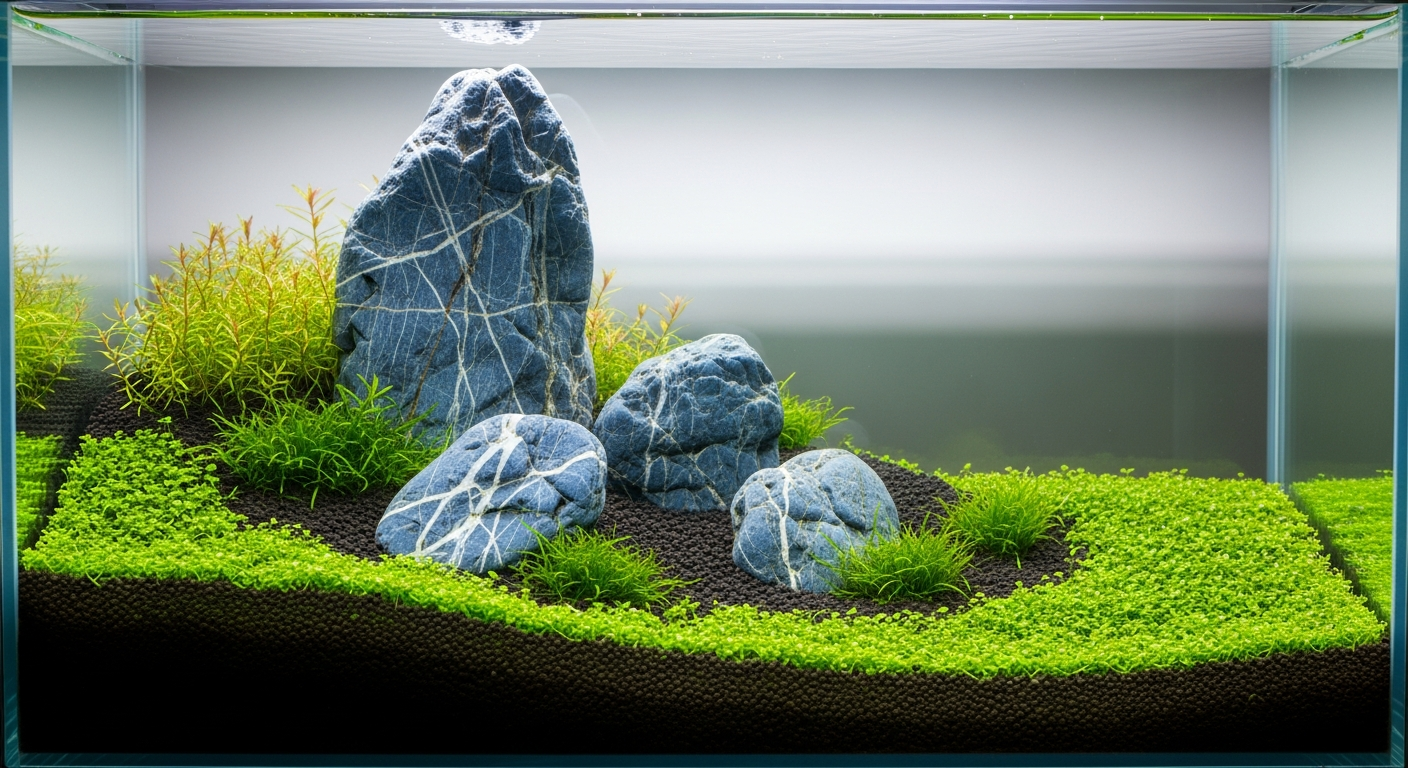
Iwagumi for Beginners: Rules and Adaptations
Updated June 2026
Takashi Amano introduced iwagumi to the aquascaping world in the 1980s, borrowing directly from the Japanese rock garden tradition. The word itself translates roughly to “rock formation style,” and the philosophy is severe by aquascaping standards: no wood, no ornaments, no fussiness. Just stone, carpet grass, and water. That restraint is exactly what makes it one of the hardest styles to execute well, and one of the most satisfying when you get it right.
This guide walks you through every decision in order, from choosing your stones to keeping the carpet alive six months in.
What Makes Iwagumi Different From Other Aquascape Styles
Most planted tank styles give you creative flexibility. Iwagumi does the opposite. The composition follows strict rules borrowed from Japanese aesthetics, and breaking them usually produces a layout that looks busy rather than calm.
The defining characteristics are three: an odd number of stones, asymmetrical placement guided by the golden ratio, and a single foreground carpet plant that reads as a continuous green field. There are no focal-point plants competing for attention. The stones carry the entire visual weight.
If you are coming from a nature aquarium background or just setting up your first planted aquascape, iwagumi will teach you to see negative space as a design element, not wasted glass.
The Golden Ratio and the Odd-Number Rule
Amano based the iwagumi layout on the phi ratio (approximately 1:1.618), the same proportion found in classical painting and architecture. In practice, you place the Oyaishi at roughly the 1/3 or 2/3 mark of the tank’s width, never dead center. Centered placement kills the sense of depth and makes the tank read as a display case rather than a landscape.
The odd-number rule comes from a different Japanese principle: even numbers feel static, odd numbers feel alive. Three stones is the most common starting point for a 60-90 cm tank. Five or seven work for larger setups. Two or four stones almost always look unresolved, so avoid them regardless of tank size.
You do not need to measure with a ruler. Place the main stone, step back, and check whether your eye moves naturally across the layout. If it stops in the middle or bounces between two equal points, the balance is off.
Stone Roles, Names, and How to Place Them
Every stone in an iwagumi has a specific function. Learning the names is not academic, it is a practical shortcut for making placement decisions faster.
| Stone Name | Japanese Term | Role in the Layout | Typical Size Relative to Oyaishi |
|---|---|---|---|
| Main stone | Oyaishi | Dominant focal point, anchors the entire composition | 100% (reference stone) |
| Secondary stone | Soeishi | Companions the Oyaishi, creates visual conversation | 60–75% |
| Accent stones | Fukuishi | Support the group, add rhythm and layering | 30–50% |
| Throwaway stones | Suteishi | Partially buried or hidden, prevent the group from floating visually | 15–25% |
The Oyaishi goes in first. Everything else orbits it. Place the Soeishi close enough to feel connected but far enough to create a gap. That gap is where the carpet grass will read most clearly, so do not close it off with stones.
Suteishi are the most overlooked element. Burying a smaller stone at the base of the main group prevents the composition from looking like rocks sitting on a substrate shelf. It ties the stones into the ground and gives the layout a sense of geological weight.
Choosing the Right Stone for Iwagumi
Stone selection matters more here than in any other aquascaping style, because there is nothing else to look at. The two most commonly used varieties each have real tradeoffs.
Seiryu stone is the classic choice. Its blue-grey color with white veining photographs beautifully and pairs well with bright green carpet plants. The downside is that seiryu raises carbonate hardness noticeably over time, which can cause problems in soft-water tanks or with pH-sensitive shrimp. Test your water weekly during the first month.
Dragon stone (also called ohko stone) has a warmer reddish-brown tone and a pitted, textured surface that catches light differently. It is inert in most setups and does not affect water parameters as aggressively. The texture also makes it easier to create a convincing sense of scale in smaller tanks.
Whatever you choose, match your stones. Mixing two types rarely works. All stones in a layout should share the same species, color family, and grain direction. Before you place anything, check the full guide on hardscape-safe rocks for planted tanks if you are not sure whether a stone is aquarium-safe.
Carpet Plants for Iwagumi and Why CO2 Is Non-Negotiable
The carpet is the second half of every iwagumi. Get it wrong and the stones look like they are sitting in weeds. Get it right and the layout reads like a hillside miniaturized.
Three plants dominate this style for good reason.
Hemianthus callitrichoides (HC Cuba) is the most demanding option and also the most striking. The leaves are tiny, roughly 2 mm, which gives the carpet a fine-grained texture that makes stones look massive by contrast. It requires high light and injected CO2, and it will melt within two weeks without both.
Monte Carlo (Micranthemum tweediei) is a more forgiving alternative. The leaves are slightly larger and rounder, the growth habit is less aggressive, and it tolerates moderate CO2 levels better than HC. For a first iwagumi, Monte Carlo reduces the number of things that can go wrong simultaneously.
Dwarf hairgrass (Eleocharis parvula or acicularis) gives a different texture entirely, more meadow than lawn, with thin blades that sway with water movement. It spreads by runners rather than carpeting uniformly, so it works better as an accent alongside stones than as a full-coverage foreground.
All three need injected CO2 to carpet properly in a reasonable timeframe. Drop checkers and diffusers are the minimum setup. Running an iwagumi without CO2 is possible in theory but you will wait months for coverage and fight algae constantly. A quality CO2 system also gives you better control over the plant growth rate, which matters for keeping the carpet at a consistent height. Pair this with one of the best LED lights for planted tanks at the right spectrum and intensity, and the carpet will fill in within six to eight weeks.
Substrate depth counts. Iwagumi carpet plants send roots down aggressively. Use at least 6 cm of planted-tank substrate under the foreground, sloping up to 8-10 cm at the back. A shallow bed starves the roots and produces patchy coverage regardless of light and CO2. Capping with fine sand looks clean but eliminates nutrients the roots need. Use a purpose-built planted aquarium substrate throughout, not gravel with a decorative layer on top.
Building Your Iwagumi Layout Step by Step
Do all of this before adding water. Wet stones are heavier and the substrate becomes difficult to reposition.
Start with an empty tank and build the substrate slope first. Rake it flat, then push substrate toward the back so the front sits at roughly 4 cm and the back at 8-10 cm. This slope creates the illusion of depth and ensures carpet plants in the foreground are not competing with shadow from tall substrate mounds behind them.
Place the Oyaishi. Tilt it slightly backward, around 10-15 degrees, so the face leans toward the viewer. Vertical stones look artificial. Stones that lean inward feel rooted.
Add the Soeishi next. Angle it to complement the main stone, not mirror it. If the Oyaishi leans left, the Soeishi can lean right at a shallower angle. The gap between them should be wide enough to read clearly from viewing distance.
Position Fukuishi and Suteishi last. Bury the smallest stones partially so they look grown-in rather than placed. Step back every few minutes and check from eye level with the tank.
Fill slowly to avoid disturbing the substrate. A plate or plastic bag on the substrate surface during filling absorbs the water force. Once full, wait 24 hours for sediment to settle before planting.
Plant the carpet in small plugs or tissue culture trays, spread evenly. Do not leave bare patches expecting the plant to fill in. Dense initial planting shortens the establishment phase and gives algae fewer openings.
Common Mistakes That Kill Iwagumi Layouts
Symmetrical stone placement is the most common error. Two stones of equal size on either side of center looks like a gate, not a landscape. If your composition feels balanced but boring, this is almost certainly why.
Choosing stones with different grain directions is the second mistake. Seiryu and dragon stone both have visible grain lines in the rock face. When stones in the same layout point in conflicting directions, the eye reads chaos rather than a coherent geological formation. Before purchasing, hold stones together and check that the strata run in the same general direction.
Skipping CO2 to save money then fighting algae for months is a rite of passage for many beginners, but it is avoidable. The carpet plants that define iwagumi are genuinely CO2-dependent. Without it, green spot algae and thread algae will colonize the foreground before the carpet can outcompete them.
Finally, trimming the carpet too late. Once HC Cuba or Monte Carlo grows tall enough to fold over, it shades itself and the lower layer dies. Trim frequently and low, every ten to fourteen days during peak growth, to keep the carpet dense and horizontal.
Frequently Asked Questions
How many stones does an iwagumi aquascape need?
Iwagumi layouts use an odd number of stones: three, seven, nine, or more depending on tank size. Three stones is the most practical starting point for tanks between 60 and 90 cm. The odd-number rule comes from Japanese aesthetic principles where even groupings feel static and odd groupings feel alive. Never use two or four stones.
Can you do an iwagumi aquascape without CO2?
Technically yes, but not reliably. The foreground carpet plants used in iwagumi (HC Cuba, Monte Carlo, dwarf hairgrass) grow slowly and weakly without injected CO2, and they lose the competition against algae before they can carpet. Most successful low-tech planted tanks use different plant selections. If you want the classic fine-carpet look, CO2 injection is not optional.
What is the best stone for a beginner iwagumi layout?
Dragon stone is the more forgiving choice for beginners because it is largely inert and does not raise carbonate hardness the way seiryu does. Its textured surface also makes it easier to create convincing scale in smaller tanks. Seiryu stone is more traditional and photographs with greater contrast, but it requires closer water parameter monitoring, especially in soft water or shrimp tanks.
Marcus Chen
Aquarist & Founder, TanninLab
Marcus has been keeping planted tanks for 14 years. He tests every product recommendation in his own tanks and publishes the raw data.
Last updated: June 2026