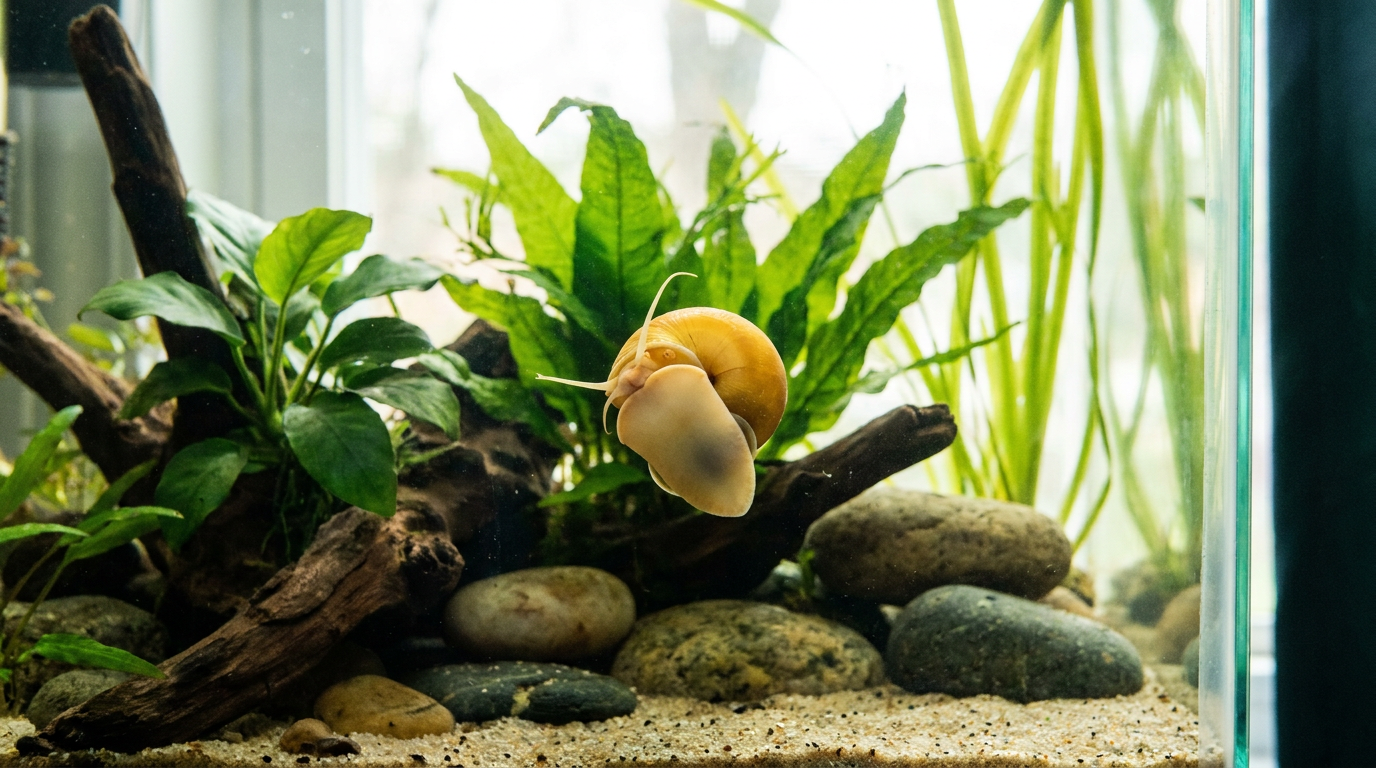
Mystery snail care: shell health, food, and tank mates
Updated September 2026
Mystery snails are among the easiest invertebrates you can keep in a planted tank, and one condition decides the outcome: the water must be hard and calcium-rich. Kept in soft, acidic water, an adult erodes within months and dies long before its one to two year lifespan is up. Fix the hardness first. Everything else in this guide is negotiable.
Water parameters and the shell
Aim for a pH between 7.0 and 8.0, general hardness above 8 dGH, and a temperature of 20 to 28 degrees Celsius. The shell is the health gauge: fresh growth should form a smooth lip near the opening. Pitting, chalky patches, or a thinning spire mean the calcium supply or the hardness has fallen behind what the snail can deposit.
The standard failure story: a snail goes into a 19 liter nano tank running soft water for Caridina shrimp. It eats well for six weeks, then the shell pits and the snail stays shut for days. Remineralize toward neo parameters or float a piece of cuttlebone in the tank; both work, but only before the erosion gets deep.
Video: Aquarium Source
How it stacks up against a nerite
Stores sell both as algae cleaners, and they are not interchangeable. A nerite snail rasps glass and hardscape all day but cannot breed in freshwater, leaving white egg sacs across the hardscape instead. A mystery snail eats less algae, needs targeted feeding, and lays one pink clutch above the waterline that you can remove with a fingertip.
| Mystery snail | Nerite snail | |
|---|---|---|
| Adult size | about 5 cm | about 2.5 cm |
| Main diet in a tank | biofilm, blanched vegetables, sinking wafers | hard algae films on glass and rock |
| Calcium demand | high; shell erodes in soft water | moderate |
| Breeds in freshwater | yes, egg clutch above the waterline | no; white egg sacs stay unfertilized |
| Practical floor | 19 liters for one adult | 19 liters for a small group |
Feeding beyond the algae film
Alone in a mature tank, a mystery snail mows the biofilm and then quietly goes hungry. Blanched zucchini, spinach, or a sinking wafer two or three times a week keeps it active, with the leftovers pulled after a day so the water stays clean. A healthy snail reaches new food within a minute of it landing; one that ignores it is telling you the water is wrong, not the menu.
Tank mates that work and ones that bite
Tetras, rasboras, guppies, and corydoras leave them alone. The exceptions are real: some bettas nip the long tentacles until the snail stops opening up at all, and any loach, crayfish, or assassin snail will eventually kill an adult. Watch the first week closely with a betta, and rehome the snail if it stops coming out to feed.
The snails themselves rarely carry disease into a tank, but the plants they arrive on can bring hitchhikers. A short stay in a quarantine tank for anything new protects the whole setup.
Marcus Chen
Aquarist & Founder, TanninLab
Marcus has been keeping planted tanks for 14 years. He tests every product recommendation in his own tanks and publishes the raw data.
Last updated: September 2026