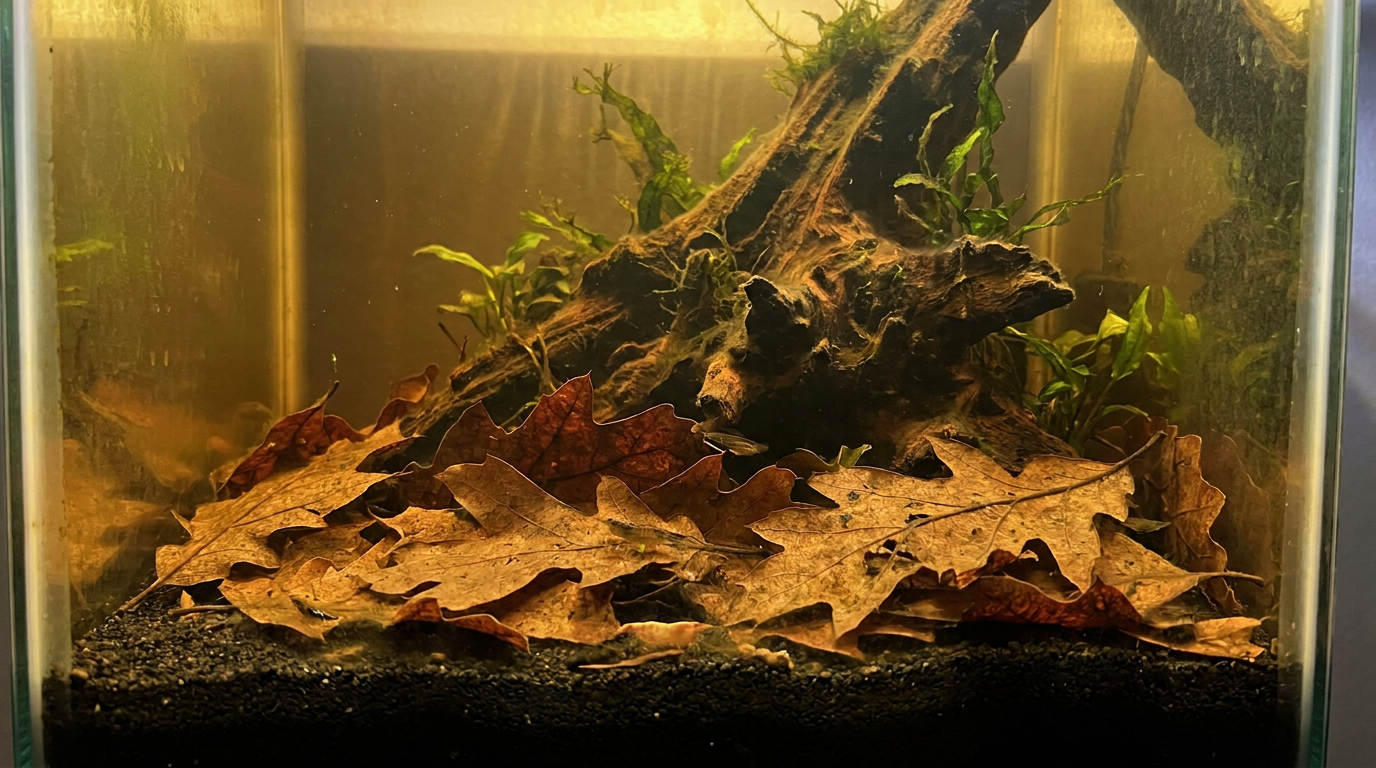
Oak Leaves for Blackwater Tanks: A Free Alternative to Catappa
Updated August 2026
Oak leaves work in a blackwater tank. They release tannins, tint the water, and cost nothing if a tree stands nearby, though they tint less per leaf than catappa and take longer to get going.
Which oaks are safe
White oak, English oak, red oak, and pin oak all get used regularly in blackwater setups. Condition matters more than species.
Collect brown, fully fallen leaves off the ground in autumn, away from roadsides, sprayed lawns, and industrial areas. Green leaves hold more sap and tend to foul water.
Skip anything mixed with walnut litter, which carries juglone, and skip eucalyptus and cherry unless you know exactly what you are handling.
Preparing them
Rinse under cold water, then either boil for ten minutes or soak in hot water until the leaves sink. Boiling strips some tannin but removes surface dust and speeds up sinking.
Dry leaves float for days otherwise, and a floating leaf does almost nothing for your water chemistry.
How oak compares to catappa
Catappa leaves are larger, thinner, and dump tannin quickly. Oak is thicker with a heavier cuticle, so release runs slower and steadier.
Per leaf you get less tint from oak. Per handful the gap narrows, because oak is cheap enough to be generous with. The same tradeoff appears in alder cones vs catappa leaves, where the smaller botanical hits harder per gram.
Oak also holds its structure longer, which matters for shrimp. A catappa leaf turns to lace in about two weeks, while oak often lasts four to six.
Dosing and pH
Start with roughly one medium leaf per two gallons and watch the tint across a week. Add more gradually instead of front-loading a full handful.
Tannins only acidify if your water lets them. In hard water with high KH the pH barely moves and you get color without a chemistry shift.
In soft, low KH water the drop can be fast, which is where most crashes come from. Track it the same way you would with wood, using the thresholds in our guide to driftwood tannins.
What the biofilm does
Within a week the leaf surface grows biofilm. Neocaridina and Caridina shrimp graze it constantly, and fry survival tends to be better in tanks with steady leaf litter.
Bettas use larger leaves as resting shelves and cover. The stiffer oak structure supports a fish better than a softened catappa leaf does.
Replace leaves as they disintegrate rather than pulling them whole. Half-broken leaves are still working. If you run catappa alongside, the dosing logic in the catappa leaves guide transfers directly.
The real drawbacks
Collection is seasonal, so you either stockpile in autumn or go without. Store them fully dry in paper bags rather than plastic.
Ground-collected oak also carries a mild hitchhiker risk: springtails, mites, the occasional snail egg. Boiling handles nearly all of it.
Marcus Chen
Aquarist & Founder, TanninLab
Marcus has been keeping planted tanks for 14 years. He tests every product recommendation in his own tanks and publishes the raw data.
Last updated: August 2026