Indian Almond Leaves in a Betta Tank: How Many and How Often to Replace
Updated October 2026
Indian almond leaves, usually sold as catappa leaves, are the single most used botanical in the betta hobby, and for good reason. Dropped into the tank they slowly release tannins and humic substances that tint the water amber, soften it very slightly, and create conditions close to the shallow pools wild bettas actually live in. They are also one of the most commonly misused products in the hobby: too many leaves, no removal of the decaying ones, and a tank that was healthy turns into a maintenance problem. Here is what the leaves genuinely do, how many to use, and how to keep them from becoming a mess.
What Catappa Leaves Actually Release
A catappa leaf is a slow-release packet of tannic and humic acids plus a range of other organic compounds. As the leaf breaks down over roughly two to three weeks, the water gradually takes on a tea-coloured tint, the pH drifts down by a small amount in soft water, and the humic substances accumulate. The pH effect is real but modest: in moderately hard tap water the drop is barely measurable, while in already soft, mineral-poor water it can be a few tenths. That matters for consistency, because a tank that swings between heavily leafed and freshly cleaned can drift more than a tank kept stable. The other reason the nitrogen readings in a blackwater tank can look odd is covered in our article on tannins and the nitrogen cycle.
The biological side is why breeders use them. Humic substances have mild antibacterial and antifungal properties, which is why breeders condition spawning pairs in leaf-littered water and why wild betta imports settle faster in a tank with catappa than in bare glass. They are not medicine. If your betta has fin rot, catappa leaves are supportive care, not a treatment, and you should be treating the actual cause.
How Many Leaves, and for What Tank Size
The commonly quoted starting dose is one medium leaf per roughly 40 to 80 litres, or one small leaf per 20 litre betta cube. Treat that as a starting point, not a rule, because leaf size varies enormously, and so do goals. For a 20 litre betta tank, one medium leaf or two small ones is plenty for a permanent light tint. Scale up by volume, and judge by the water, not by the count: once the tint is where you want it and the fish is comfortable, stop adding leaves until the old ones are gone.
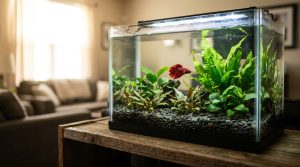
Because bettas are the classic use case, dosing is often tested on a 5 gallon betta setup first, where a single leaf visibly tints the whole tank within a week. That is a good place to see the process end to end before committing to it in anything larger.
Do not stack leaves for a darker tank in one go. Deep blackwater looks dramatic, but the visual target should be reached gradually, over weeks, so your bacteria colony and your fish adjust together with the chemistry.
Preparation and Placement
Dry catappa leaves float for the first day or two, then sink as they waterlog. Two preparation methods are common: rinse the leaf and drop it in dry, or pour hot water over it first, which sinks it immediately and goes some way toward killing anything riding on the surface. If the leaves smell mouldy rather than earthy, or came from an unknown source, skip them; leaves collected off the ground can carry pesticides, and aquarium-bought leaves exist precisely to avoid that question. Snails, shrimp, and corydoras will graze a softening leaf happily, and that is part of the point: a leaf that is being eaten is also being cleaned up.
Anchor them where the current is gentle. A leaf pinned against a filter outflow shreds in days and sends fibres everywhere; the same leaf tucked under a stone or driftwood in a calm corner lasts its full two to three weeks and looks natural doing it.
Removal, Replacement, and the Mess Nobody Warns You About
A catappa leaf goes through three stages: fresh and leathery, soft and grazing-friendly, then a skeleton that starts to fragment. Remove the leaf when it is mostly skeleton, or when fungus covers more of it than the cleanup crew will eat within a couple of days. Replace it when you replace it, and this is the important part: replace one for one. The steady state you want is a few leaves at different stages of decay, not a synchronized batch that all dies the same week.
Two maintenance consequences are unavoidable. First, the tint fades as water changes dilute it, so blackwater tanks are on a gentle treadmill: water changes in, partial tint loss, replacement leaf in. Second, decomposing botanicals add to the organic load your filter and gravel routine handle, so a heavily leafed tank needs its substrate syphoned during water changes more often than a bare tank. Vacuuming a planted, leaf-littered substrate without uprooting everything has its own technique, which is in our substrate cleaning guide.
Do Leaves Fit Your Tank?
Catappa suits bettas, wild betta types, shrimp tanks, and the tetra/barb communities that come from soft, tannin-stained waters. It is a poor fit for hard-water species like Rift Lake cichlids or livebearers that need alkaline conditions, not because a single leaf will hurt them, but because the whole blackwater direction runs against the chemistry they need. If you keep both types of fish, run the blackwater look in the tank where it fits the stock, and consider botanicals like driftwood varieties that leach tannins more gently for borderline cases.
Used in moderation and removed on schedule, catappa leaves are one of the cheapest, most natural upgrades to a betta tank: real environmental enrichment, a food source for the cleanup crew, and chemistry the fish evolved in. Used as a set-and-forget decoration, they are a slow-moving mess. The difference is entirely in the maintenance routine.