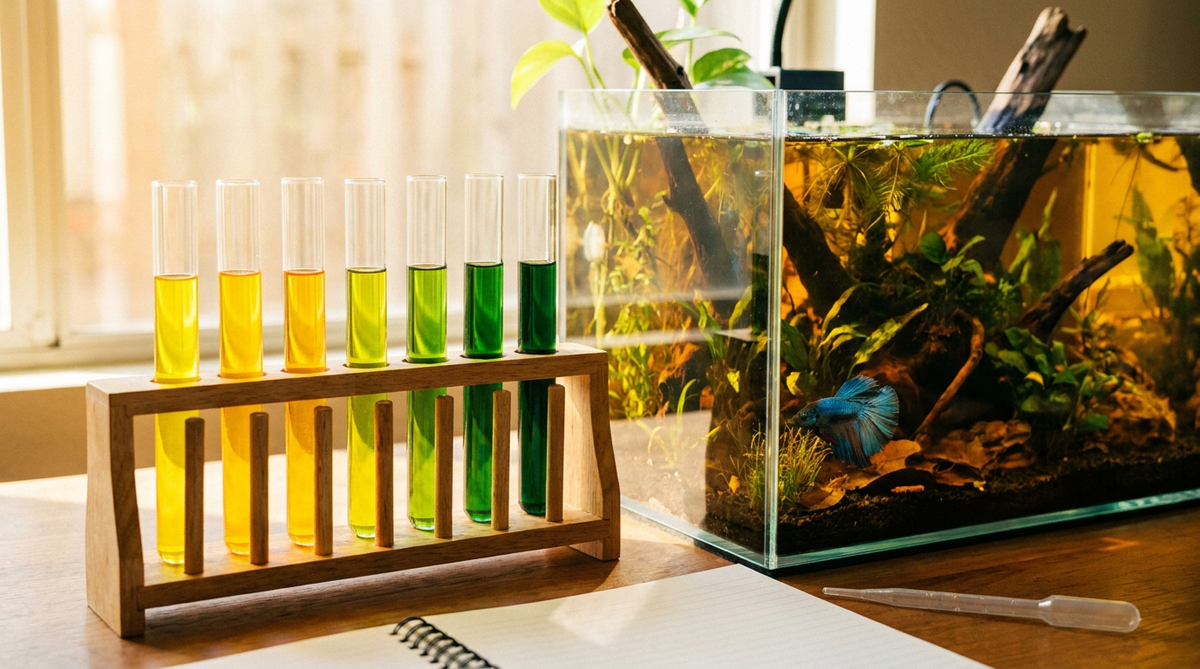
How to Lower pH in a Betta Tank (and Why You Usually Should Not)
Updated October 2026
Betta keepers ask about lowering pH. Wild bettas live in soft, acidic blackwater, which is where the instinct comes from. But the bettas in shops are dozens of generations removed from that, and a stable pH of 7.4 will outperform an unstable 6.8 every single time. This is what pH actually does to a betta, what safely moves it, and the scenarios where chasing a number kills fish.
What pH stability means to a fish
A betta tolerates a wide pH range if it stays put. Fish osmoregulation adapts to the water it lives in; what damages them is the swing, not the value. A fish moved from pH 7.6 to 7.0 over an afternoon goes through more physiological stress than a fish kept at 7.6 for its whole life. The practical target for a tank is so not “6.5” or “7.0”. it’s “whatever comes out of your tap, held constant”. Test your tap water, dechlorinated and aged 24 hours, and if it lands anywhere between 6.5 and 8.0 you’re already in the safe zone.
The nitrogen cycle drags pH down on its own
Every mature tank acidifies slowly. The biological filter produces hydrogen ions as ammonia converts to nitrate, and humic substances from wood and botanicals buffer the water toward acidic. This is why the common failure mode looks like this: a keeper fights to hold 7.2 in a new tank, adds pH-down products weekly, and then one water change of neutral tap water drops the tank back up by half a point in an hour. That swing, not the number, is what shreds fins and dulls colour. If you want a lower pH, let the tank do it and stop interfering: add catappa leaves, keep the stocking light, and change smaller volumes of water more often.
What actually lowers pH, ranked by how much it deserves a place in your tank
Indian almond leaves and other botanicals. The honest option. Catappa releases humic and tannic acids gently, buffers toward roughly 6.5 to 7.0 depending on your starting carbonate hardness, and can’t crash a tank because the release is slow and self-limiting. Two to three leaves per 40 litres is a normal dose; replace them every two to three weeks as they break down. The water goes tea-coloured, which is the point, not a problem.
Reverse osmosis water. The precise option. RO strips everything, then you rebuild with a remineraliser to hit a target. it’s the only repeatable way to reach true blackwater parameters in a hard-water area. The cost is discipline: RO has zero buffering, so parameters move fast and a missed water change bites harder. Not worth it for a shop-bought betta.
Peat in the filter. Works, and old-school. Expect a 0.5 to 1.0 point drop in moderately hard water. It stains heavily and needs replacing every few months.
Chemical pH-down liquids. Almost never justified. They add acid without touching carbonate hardness, so the KH eats the acid, the pH snaps back, and the cycle repeats until one dose finally overwhelms the buffer and the pH dives overnight. Fish die at 5:00 a.m. And the keeper posts a photo asking what went wrong.
KH is the number that actually decides this
Carbonate hardness is what resists pH change. Test it before changing anything.
- KH above about 8 dKH: your water resists acidification hard. Botanicals will tint the water and do very little to the pH. Either accept your tap value or use RO; chemical adjusters just fight the buffer.
- KH 4 to 8 dKH: botanicals and peat can move you down half a point or so over weeks. Good middle ground.
- KH under 3 dKH: your pH moves on its own. don’t add acids at all. Here the risk is a pH crash, where the buffer runs out and the pH falls several points during a skip of water changes.
Those KH bands matter.
When lowering pH is genuinely the right call
Three situations justify the effort. Breeding wild-type bettas, where softer acidic water triggers spawning behaviour. Keeping caridina shrimp, which genuinely need soft acidic water to thrive and often share a tank with a betta. And rehoming a wild-caught fish, which needs a proper acclimation and a blackwater setup from day one. For everything else, a shop betta in aged, dechlorinated tap water with leaves for cover and tannins will live its full four to five years.
The test that settles whether you should act
Before you buy any product, run this: test pH and KH straight from the tap after 24 hours of resting, then test the tank the same moment of day one week later. If the two numbers differ by more than 0.3, your problem is instability and the fix is smaller, more frequent water changes, not a bottle. If they’re identical and stable, your betta is fine and the pH conversation is finished. Stability is the whole game; the people losing fish to pH are almost never the ones with hard tap water.
Want the full run-down on tannin dosing? See the catappa leaves guide, and start with the betta tank setup guide if the tank isn’t cycled yet.
Acclimation matters. A betta in a cup from the shop is sitting in whatever pH that shop ran, often 7.5 or higher. Float the bag for temperature, then add tank water to the bag in halves over 45 minutes before releasing. don’t chase an exact decimal on day one; let the fish tell you the water works by eating, looking at and building a bubble nest within the first week. Those three behaviours are a better chemistry report than any test kit.
Keep reading
 Small Fish Tank: Sizes Under 10 Gallons Compared and Which Ones Are Not a Trap
 Best Aquarium Fish for Beginners: 9 Species That Forgive Week-One Mistakes