Best Aquascaping Tools
Updated August 2026
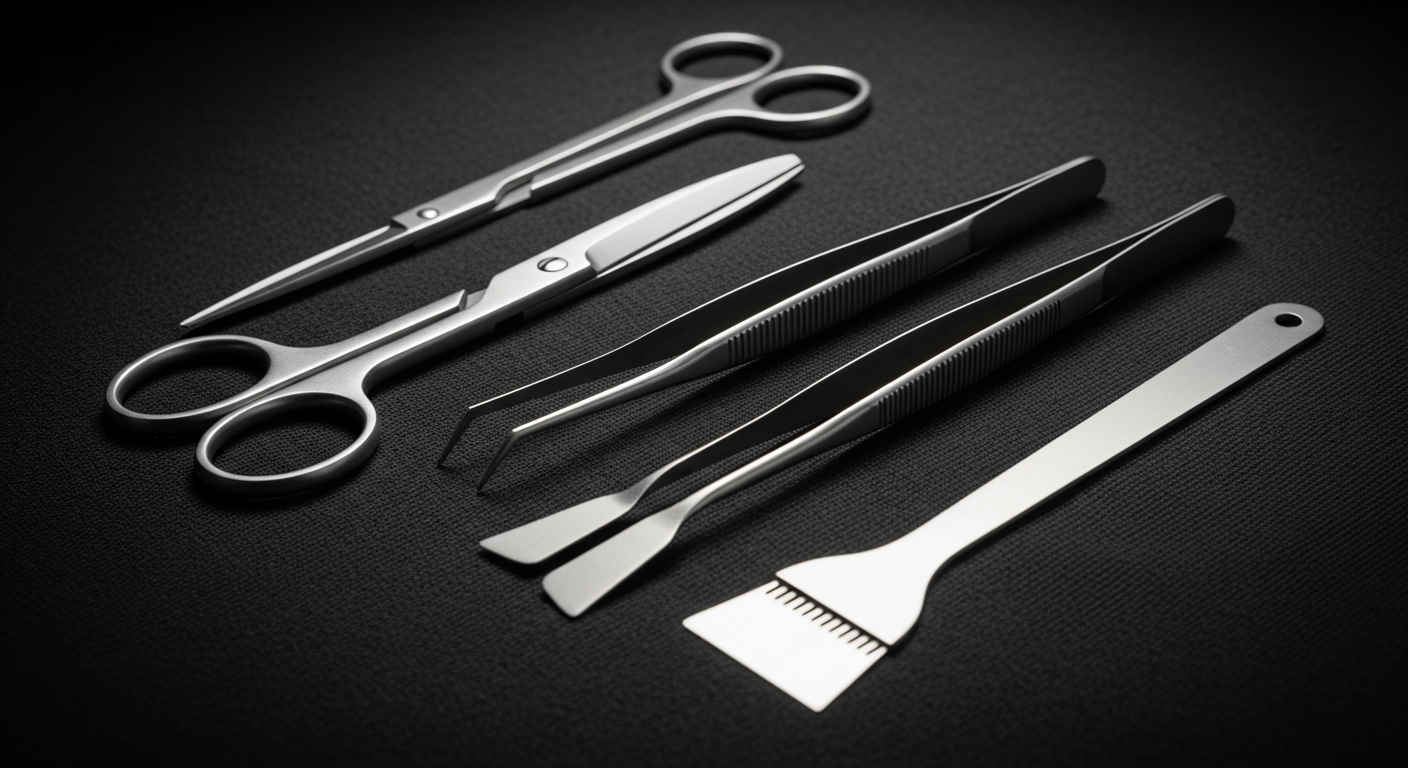
Most tool kits sold as “complete aquascaping sets” bundle four or five implements that serve the same function with different handle lengths. You end up with redundancy, not coverage. The smarter approach is to understand what each tool category does, then buy individual pieces matched to your tank depth and the type of plants you grow.
This guide covers every tool type, when to use it, what to look for in stainless steel quality, and how to build your own kit for far less than a pre-packaged bundle. If you are still figuring out what kind of layout you want to build, the aquascaping for beginners guide is worth reading first.
Aquascaping Scissors: Straight vs Curved and When Each Wins
Scissors are the tool you will reach for most often. The distinction between straight scissors and curved scissors is not cosmetic; they solve different trimming problems.
Straight scissors work for direct, perpendicular cuts: topping stem plants, pruning moss carpets along a hard line, trimming emergent growth at the waterline. The blade meets the stem at a predictable angle you can see clearly from outside the tank.
Curved scissors let you cut sideways or at an angle without your hand crossing the field of view. They are the right choice for reaching under plant canopies, shaping the contours of a foreground carpet like Hemianthus callitrichoides, or trimming near hardscape where a straight blade would gouge substrate. The curve does the geometric work for you.
A tank under 20 gallons usually runs fine with straight scissors alone. Once your tank hits 24 inches depth or you are growing a foreground carpet, curved scissors earn their spot. For a scaped nano setup, the best nano tanks for aquascaping roundup covers which tank dimensions most affect how long your scissors need to be.
On blade length: most aquascaping scissors run 5.5 to 6.7 inches overall. That works for tanks up to around 18 inches deep. For deeper tanks (24 inches or more), look for a blade length of at least 4 inches so you reach the substrate without submerging your hand past the wrist.
Material matters more here than anywhere else in the tool kit. Budget scissors use carbon steel that rusts after a few weeks in a humid environment. Look for stainless steel that specifies surgical-grade (420 or 440 series); this steel holds an edge and resists corrosion even with regular submersion. Wipe blades dry after each session anyway. Rust is almost always a drying failure, not a steel failure.
Tannin Lab earns a commission on qualifying purchases through the Amazon links on this page, at no extra cost to you. Picks are chosen on performance and suitability, not on commission.
Tweezers: Choosing Length by Tank Depth
Aquascaping tweezers are long, spring-loaded, and tip-precise. They do two distinct jobs: planting individual stems and foreground plants into substrate, and arranging small hardscape elements or botanical pieces without disturbing adjacent plants.
Straight tweezers handle most planting tasks. You push the tip into substrate, release the stem, and withdraw cleanly. The key variable is length relative to tank depth. As a working rule: your tweezers should be at least 2 to 3 inches longer than your tank’s water depth so you can plant at the substrate level with your elbow clear of the water surface.
For tanks up to 14 inches deep, 10-inch tweezers work. Tanks in the 16 to 20-inch range usually call for 12-inch tweezers. A 24-inch-deep aquascape calls for at least 14 to 16 inches of tool length; shorter tweezers force you to submerge your arm past the elbow, and you lose fine motor control instantly.
Curved tweezers are useful when you need to plant in tight spots, around the base of rocks, or inside dense foreground areas where a straight tip would crush neighboring plants on the way in. They are a secondary tool, not a starting point.
Same rule on material as scissors: stainless steel only, and verify the spring tension before buying. Weak spring tension means the tips splay open the moment you release grip pressure, which tears roots instead of planting them. Squeeze the tweezers and check that the tips realign precisely at the tip ends; any lateral offset indicates poor manufacturing tolerances.
Spatula and Sand Flattener: Substrate Control
A spatula or sand flattener is the least glamorous tool in the kit and probably the most underestimated. Its job is creating and maintaining precise substrate slopes, smoothing sand foregrounds without finger drag marks, and repositioning substrate without disturbing plant roots.
Most quality spatulas combine a flat paddle on one end for broad smoothing and a pointed scoop on the other for moving small volumes of substrate to a precise location. This two-in-one design covers the majority of use cases.
You need one if you are working with a sloped substrate design (substrate graded from front to back is standard in Nature Aquarium style), building an Iwagumi layout where sand foreground precision is visible from every angle, or refilling substrate around established plant roots after a partial hardscape adjustment. The Iwagumi style in particular demands very clean substrate work; the Iwagumi for beginners guide explains why the foreground void is where most layouts succeed or fail.
Look for a total length of at least 11 inches so the handle clears the tank rim with the paddle at substrate level. Stainless steel again; a plastic spatula will flex and lose precision when you try to apply any lateral force to compact or grade substrate.
Algae Scrapers: Glass vs Acrylic and Blade Options
An algae scraper is maintenance gear, not aquascaping gear, but every planted tank grows algae on glass surfaces, and hand-wiping with a cloth or sponge leaves streaks and misses corners. A proper scraper saves glass clarity and saves time.
The critical variable here is your tank material. Glass tanks accept a stainless steel blade without damage; steel blades cut through spot algae and coralline algae growth cleanly in one pass. Acrylic tanks scratch severely with metal blades; use a plastic or felt-faced scraper exclusively.
Long-handle scrapers with a blade at the end work for deep tanks and tall sided setups. Handheld scraper pads work fine for shallow or nano tanks. If you own glass and want the most effective single tool, a retractable-blade long handle scraper handles everything from daily surface film to weekly glass cleaning without swapping tools.
Starter Kit Essentials
Building your first aquascaping tool kit? Buy these four items before anything else: straight scissors (the tool you use every single trim session), spring tweezers sized for your tank depth, a two-ended spatula, and a glass-safe algae scraper. Curved scissors and long tweezers come when your first layout is running and you know where your trimming limitations are. A pre-packaged kit almost never gets this combination right.
Aquascaping Tools Compared: Purpose, Type, and When You Need Each
| Tool | Type | Primary Purpose | When You Need It |
|---|---|---|---|
| Straight scissors | Trimming | Trimming stem plants and moss vertically | Every tank, every trim session |
| Curved scissors | Trimming | Shaping carpets, reaching under canopies | Tanks with foreground carpets or dense mid-ground |
| Straight tweezers | Planting | Planting stems and foreground plants into substrate | Every planted tank; length matched to depth |
| Curved tweezers | Planting | Planting in tight spaces around rocks or driftwood | Complex hardscape layouts with tight planting zones |
| Spatula / sand flattener | Substrate | Grading substrate slope, smoothing foreground sand | Any sloped substrate design or Iwagumi-style layout |
| Algae scraper | Maintenance | Removing algae from glass or acrylic surfaces | Every tank with any glass-facing algae growth |
Prices move, and stock does too. Each of these opens the product page on Amazon in a new tab.
Pre-Packaged Kit vs Individual Tools: The Honest Trade-Off
Pre-packaged aquascaping kits are convenient for a reason: one purchase, one shipping cost, all items arrive together. The problem is that most kits are assembled around a price point, not around a logical tool set. You often get three types of tweezers (two of which you will never use), no sand spatula, and scissors that are too short for any tank deeper than 14 inches.
Buying individual tools costs slightly more upfront if you price each item separately, but you end up with pieces that actually fit your tank. The math usually works out close to even once you factor in what you would discard from a kit.
The exception: entry-level kits from established aquascaping brands sometimes bundle four genuinely useful items at a lower combined price than buying each separately. Check the individual item lengths against your tank depth before buying any kit. A 10-inch tweezer set designed for shallow nano tanks will not serve a 24-inch deep aquascape regardless of how good the steel is.
Stainless Steel Grades and Why They Matter
Not all stainless steel behaves the same in an aquarium environment. The two grades you will encounter in aquascaping tools are 410 stainless (magnetic, moderate corrosion resistance, common in budget tools) and 420 or 440 stainless (higher carbon content, harder edge, better corrosion resistance at equivalent surface finish).
For scissors, a harder steel means the blade holds its edge through hundreds of trimming sessions before needing sharpening. For tweezers, hardness affects tip precision: softer steel tips wear and splay faster. This is the quality gap between a $12 tool set and a $35 individual piece.
You do not need to verify the steel grade number on every purchase. A practical proxy: hold the scissors up to light and look at the blade finish. Brushed or polished finishes that show uniform texture usually indicate better steel processing. Pitted or uneven finishes on new tools are a red flag regardless of what the listing claims.
Tool Maintenance: Drying and Storage
Stainless steel rusts when left wet. This sounds obvious, but most aquascaping tool failures come from leaving tools on the tank rim or storing them in a drawer without drying. A five-second wipe with a dry cloth after each session eliminates virtually all corrosion risk.
For scissors, occasionally open the blades fully and wipe the hinge pivot point. Mineral deposits from hard water accumulate there and stiffen the action over time. A small amount of food-grade mineral oil on the pivot once every few months keeps action smooth without introducing chemicals that could enter your tank.
Store tools flat or in a roll case. Standing tweezers tip-up in a jar is convenient but puts the most precise part of the tool at risk of being knocked and bent. Tip damage on tweezers is usually permanent.
Frequently Asked Questions
Do I need both straight and curved scissors, or will one pair cover everything?
One pair of straight scissors handles the majority of trimming tasks in most planted tanks. Curved scissors become worth adding when you grow a foreground carpet species like HC Cuba or dense mid-ground plants where you need to cut sideways without your hand blocking your line of sight. If your tank is a simple stem-plant setup, straight scissors alone will serve you fine for months.
How do I know what tweezer length I need for my tank?
Add 2 to 3 inches to your tank’s water depth. A 14-inch-deep tank needs at least 16 to 17-inch tweezers for comfortable planting without submerging your elbow. Most entry-level sets come with 10-inch tweezers, which work for tanks up to around 12 inches of water depth. Longer is rarely a problem; shorter is always a limitation.
Are aquascaping tools safe to use with fish and shrimp in the tank?
Yes, provided the tools are clean stainless steel with no rust, oil, or residue on the blades. Move slowly when working near fish and shrimp; sudden movements stress them. New tools should be rinsed thoroughly before first use to remove any factory oils or packaging residue. Never use tools that have been exposed to cleaning chemicals, soap, or lubricants; even trace amounts can harm shrimp in particular.
Marcus Chen
Aquarist & Founder, TanninLab
Marcus has been keeping planted tanks for 14 years. He tests every product recommendation in his own tanks and publishes the raw data.
Last updated: August 2026