Mold on Botanicals: Is It Safe or Should You Remove It
Updated August 2026
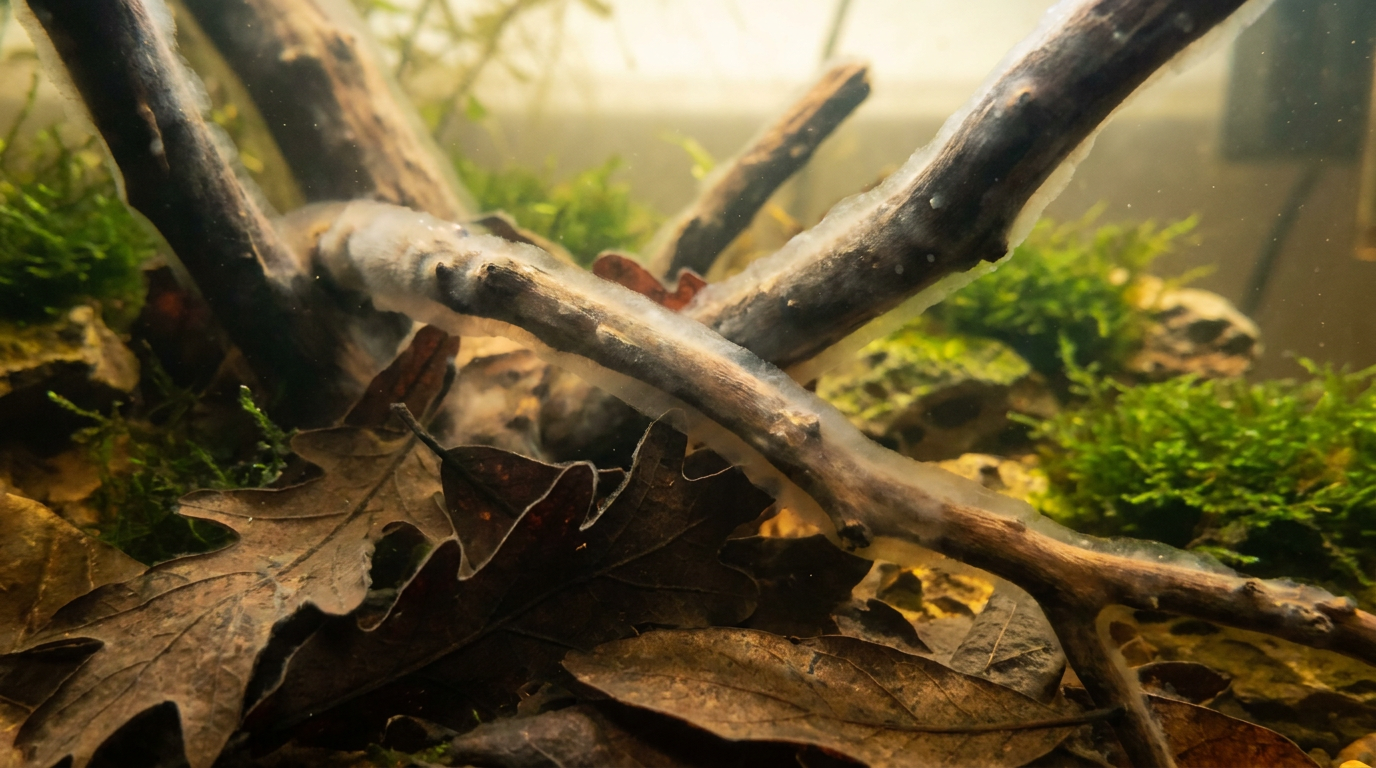
That white fuzz on your new driftwood or leaves is almost always harmless biofilm, not true mold. It is a bloom of saprophytic bacteria and fungi feeding on the sugars and lignin the wood leaks during its first weeks underwater.
Leave it alone. In a cycled tank it peaks around week two and fades on its own once the easy sugars are gone.
How to tell fuzz from a real problem
Harmless growth is white or pale grey, cottony or slimy, and stays on wood, seed pods, and leaf edges. It wipes off with a finger and returns within a day.
Worry when the growth is grey-green and slick like paint, smells sour or sulfurous, or spreads across the substrate in sheets. That points at trapped decay under the hardscape rather than normal colonization.
Cotton-like tufts growing on a fish, usually on fins or an old wound, are a different issue entirely and need treatment rather than patience.
Why some botanicals bloom harder
Sugar content drives it. Cholla wood, coco curls, and softer seed pods bloom hardest, while dense manzanita and boiled catappa leaves barely bloom at all.
Boiling cuts the bloom down but never removes it completely, and that is fine. How to prep botanicals covers the soak and boil times that keep week one manageable.
What to do about it
Do nothing for two weeks and watch. If the coating bothers you visually, siphon it during a water change or swab the wood with a soft toothbrush.
Do not dose antifungals or peroxide into a stocked blackwater tank. You will damage your biological filter and your invertebrates before you touch the fuzz.
The fastest real fix is a cleanup crew. Amano shrimp, Neocaridina, and nerite snails graze the coating flat within days, and amano shrimp care lists the parameters they want before you add them.
When the wood keeps blooming for months
Repeat blooms usually mean the wood is still leaching heavily, or your flow has left dead spots around the hardscape. Aim a filter output across the wood and check your tannin load, since heavy leaching and heavy fuzz travel together.
Driftwood tannins covers how far to let that run before you start pulling water.
Persistent growth in an unstocked tank is also normal. Add grazers before you add fish and the problem tends to solve itself.
Marcus Chen
Aquarist & Founder, TanninLab
Marcus has been keeping planted tanks for 14 years. He tests every product recommendation in his own tanks and publishes the raw data.
Last updated: August 2026