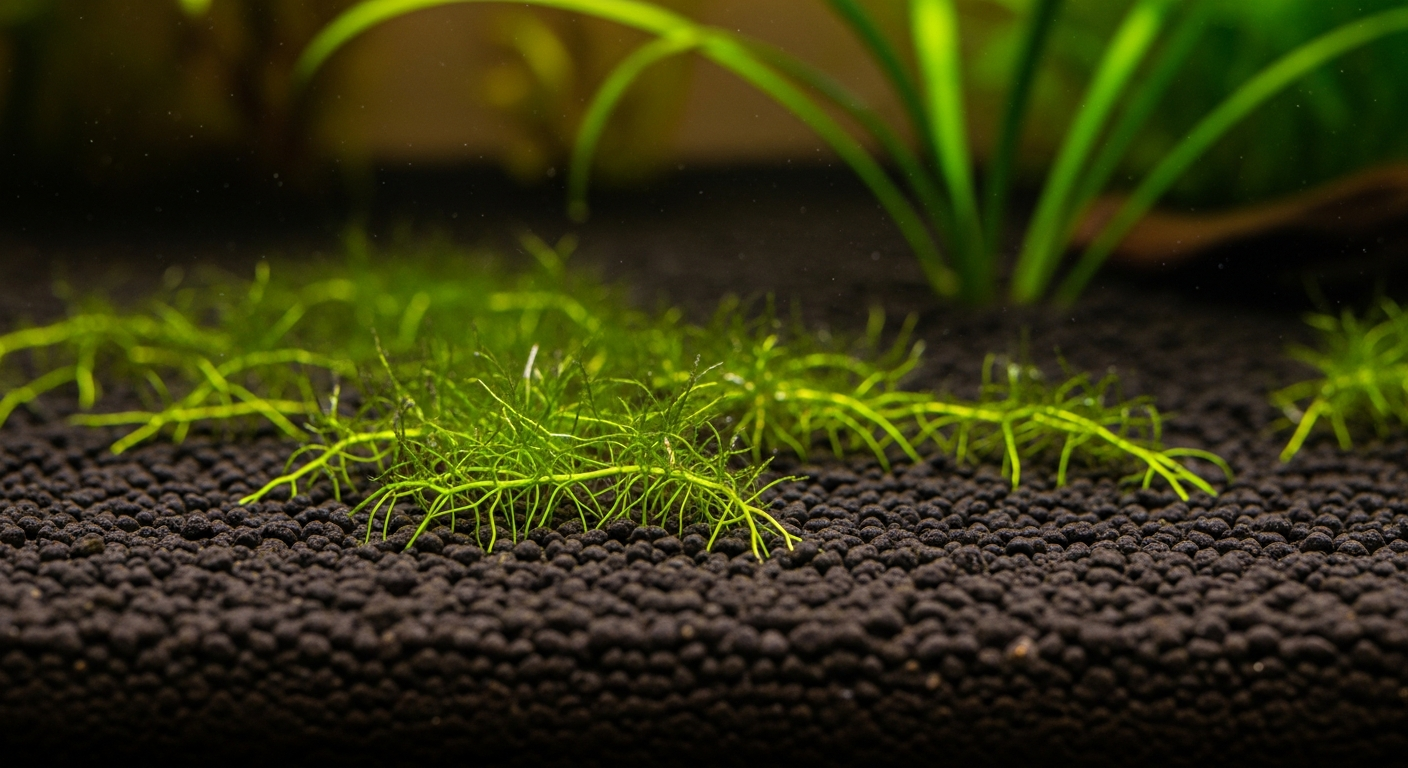
Best Substrate for a Planted Tank
Updated August 2026
Substrate choice is the most consequential decision you make when setting up a planted tank, and it gets the least attention. Light and CO2 get all the debate, yet plants sit in their substrate every day, pulling water, nutrients, and physical support from it continuously.
Get this wrong and you spend months wondering why your carpeting plants stall or your stem plants look pale two centimeters above the gravel line.
This guide covers the four substrate types that actually matter for planted tanks, how to choose between them based on your setup, and the details most buying guides skip: depth, capping ratios, shrimp compatibility, and what happens after year two when a substrate starts breaking down.
Tannin Lab earns a commission on qualifying purchases through the Amazon links on this page, at no extra cost to you. Picks are chosen on performance and suitability, not on commission.
What Substrate Actually Does in a Planted Tank
Substrate performs three jobs simultaneously. First, it anchors plants physically so they can develop root systems without being pulled loose by flow or fish activity. Second, it acts as a nutrient reservoir, releasing nitrogen, phosphorus, potassium, and trace minerals directly to root tissue.
Third, it hosts the beneficial bacterial colonies that process ammonia in the substrate zone, separate from the water column cycle.
Inert substrates handle the first job only. Active substrates handle all three.
That distinction matters most for root-feeding plants like Echinodorus (Amazon swords), Cryptocoryne species, and carpeting plants such as Hemianthus callitrichoides (HC Cuba). These plants pull the majority of their nutrition from substrate, not the water column, so a nutrient-poor substrate puts a hard ceiling on their growth.
Column feeders like Vallisneria, Ceratophyllum, and floating plants are far less picky about substrate. If your tank is primarily these species, inert gravel with liquid fertilization is genuinely sufficient.
Prices move, and stock does too. Each of these opens the product page on Amazon in a new tab.
Aquasoil vs. Gravel: The Core Tradeoff
Aquasoil is fired clay or volcanic ash processed to carry a high cation exchange capacity (CEC). It physically holds nutrient ions and releases them to roots on demand, rather than letting them wash out into the water column.
It also lowers and buffers pH toward the acidic range, typically landing between 6.5 and 7.0 when used at depth, which suits most South American and Southeast Asian plant species.
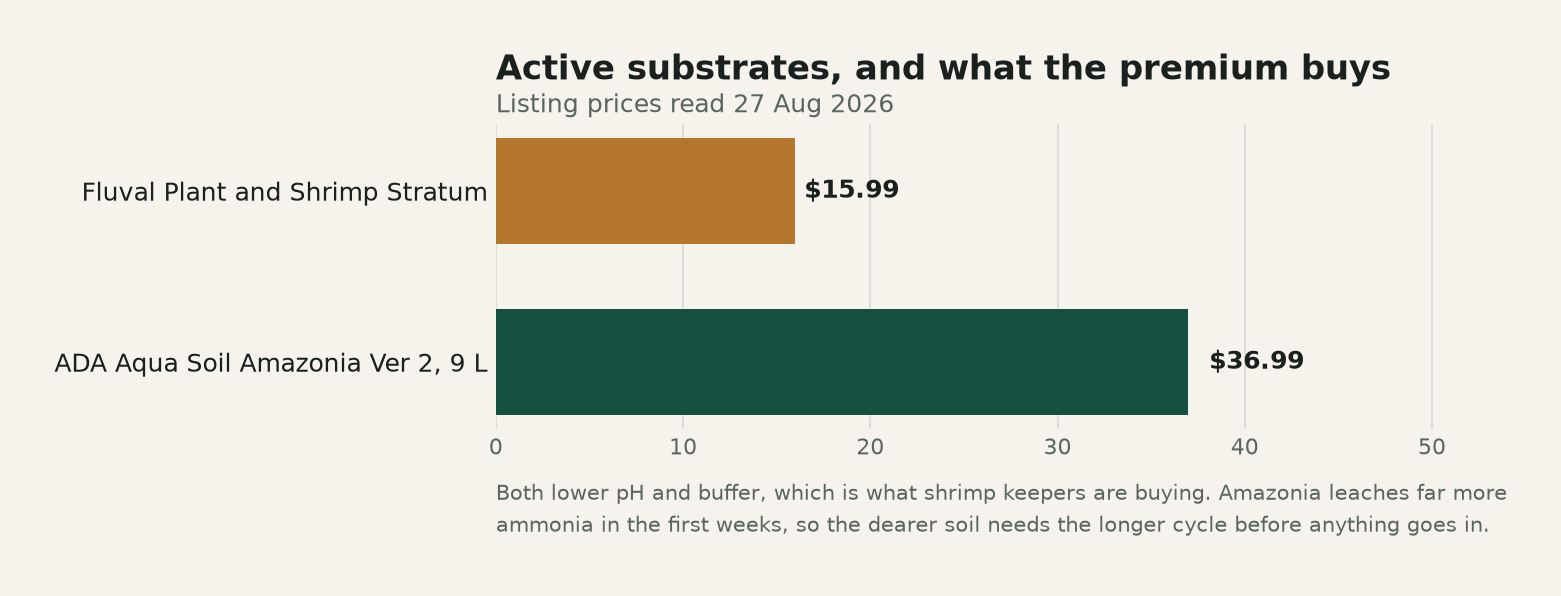
The tradeoff: aquasoil costs significantly more than gravel, has a finite lifespan (typically two to four years before the granule structure degrades and nutrient capacity exhausts), and causes an ammonia spike during the first two to four weeks as the substrate leaches. New tanks on aquasoil require a proper cycling period and frequent water changes before fish are introduced.
Inert gravel and sand contain no nutrients and do not affect water chemistry. That stability is an actual advantage for community tanks with livebearers or rift lake cichlids that need hard, alkaline water. Inert substrates also last indefinitely and are easier to vacuum without disturbing a nutrient layer.
The limitation is clear: root-feeding plants on inert substrate need regular root tab supplementation, often every four to six weeks, to match what aquasoil provides passively.
If you want the planted-tank look without the aquasoil cost and leaching period, read the capped substrate section below before deciding.
Depth Matters More Than Most Guides Admit
Aquasoil needs a minimum of 6 cm (about 2.5 inches) to buffer pH effectively and support deep root development. At 3 cm it still feeds roots but loses much of its buffering capacity. For carpeting plants specifically, a sloped bed of 6 cm at the back tapering to 4 cm at the front gives roots room to spread horizontally while keeping the front glass clear. For large stem plants and swords, 8 to 10 cm at the rear is worth the extra cost. Thin substrates are one of the most common reasons planted tanks underperform relative to expectations.
The Four Substrate Types: Full Comparison
| Substrate Type | Nutrient Supply | pH Effect | Approximate Cost | Usable Lifespan | Best For |
|---|---|---|---|---|---|
| Aquasoil (e.g., ADA Amazonia, Fluval Stratum, UNS Controsoil) | High; slow-release macros + trace minerals for 12-18 months, then declining | Lowers to 6.5-7.0; buffers acidic | High ($1.50-$3.00/liter) | 2-4 years before re-set or supplementation needed | Dutch-style, Nature Aquarium, high-tech CO2 planted tanks, blackwater setups |
| Inert Gravel / Sand (pool filter sand, quartz gravel, blasting sand) | None; requires root tabs or liquid ferts to feed root feeders | Neutral; no effect on pH | Low ($0.20-$0.60/liter) | Indefinite | Community tanks, low-tech setups, rift lake and hard-water species, budget builds |
| Capped Substrate (nutrient base layer topped with inert sand or fine gravel) | High at root zone; base layer feeds plants, cap prevents leaching into water column | Depends on base layer; cap moderates surface buffering | Medium ($0.50-$1.20/liter total for both layers) | 4-6 years; base layer exhausts slowly, top layer is permanent | Budget planted tanks, tanks with substrate-disturbing fish, long-term builds |
| Clay-Based Substrate (Seachem Flourite, Eco-Complete) | Medium; iron-rich, good for root color and growth, lower nitrogen than aquasoil | Mostly neutral; slight variance by product | Medium ($0.80-$1.50/liter) | Very long; structure does not degrade like aquasoil | Low-to-medium tech planted tanks, long-term setups where re-setting is undesirable |
Why Capped Substrates Deserve More Credit
A capped substrate is exactly what it sounds like: a nutrient-rich base layer, typically aquasoil or a DIY mix of organic matter and clay, covered with 1 to 2 cm of inert sand or fine gravel.
The cap does two things. It prevents the nutrient-rich base from clouding the water column during planting and maintenance, and it slows the exhaustion of the base layer by reducing direct water contact.
The practical result is a substrate that feeds plants as effectively as bare aquasoil in year one but lasts considerably longer before nutrients are fully depleted. You also spend less, because the cheap inert layer makes up the visible top portion and you only need aquasoil or a nutrient mix for the bottom 4 to 6 cm.
The one limitation is fine-rooted carpeting plants, which need to push through the cap. For HC Cuba or Glossostigma elatinoides, keep the cap thin (1 cm maximum) and use fine sand rather than coarse gravel so roots penetrate without resistance. For everything else including swords, crypts, and stem plants, a standard 2 cm cap poses no problem.
For a complete breakdown of how substrate fits into your overall setup plan, the planted tank setup guide covers substrate depth, hardscape placement, and plant selection as an integrated workflow.
Nutrient-Rich vs. Inert: How to Choose
The decision comes down to three factors: your target plant species, your water chemistry goals, and how frequently you are willing to maintain the substrate over time.
Choose a nutrient-rich substrate if you are growing heavy root feeders, running CO2 injection, or targeting a high-tech planted tank aesthetic. The initial ammonia leach and higher cost are one-time commitments. Every month after that, you get passive root nutrition without the labor of placing root tabs throughout the tank.
Choose inert substrate if your tank fish require hard, alkaline water; if you keep substrate-digging fish like large cichlids that would uproot a nutrient base layer; or if you want the lowest possible setup cost. Account for ongoing root tab costs in your budget. Liquid fertilizers alone, such as the options covered in the root tabs vs. liquid fertilizers comparison, cannot fully substitute for root-zone nutrition in demanding plant species.
Choose clay-based substrate if you want a middle path: better than inert, permanent structure that will not collapse over years, and iron-rich enough to support most planted tank species without the pH swings of aquasoil. The tradeoff is that clay substrates are not quite as nutrient-dense as quality aquasoil in the first year.
Shrimp Safety and Substrate Selection
Dwarf shrimp, particularly Neocaridina and Caridina species, are sensitive to substrate choices in ways fish are not. The main concern is buffering.
Neocaridina (cherry shrimp, blue velvet, etc.) thrive in neutral to slightly alkaline water, pH 7.0 to 7.8 with moderate hardness. Aquasoil will pull their pH down and soften the water, which stresses them over time. For Neocaridina tanks, inert substrate or clay-based substrate is the safer choice.
Caridina species (crystal red, Taiwan bee, etc.) are the opposite. They prefer soft, acidic water, pH 5.8 to 6.8, which is exactly what aquasoil provides. Aquasoil is the standard substrate in serious Caridina breeding setups for this reason. It removes the need for RO water remineralization to hit low pH targets.
If you are keeping a mixed community with shrimp, test your tap water pH first and choose accordingly. Aquasoil in a tank with tap water above pH 7.5 will struggle to buffer down and may exhaust its buffering capacity faster than usual.
Substrate Lifespan and What Happens After Year Two
Aquasoil does not last forever. The granule structure eventually softens and compacts, which reduces water circulation through the root zone and can create anaerobic pockets. The nutrient content depletes as plants absorb it over time.
Most aquasoil products are realistically effective for two to four years in a heavily planted, CO2-injected tank. Lightly planted, low-tech tanks may get five years or more before seeing a real decline.
Signs your aquasoil is aging: plant growth slowing despite adequate lighting and CO2, unusual algae patterns along the substrate surface, and the substrate visibly compacting or turning muddy in disturbed areas.
You have two options at that point. The first is a full re-set: remove everything, replace the substrate, and restart. This is disruptive but thorough. The second is supplementation with root tabs placed every 4 to 6 weeks and increased liquid fertilization to compensate for what the substrate is no longer providing.
Clay-based substrates and capped setups tend to age more gracefully because the base layer exhausts slowly and the inert cap maintains structure.
If your planted tank includes high-output LED lighting, the substrate’s role in driving growth becomes even more critical as light intensity scales up. The best LED lights for planted tanks guide includes substrate pairing notes for high-tech builds.
Frequently Asked Questions
- Can you use regular gravel for a planted tank?
- Yes, with limitations. Regular gravel is inert, which means it provides zero nutrients to roots. For low-tech tanks with column-feeding plants like Vallisneria or floating species, gravel paired with liquid fertilization works fine. For root-heavy plants like swords and crypts, you will need to add root tabs every four to six weeks to compensate for the lack of substrate nutrition. Over time, this costs more in labor and consumables than starting with aquasoil.
- How deep should planted tank substrate be?
- A minimum of 6 cm (2.5 inches) for nutrient-active substrates, and no less than 5 cm for inert substrates that will receive root tabs. For large stem plants and swords in the rear of the tank, 8 to 10 cm is better. Thin substrate beds, commonly 2 to 3 cm, restrict root development and reduce the buffering effect of active soils. Slope the substrate higher at the back and lower at the front for visual depth and better root room where you need it.
- Does aquasoil work for shrimp tanks?
- It depends on the species. Caridina shrimp (crystal reds, Taiwan bees) thrive on aquasoil because it softens water and lowers pH to their preferred 5.8 to 6.8 range. Neocaridina shrimp (cherry shrimp) prefer neutral to slightly alkaline water and do better on inert or clay-based substrate. Using aquasoil in a Neocaridina tank risks dropping pH below their comfort zone, particularly when the substrate is fresh and buffering is strongest.
Marcus Chen
Aquarist & Founder, TanninLab
Marcus has been keeping planted tanks for 14 years. He tests every product recommendation in his own tanks and publishes the raw data.
Last updated: August 2026