Cherry Shrimp Molting: How Often It Happens and What a Failed Molt Means
Updated October 2026
Molting is the single most important event in a cherry shrimp’s life, and the most common reason keepers find a dead shrimp behind the filter with no warning. A Neocaridina davidi sheds its shell every few weeks as an adult and far more often as a juvenile. The old shell holds everything: the outer layer of every leg, the shell over the gills, the lining of parts of the gut. When the molt goes wrong, the shrimp dies inside it. When it goes right, the animal grows, and the shell left behind becomes a free calcium meal the colony will pick at for days.
How often cherry shrimp actually molt
Frequency depends mostly on age, temperature and food:
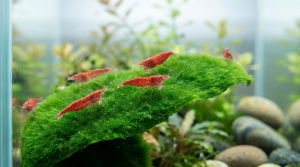
- Juveniles under 1 cm molt every 3 to 7 days. They grow fast and shed constantly, which is why breeding tanks with lots of tiny shrimp seem to always have white husks on the moss.
- Adult females molt roughly every 3 to 4 weeks at 24 degrees C. Above 26 degrees metabolism speeds up and the cycle shortens, but hot water also stresses them, so the net effect is worse, not better.
- Older shrimp past breeding age molt less and less, and a very old female that stops molting for two months or more is usually in her last stretch.
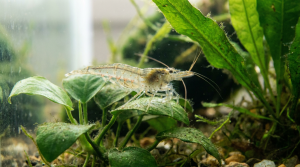
The molt itself takes under a minute. You will almost never see it happen. What you see the next morning is the intact, translucent shell lying on the substrate, often with the carapace hinged open like a little door, and a freshly soft shrimp hiding in the plants.
Leave the shell in the tank. The colony recycles the minerals from it, and freshly molted shrimp in particular eat their own cast. Pulling every molt out with tweezers is a common beginner habit that removes calcium the tank would have reused.
Why a fresh molt makes shrimp vulnerable
For 12 to 36 hours after molting, a shrimp’s new shell is soft, and it cannot defend itself or run properly. Two problems follow:
- Predator risk. Even peaceful fish will sample a soft shrimp. In a tank with bettas this matters, and the combination needs cover: dense moss, fine-rooted plants and leaf litter give a fresh molt somewhere to sit out the hardening. Our piece on shrimp compatibility in planted community tanks goes into which fish are genuinely safe and which only look it.
- Water parameter shocks. A soft shrimp takes up water and minerals through the new shell. Any sudden swing in GH, KH, temperature or TDS during the hardening window lands directly on the animal. Stability beats any target number here.
The parameters that decide whether a molt succeeds
Molting is a chemistry process, not a luck process. The shell is mostly calcium carbonate, so the shrimp needs both calcium and carbonate in the water, plus iodine and magnesium in trace amounts for the shell to form properly. The ranges that work for Neocaridina:
- GH 6 to 8, KH 2 to 6. GH carries the calcium and magnesium. Tanks below GH 4 are where failed molts concentrate.
- Temperature 21 to 25 degrees C.
- pH 6.8 to 7.6. Very acidic water dissolves the shell as it forms, which is one reason blackwater setups with low pH and low GH take more care; see how Indian almond leaves change tank water for what tannins do and do not alter.
- TDS is a proxy, not a rule. Anything from 150 to 300 works if the minerals behind the number are right. Chasing a TDS figure with random salts does nothing for the shrimp.
If you keep shrimp in soft, mineral-poor tap water, a shrimp-specific remineralizer with calcium and magnesium beats a generic GH booster, because it holds the calcium to magnesium ratio near the 3:1 the shell actually uses.
Failed molts: what you see and what it means
Most dead shrimp are dead molts. The signs, in order of how treatable they are:
- A shrimp bent into a U under a shell, dead with the molt half off. This is the classic failed molt. The cause is nearly always water: missing minerals, a swing, or a cycle that went soft over months.
- The “white ring of death”: a pale white band where the old shell split but the new one never hardened. It is a calcium and stability problem, not a disease, and it is not contagious.
- Shrimp stuck in the shell but alive, legs twitching, sometimes for hours. Some pull free. Most do not. Do not pull the shell off by hand; you will tear the soft shell under it.
- Repeat failures in one tank across weeks means the problem is the tank, not the individual. Test GH, KH and pH properly, not with strips, and log them for a few weeks before changing anything.
One change at a time
When molts fail, the instinct is to dump minerals in at once. Resist it. Raise GH by no more than 1 degree per day, on a schedule, and let a week pass before judging. Sudden mineral jumps trigger the exact molts you are trying to protect, and a shrimp pushed into an early molt in unstable water is a shrimp at maximum risk.
The tanks with the fewest failed molts are the boring ones: stable temperature, stable minerals, a bag of dried leaf litter doing slow chemistry, and no weekend projects. If your parameters sit inside the ranges above and you still see white rings, look at temperature swings and heavy metals from untreated tap water before reaching for supplements.
A colony that molts cleanly leaves shells on the glass, on the moss and in the filter intake. That is not a mess. That is a tank doing its job.