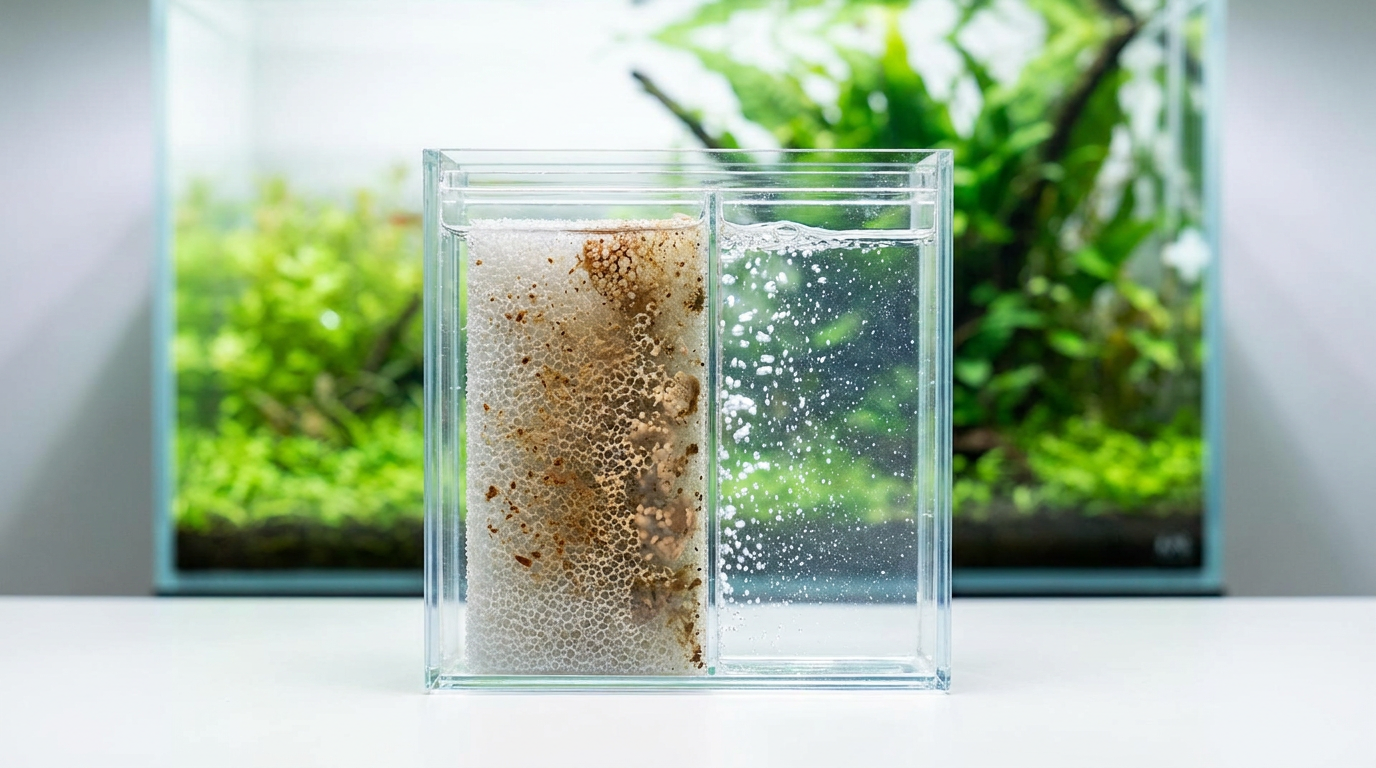
What a filter sponge actually does inside your filter
Updated September 2026
A filter sponge does two jobs inside your filter: it traps floating debris, and it gives bacteria a surface to colonize. Pore size decides which job it does better. That single spec, not the sponge shape or color, is what actually changes how your tank runs.
Pore size is the spec that matters
Sponge foam is graded by pores per linear inch, PPI. Coarse foam, roughly 10 to 15 PPI, has large open channels. It catches big particles, resists clogging, and carries a huge surface area for bacteria because water moves through it easily.
Fine foam, roughly 30 to 45 PPI, polishes the water and pulls out fine particulate that coarse foam lets through. It also clogs faster, and a clogged fine sponge starves the bacteria living deeper in the foam of oxygen. Medium foam, 20 to 30 PPI, is the default most sponge filters ship with because it balances both jobs.
Video: Aquarium Co-Op
Mechanical load and biological load pull in opposite directions
A sponge doing mostly mechanical work, catching mulm and plant debris, wants regular light rinsing so it never packs solid enough to choke your flow. A sponge doing mostly biological work wants to be left alone, because a hard rinse under tap water kills a large share of the bacteria colony living in it.
You cannot fully separate the two roles in a single sponge, which is why sponge filters built for shrimp tanks lean toward coarser foam. Shrimp tanks carry lighter bioload than fish tanks of the same size, so the filter can afford to prioritize gentle biological filtration over aggressive mechanical polishing.
A replacement schedule that follows bioload, not the calendar
| Bioload level | Example stocking | Foam grade (PPI) | Rinse frequency | Full replacement |
|---|---|---|---|---|
| Light | Shrimp-only tank, 10 to 20 gallons | 10 to 15 (coarse) | Every 4 to 6 weeks | 12 to 18 months |
| Moderate | Community tank, light stocking | 20 to 30 (medium) | Every 2 to 3 weeks | 8 to 12 months |
| Heavy | Densely stocked fish tank | 20 to 30 (medium), doubled up | Weekly to every 2 weeks | 6 to 9 months |
Rinse only in removed tank water, never tap water, since chlorine and chloramine kill the bacteria you are trying to preserve. Replace the sponge once it stays compacted and slow-draining right after a rinse, since that means the foam structure itself has broken down, not just clogged.
Sizing the schedule to your actual tank
The bioload column above only works if you know where your tank sits, and that depends on stocking, not tank volume alone. Working out how many shrimp your gallon count actually supports gives you the stocking side of that estimate before you pick a rinse interval.
Flow rate matters as much as pore size, because a sponge filter is only pulling water through the foam as fast as its air pump pushes air through the airline. An undersized or aging pump lets flow drop gradually, which makes a sponge look clogged when the real problem is an air pump that can no longer move enough air for the sponge filter it is running.
Marcus Chen
Aquarist & Founder, TanninLab
Marcus has been keeping planted tanks for 14 years. He tests every product recommendation in his own tanks and publishes the raw data.
Last updated: September 2026