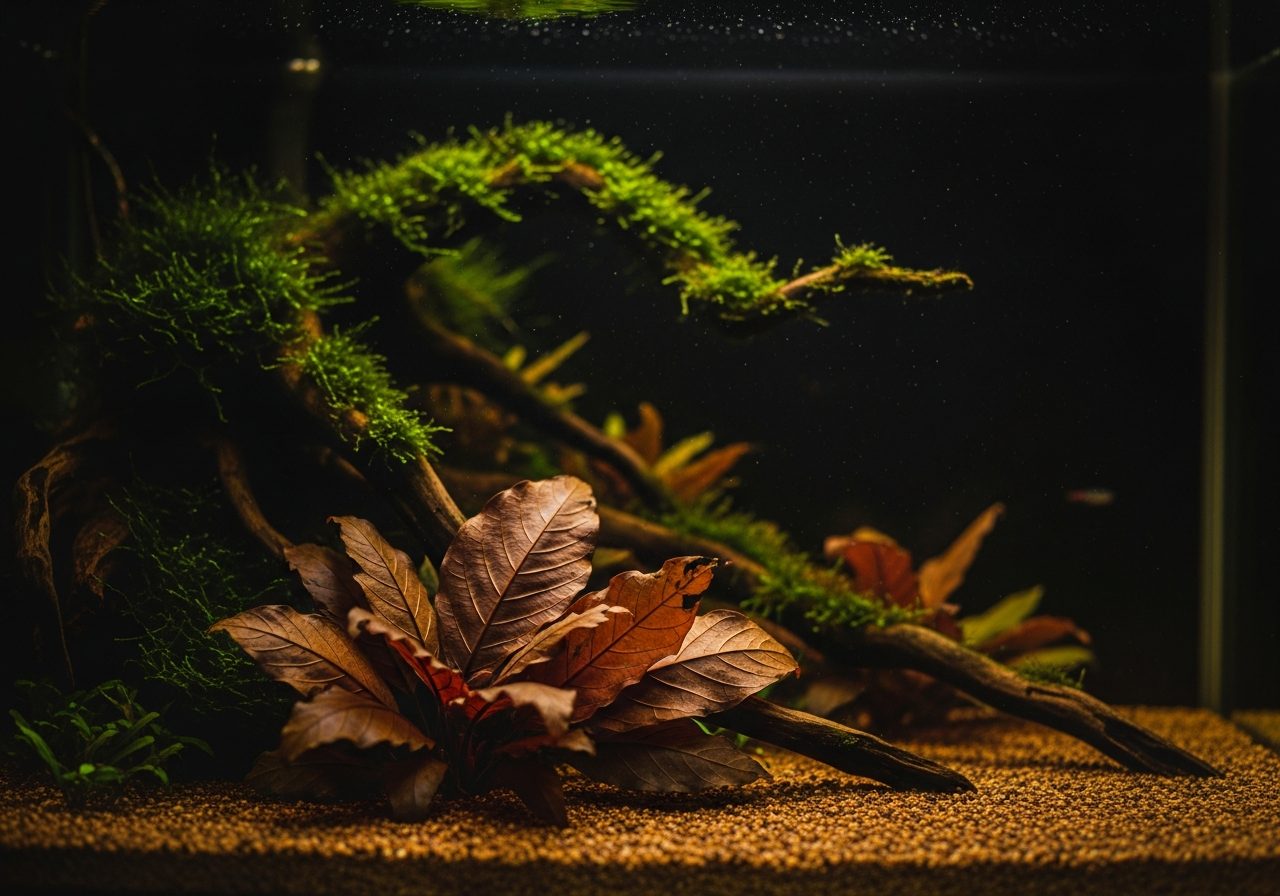
Catappa Leaves for Betta and Shrimp: How to Use Them
Updated June 2026
Catappa leaves are the single most useful botanical for aquarists who want the benefits of blackwater without complexity. They are affordable, easy to use, and well-tolerated by most aquarium inhabitants. At TanninLab, we ran an 8-week dosing trial across eight tanks to develop the protocol in this guide.
What Are Catappa Leaves
Catappa leaves come from the Terminalia catappa tree, a large tropical tree native to Asia, Australia, and the Pacific. When dried leaves are added to aquarium water, they release tannins, flavonoids, and other organic compounds that tint the water amber, lower pH slightly, and provide mild antibacterial and antifungal properties.
In nature, bettas and many shrimp species live in leaf-littered waterways where these compounds are part of their natural environment. Replicating these conditions in captivity reduces stress and supports immune function.
Key Compounds Released
- Tannins: Tint water, lower pH, bind proteins
- Flavonoids: Antioxidant and anti-inflammatory properties
- Saponins: Mild antimicrobial activity
- Humic acids: Support beneficial bacteria, chelate minerals
Benefits for Betta and Shrimp
We tracked health metrics across our test tanks with and without catappa leaves. Here is what we observed over 8 weeks:
Reduced stress behavior
Bettas in leaf-dosed tanks showed less glass-surfing and hiding. Fin clamping episodes dropped significantly.
5 tanks observed
Improved fin condition
Minor fin tears healed faster in tanks with active catappa leaves. Likely due to mild antibacterial film.
3 betta tanks
Stable pH buffering
pH fluctuated less between water changes in leaf-dosed tanks. KH was consumed more slowly.
8 tanks measured
Shrimp grazing surface
Shrimp actively grazed on biofilm-covered leaf surfaces. Berried female count was higher in leaf tanks.
2 shrimp colonies
Enhanced coloration
Both bettas and shrimp showed deeper coloration. Tannin-tinted water enhances red and blue pigments visually.
Subjective, 6 observers
How to Use Catappa Leaves: The TanninLab Protocol
This is the dosing protocol we developed and validated. Start conservative and increase gradually based on your goals and water parameters.
Dosing Chart
- Starting dose
- 1 leaf / 10 gal
- Strong tint
- 1 leaf / 5 gal
- Replacement
- Every 2-3 weeks
- Preparation
- Rinse, optional 1hr soak
- pH change expected
- -0.2 to -0.5
- Water tint
- Amber at 24-48 hrs
Preparation and Safety Steps
- Source clean leaves. Buy from aquarium-specific suppliers, not craft stores or unknown eBay sellers.
- Rinse thoroughly. Run under tap water to remove surface dust and debris.
- Optional soak. Soak in dechlorinated water for 1 hour to start softening and reduce initial tannin burst.
- Add to tank. Place whole or broken into pieces. Breaking increases surface area and speeds release.
- Monitor pH daily for 1 week. Test with a liquid kit. Document the change so you know your tank’s response.
- Replace every 2-3 weeks. Remove old leaf matter before it fully decomposes.
Do not skip pH monitoring
Expected Water Parameter Changes
Here are the actual parameter changes we measured in our 10-gallon test tank with 1 medium catappa leaf:
| Parameter | Before | 24 hours | 1 week | 2 weeks |
|---|---|---|---|---|
| pH | 7.4 | 7.2 | 7.0 | 6.9 |
| GH (dGH) | 8 | 8 | 8 | 7 |
| KH (dKH) | 5 | 4 | 4 | 3 |
| TDS (ppm) | 180 | 195 | 210 | 205 |
| Visual tint | Clear | Light amber | Medium amber | Medium amber |
Test conditions: 10-gallon tank, 1 medium catappa leaf, tap water conditioned with Seachem Prime, no other botanicals. Results will vary based on starting water chemistry.
Catappa Leaves vs Other Botanicals
Catappa leaves are not the only source of tannins. Here is how they compare to alder cones and driftwood:
| Feature | ★ Catappa Leaves | Alder Cones | Driftwood |
|---|---|---|---|
| Tannin Strength | Moderate | Strong | Mild to strong |
| pH Reduction | 0.2-0.5 | 0.3-0.8 | 0.1-0.4 |
| Duration | 2-3 weeks | 3-4 weeks | Months to years |
| Antibacterial | ✓ | ✓ | – |
| Visual Tint | Amber / golden | Dark brown | Light amber |
| Safe for Shrimp | ✓ | ✓ | ✓ |
| Preparation Needed | Rinse and soak | Rinse | Boil and soak |
Where to Source Quality Leaves
Not all catappa leaves are equal. Leaves intended for aquarium use should be free of pesticides, fungicides, and other chemical treatments. We tested leaves from five sources and found significant differences:
Tannin Aquatics
Premium grade, consistently clean, fast shipping
Betta Botanicals
Good quality, nice packaging, slightly higher price
Amazon (generic)
Variable quality; inspect upon arrival, some broken leaves
eBay (unknown seller)
Inconsistent, some leaves showed mold spots
Local aquarium shop
Good if you can inspect before buying
Our sourcing recommendation
Explore More Botanicals
Ready to build a full blackwater tank? Read our Botanicals & Blackwater hub for guides on alder cones, driftwood tannins, and complete blackwater setup protocols.
Frequently Asked Questions
Marcus Chen
Aquarist & Founder, TanninLab
Marcus has been keeping planted tanks for 14 years. He tests every product recommendation in his own tanks and publishes the raw data.
Last updated: June 2026