Java Fern Care: The Plant That Survives Beginner Mistakes
Updated July 2026
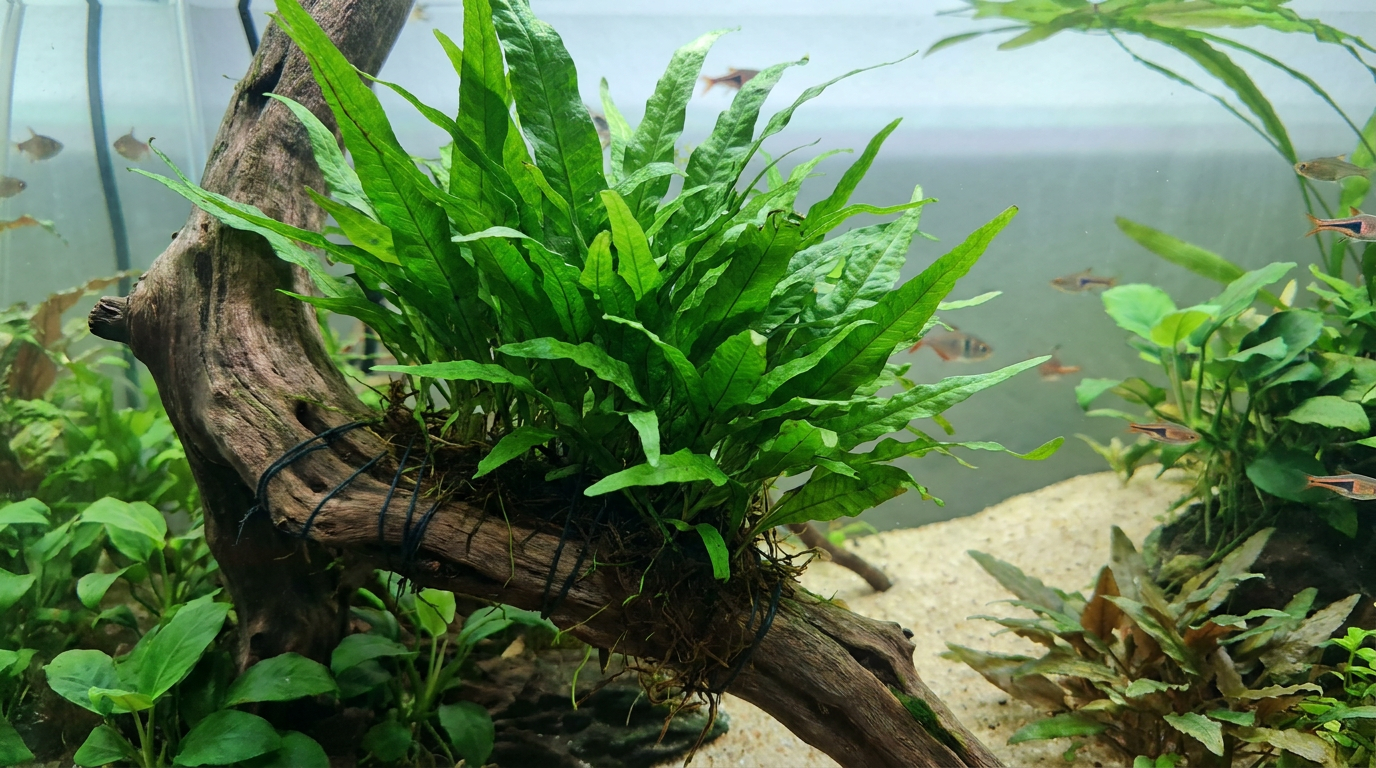
Java fern survives almost every beginner mistake, as long as you follow one rule: never bury the rhizome. Attach it to hardscape, give it low to moderate light, and it will grow on neglect.
It is slow, undemanding, and one of the few plants that thrives without CO2 or special substrate.
Why you never plant the rhizome
The rhizome is the thick green horizontal stem the leaves and roots grow from. Bury it in substrate and it rots, which is the single most common way people kill this plant.
Instead, tie the rhizome to driftwood or rock with thread or a small amount of super glue gel. The roots anchor themselves within a few weeks. This is why it fits so well into a planted tank setup that has hardscape but no rich soil.
Light and water conditions
Java fern prefers low to moderate light. Under strong light without added CO2 it often develops black spots and algae on older leaves. If you run bright lighting, floating plants or shade from taller stems help.
It tolerates a wide range, roughly 68 to 82 F and pH from 6 to 7.5. That flexibility is why it appears in almost every low-tech LED planted tank build.
Feeding and growth
Because it feeds through its leaves, java fern does not need root tabs. A basic liquid fertilizer covers it in most tanks. If your water is very lean, dosing helps, but heavy feeding is wasted on a plant this slow.
You will not need rich planted substrate for it, which makes it ideal for gravel or sand tanks where other plants struggle.
Propagation and black spots
Java fern spreads two ways. The rhizome branches over time, and tiny plantlets grow on mature leaves. Once a plantlet has a few leaves and roots, snip it off and attach it elsewhere.
Black spots on leaves are usually reproductive plantlets, not disease. If a whole leaf browns, trim it at the base and leave the rhizome alone. New growth follows.
Marcus Chen
Aquarist & Founder, TanninLab
Marcus has been keeping planted tanks for 14 years. He tests every product recommendation in his own tanks and publishes the raw data.
Last updated: July 2026