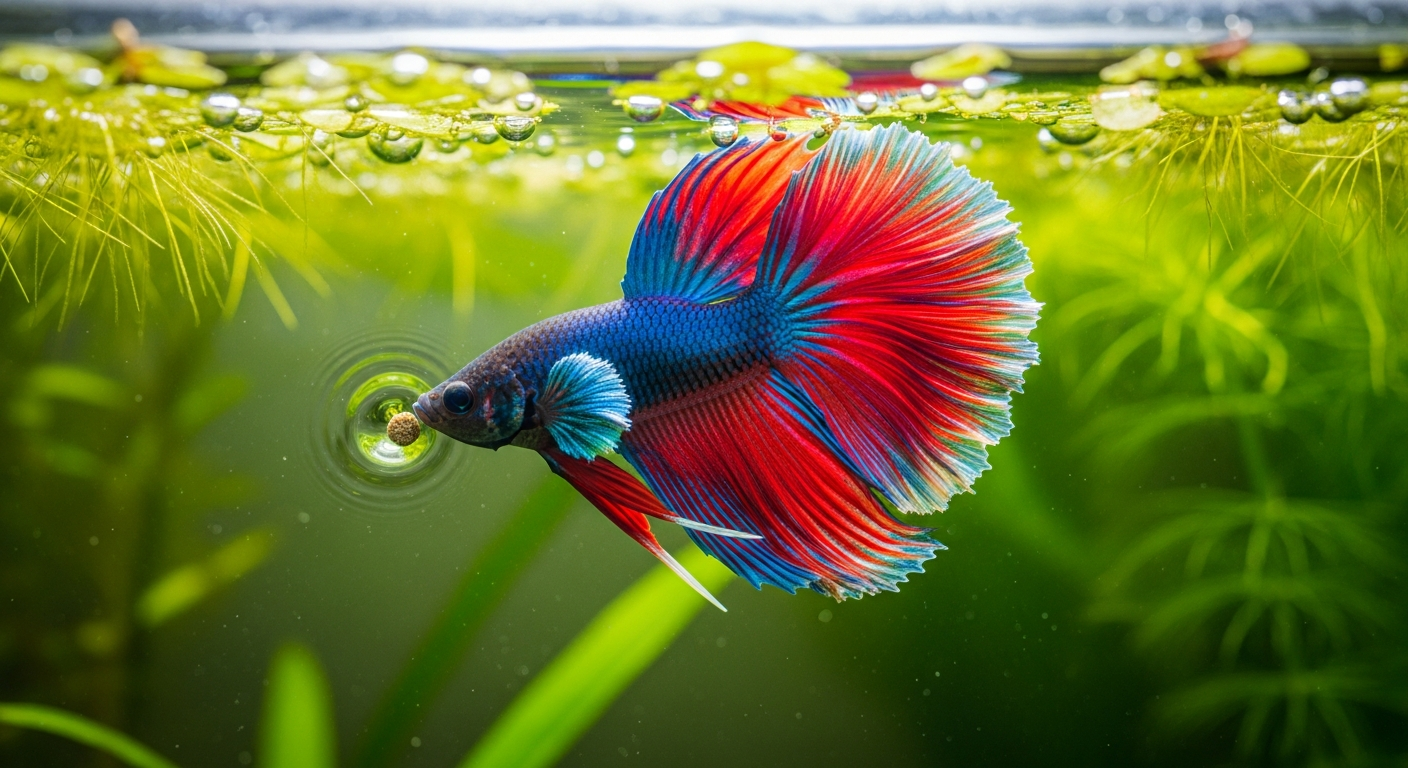
Best Betta Food for Color and Health
Updated June 2026
Most betta owners kill their fish slowly with the wrong food. Not toxins, not bad water chemistry — just a bag of generic flakes with corn starch listed second and “fish meal” (unspecified, low-grade) as the only protein source. Your betta’s wild ancestors hunted insects and larvae in the rice paddies of Thailand. That context matters for every feeding decision you make.
This guide breaks down every food type worth using, shows you how to read a label without getting tricked by marketing, and gives you a feeding schedule that prevents the two most common betta health disasters: bloat and constipation.
Why Bettas Need Animal Protein, Not Pellets That Smell Like Pond
A betta’s digestive system is short and designed for meat. It processes insect larvae, small crustaceans, and zooplankton efficiently. It does not process plant starch well. When high-carbohydrate foods pass through a betta’s gut, you get incomplete digestion, organ strain over time, and the color fade that owners often blame on genetics or lighting.
The benchmark to hold any betta food to: crude protein at or above 40%, first ingredient is a named animal source, and carbohydrates from grains should be minimal or absent. That single standard rules out most mass-market betta foods at the pet store.
Size matters too. A betta’s stomach is roughly the size of its eye. Any food that expands, particularly freeze-dried options that absorb water after you feed, can cause serious bloat if you overfeed. Keep that in mind as you read through each food type below.
Betta Food Types: How They Stack Up
No single food covers everything your betta needs. The healthiest bettas eat a rotation. Each category below has different strengths.
| Food Type | Typical Protein % | Best Use | Feeding Frequency | Watch Out For |
|---|---|---|---|---|
| Betta pellets (high-quality) | 40-50% | Daily staple | Once or twice daily, 2-4 pellets | Fillers (wheat, corn, soy near top of ingredient list) |
| Frozen bloodworms | 55-65% | Conditioning, color enhancement | 2-3x per week max | Overfeeding causes constipation; thaw fully before feeding |
| Frozen brine shrimp | 45-60% | Enrichment, gut loading variety | 1-2x per week | Lower nutritional density than bloodworms; use enriched (Selcon-fed) shrimp when possible |
| Freeze-dried foods | 40-60% | Treat / occasional use | Once per week or less | Pre-soak in tank water for 30 seconds; skipping this step causes expansion-related bloat |
| Live foods (daphnia, wingless fruit flies, microworms) | 40-55% | Behavioral enrichment, breeding conditioning | 1-2x per week | Sourcing risk (parasites from wild-caught); culture your own when possible |
| Generic tropical flakes | 25-35% | Emergency only | Avoid as staple | Formulated for omnivores; grain-heavy; not appropriate long-term for carnivores |
How to Read a Betta Food Label Without Getting Fooled
The ingredient list on a betta food package follows the same descending-by-weight rule as human food. Whatever is listed first makes up the largest portion. This one rule exposes most low-quality foods instantly.
You want to see a named protein first: salmon meal, whole herring, shrimp meal, menhaden fish meal. Avoid anything that just says “fish meal” with no species name. That is a catch-all for scraps from multiple low-grade sources. If wheat flour, ground corn, or soy protein concentrate appears in the first three ingredients, the food is not built for a carnivore.
Guaranteed analysis should show crude protein at 40% or higher and crude fat between 5-10%. Moisture matters too: freeze-dried and pellet formats are low moisture (around 8-12%), while frozen foods read 70-80% moisture, which is why you need more grams of frozen food to hit the same protein delivery as pellets. Do not compare percentages across formats without accounting for that gap.
One more trick manufacturers use: ingredient splitting. If a label lists “ground corn, corn gluten meal, corn starch” separately, those three items may collectively outweigh the named protein at the top, even though each individual corn ingredient sits below it. Treat any food with multiple corn or wheat derivatives as a filler-heavy product.
Feeding for Color: What Works and What Doesn’t
Betta color comes from chromatophores in the skin, and those cells need two things: carotenoid pigments (found in crustaceans, spirulina, and certain algae) and high overall protein status to maintain tissue health. You cannot supplement your way out of a low-protein staple diet.
Frozen brine shrimp and bloodworms are the classic color-enhancement foods because they deliver carotenoids alongside high animal protein. Shrimp meal and krill meal as ingredients in pellets do the same work passively, which is why premium betta pellets that include krill meal or astaxanthin tend to outperform basic salmon-only formulas on color over time.
Color enhancement foods work over weeks, not days. Feed a proper rotation for 4-6 weeks before judging results. If you have a well-planted tank setup with stable water parameters, you will see the full expression of your betta’s color in a way that a bare bowl simply cannot support.
Feeding Schedule and Portion Size
Feeding Protocol
Daily staple: 2-4 appropriately sized pellets per feeding, once or twice daily. Size reference: each pellet should be no larger than the betta’s eye.
Enrichment rotation: 2-3 times per week, swap one feeding for frozen bloodworms, frozen brine shrimp, or live daphnia. Never feed enrichment foods at both meals on the same day.
Weekly fast: Skip one full day of feeding per week. This clears the digestive tract and significantly reduces bloat and constipation risk. Sunday fasts are easiest to remember.
Two-minute rule: Any food your betta does not eat within two minutes should be removed with a turkey baster or pipette. Uneaten food decays quickly, spikes ammonia, and stresses the biological filter, especially critical in the small-volume tanks covered in the betta tank size guide.
Overfeeding, Bloat, and Constipation: What Actually Causes Them
Bloat in bettas is usually one of two things: bacterial (dropsy, where scales pinecone outward) or dietary (impaction from overfeeding or expanding freeze-dried foods). Dietary bloat is far more common and entirely preventable.
Constipation shows up as a bloated belly with no pineconing and a lethargic fish that stops eating. The fix is usually a 24-hour fast followed by a single small feeding of live or frozen daphnia. Daphnia acts as a natural laxative for bettas because of its fibrous shell material. This works far better than the commonly suggested “pea” remedy, which carries too much plant starch for a carnivore’s gut.
Freeze-dried foods are the most common trigger. A single freeze-dried bloodworm cube can expand to three or four times its dry volume inside your fish. If you feed freeze-dried anything, soak it in a small cup of tank water for 30 seconds first, then feed the pre-soaked portion. The expansion happens outside the fish, not inside.
For tank conditions that support digestive health, consistent water temperature between 76-82°F matters more than most hobbyists realize. A betta kept at 70°F has a slower metabolism and digests food significantly less efficiently. If you are seeing recurring digestive issues, check temperature before changing food. Visit the best betta tanks roundup for heater and tank recommendations that maintain stable temperatures without constant manual adjustment.
Foods That Have No Place in a Betta’s Diet
Generic tropical fish flakes are the worst offender. They are formulated for omnivorous community fish, not carnivores, and most contain wheat germ or corn as primary ingredients. A betta will eat them because bettas eat whatever is offered. That is not a sign of nutritional appropriateness.
Feeder goldfish are sometimes suggested as live food, but they carry a real parasite risk and introduce a fatty acid profile that is not well-suited to betta metabolism over time. Live blackworms from an unknown source carry the same parasite risk. If you want live food, culture your own daphnia or wingless fruit flies. Both are beginner-friendly and eliminate sourcing uncertainty.
Freeze-dried krill, marketed heavily in pet stores, is fine as an occasional treat when pre-soaked. It is not a staple. The protein percentage looks good on the label, but the expansion risk and lower moisture content make daily feeding inadvisable.
Buying Guide: How to Choose Without Buying Garbage
When you are standing in a pet store or scrolling Amazon, here is the shortcut evaluation:
First ingredient: named animal protein or pass. Protein percentage: 40% minimum on the guaranteed analysis. Ingredient list length: shorter is generally better. A food with 8 recognizable ingredients outperforms one with 22 ingredients including seven you cannot pronounce.
For pellet size, match it to your fish. Many mass-market betta pellets are too large. They force the fish to bite and tear rather than swallow whole, which stresses the fish and leads to more food wastage in the tank. If pellets float, that is ideal for surface-feeding bettas. Sinking pellets work for bettas that prefer mid-column feeding, which varies by individual fish.
Buy in smaller quantities unless you have multiple tanks. Fish food oxidizes after opening, and the fatty acids in quality pellets degrade faster than the expiration date suggests. A 1-oz jar refreshed every 4-6 weeks beats a 3-oz jar that sits open for six months.
Common Questions
How often should you feed a betta fish?
Once or twice daily, with one fasting day per week. Each feeding should deliver only what the fish can eat in about two minutes. Overfeeding is the most common water quality and health mistake betta keepers make, and it compounds quickly in smaller tanks.
Can bettas eat regular tropical fish flakes?
They will eat them, but regular tropical flakes are not appropriate as a staple. Most are formulated for omnivores and contain too many plant-based fillers to meet a betta’s carnivore protein requirements. If flakes are your only option temporarily, use them sparingly and supplement with frozen foods as soon as possible.
Why does my betta keep spitting out pellets?
Usually a size issue. The pellets are too large to swallow comfortably, so the fish mouths and rejects them. Try a smaller pellet size or break pellets in half before feeding. Occasionally a betta will spit and re-eat as part of normal eating behavior. That alone is not a problem if the food is eventually consumed.
What foods improve betta color?
Frozen brine shrimp and bloodworms are the most reliable color-enhancement options because of their carotenoid content. Pellets that include krill meal or astaxanthin as ingredients provide similar benefit passively, making them useful as a daily staple for fish you are trying to color up over the long term.
How long can a betta go without food?
A healthy adult betta can go 10-14 days without food without significant harm. For planned vacations up to a week, a single weekend feeder block is generally unnecessary. Bettas handle short fasts better than they handle the water quality hit from slow-dissolving feeder blocks. Anything longer than 10 days warrants an automatic feeder or a trusted person feeding manually.
Marcus Chen
Aquarist & Founder, TanninLab
Marcus has been keeping planted tanks for 14 years. He tests every product recommendation in his own tanks and publishes the raw data.
Last updated: June 2026