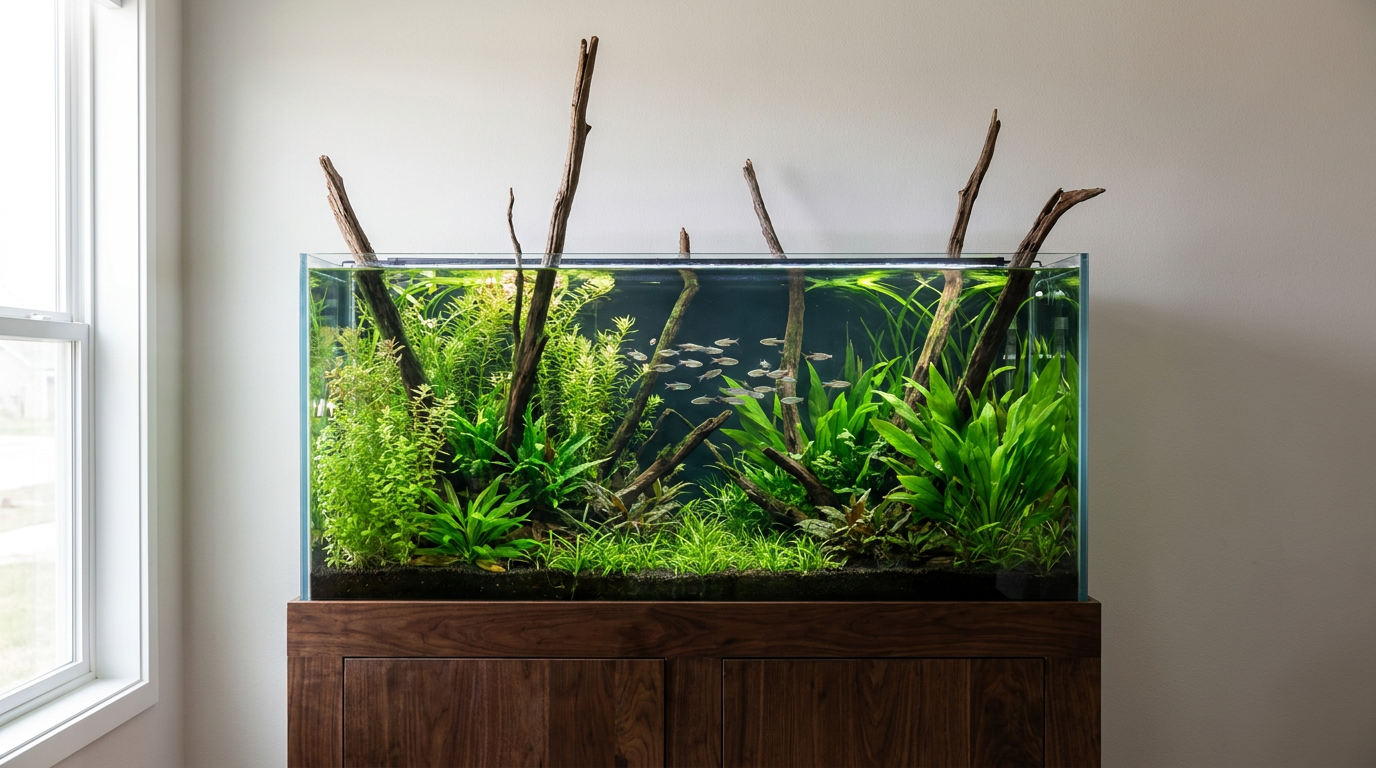
150 Gallon Fish Tank: Stocking and Structural Weight Limits
Updated October 2026
A 150 gallon fish tank weighs about 1,800 lb filled with water alone, per Aqueon manufacturer figures, before you add substrate, rock or wood. That figure, not the stocking list, decides where the tank can go and what has to sit under it.
Settle the floor and the stand first. The planted layout is the easy part once you know the tank is not going anywhere.
What a 150 gallon tank actually weighs
The standard 150 is a 6 foot tank on the same 18 1/2 inch footprint as the 125, just 6 inches taller. The figures below are manufacturer figures for Aqueon glass tanks, in inches and pounds, empty and then filled with water only.
| Aqueon tank | Dimensions (L x W x H, inches) | Empty weight | Filled weight |
|---|---|---|---|
| 75 | 48 1/2 x 18 1/2 x 21 1/8 | 98 lb | 785 lb |
| 125 | 72 1/2 x 18 1/2 x 23 3/8 | 177 lb | 1,400 lb |
| 150 | 72 1/2 x 18 1/2 x 29 1/2 | 281 lb | 1,800 lb |
| 180 | 72 1/2 x 24 1/2 x 25 5/8 | 282 lb | 2,100 lb |
| 210 | 72 1/2 x 24 1/2 x 29 5/8 | 343 lb | 2,450 lb |
Add a 3 inch layer of aquasoil, a few large stones and a stand, and a working 150 lands near a ton. Spread over a footprint of just over 9 square feet, that is roughly 190 lb per square foot resting on the floor.
Video: The king of DIY
Floor loading: joists, walls and slabs
Residential floors in the United States are designed to a 40 lb per square foot live load in living areas under the International Residential Code, Table R301.5. A 150 gallon tank puts several times that on its footprint, so the question is how the joists carry it, not whether the code number covers it.
On a concrete slab or a basement floor the tank is fine. The load goes straight into the ground.
On a wood-framed floor, place the tank so its 6 foot length runs across the joists rather than along one of them, and put it against a load-bearing exterior wall where the joists are supported. That spreads the weight over four to five joists near their strongest point.
If you cannot inspect the joists from below, pay a structural engineer for a short visit. It costs less than a sagging floor.
The stand carries everything
A 150 needs a stand rated for it by the maker, or a built frame with a vertical leg under each corner and along the front and back rails. Read our fish tank stand weight guide before you buy or build.
Level the stand before filling, and shim under the stand, never under the tank rim. A tempered bottom pane, which Aqueon fits to the 150, will not tolerate a twisted frame.
Stocking a planted 150
The 29 1/2 inch height is the design constraint. Light has to cross 27 inches of water to reach a carpet, so budget for a strong LED or skip carpets and build around tall stems, Amazon swords and large driftwood.
Fish that use the vertical space earn their place here. A group of angelfish, a school of 25 to 30 rummy nose tetras and a pair of large plecos sit at different heights and fill the tank without crowding it.
The 18 1/2 inch depth is the same as a 75 gallon fish tank, so the hardscape layering rules transfer directly. The extra 2 feet of width gives you room for a second focal point.
Compare it against the 55 gallon fish tank footprint before you commit. The 150 fixes the narrow depth that makes the 55 awkward to aquascape, at the cost of everything above about the floor.
Questions readers ask
Can a 150 gallon fish tank go on a second floor?
Sometimes, but only after you know how the joists run. Place the tank across the joists against a load-bearing wall, and have a structural engineer confirm the framing if the house is older or you cannot inspect the floor from below. On a slab or basement floor the question does not arise.
How much does a 150 gallon fish tank weigh with substrate and rock?
Aqueon lists the 150 at 281 lb empty and 1,800 lb filled with water only. A few inches of aquasoil, hardscape and the stand itself push a working setup close to 2,000 lb, so plan the floor and stand around a ton.
What stand do I need for a 150 gallon tank?
One rated by its manufacturer for a 150 or larger, or a built frame with a vertical leg at each corner and support under the front and back rails. Cabinet stands sold for 75 gallon tanks are not designed for this load.