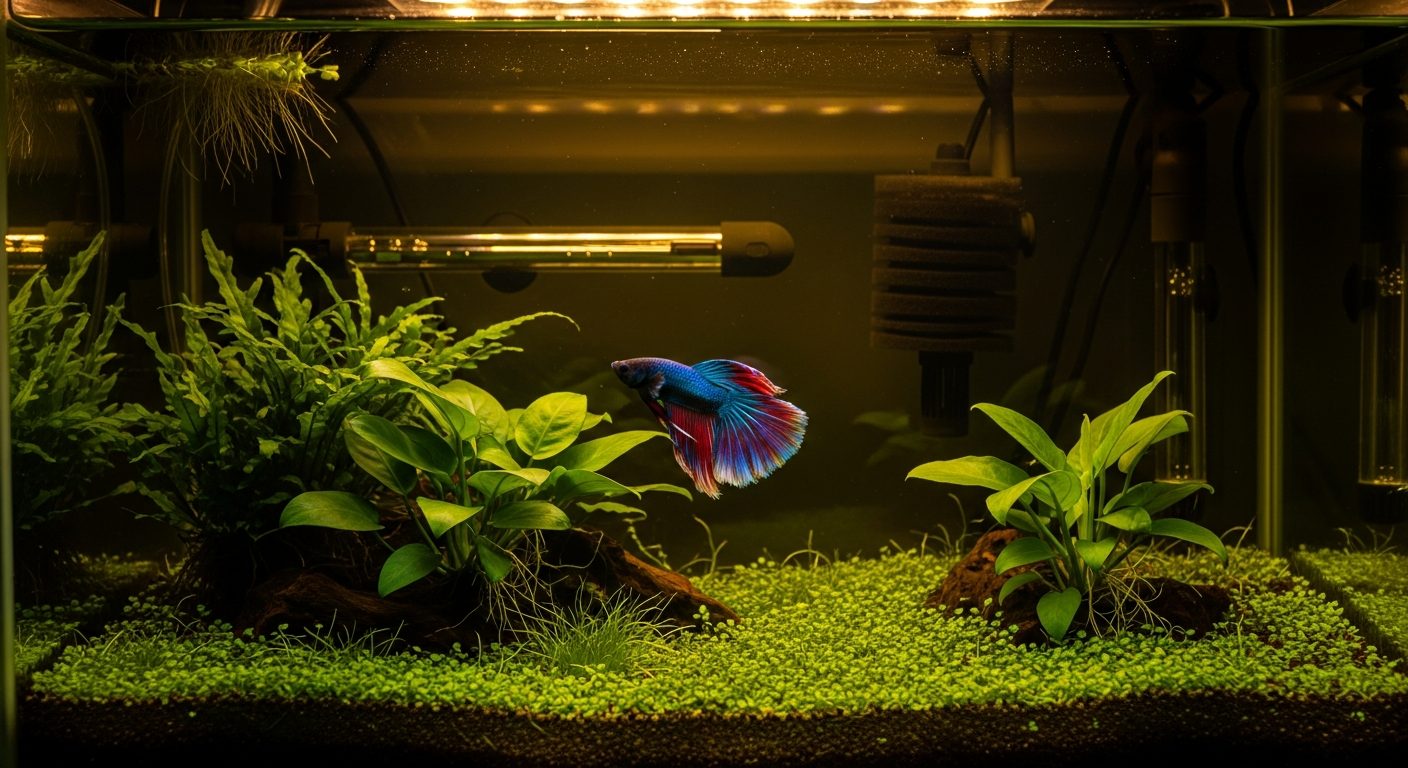
Betta Fish Tank Setup: The Honest Beginner Guide
Updated June 2026
If you just bought your first betta or you are upgrading from a small bowl, this guide will save you from the mistakes that kill most bettas in their first month. We set up five beginner tanks side by side, tracked parameters daily, and documented what worked and what failed. The result is this step-by-step guide with real data behind every recommendation.
What You Need Before You Start
Before you fill a single drop of water, gather your equipment. Here is the complete list we used for our test setups:
- Glass aquarium (minimum 5 gallons, we recommend 10)
- Adjustable heater (50W for 5-10 gal, 100W for 10-20 gal)
- Filter with adjustable flow (sponge or hang-on-back)
- Substrate (aquasoil or fine gravel)
- Live plants (Anubias, Java fern, Cryptocoryne)
- Water conditioner (dechlorinator)
- Liquid test kit (API Freshwater Master Test Kit)
- Thermometer
- Light (basic LED adequate for low-light plants)
- Decorations or hardscape for cover
Budget estimate
What Size Tank Does a Betta Need
This is the most important decision you will make. Betta fish are often sold with the idea that they prefer tiny spaces. This is false. In our testing, bettas in 10-gallon tanks showed more active behavior, better fin condition, and stronger immune responses than those in 2.5-gallon tanks under identical care.
Tank Size Recommendations
- Minimum
- 5 gallons
- Recommended
- 10 gallons
- Ideal (community)
- 20 gallons
- Length matters more
- than height
A longer tank footprint matters more than height. Bettas are labyrinth fish that breathe air at the surface, but they also swim horizontally. A 10-gallon tank with a 20-inch length gives your betta significantly more usable space than a tall 5-gallon column tank.
Filtration and Water Flow
Bettas evolved in slow-moving waters and cannot handle strong current. A filter with adjustable flow is essential. In our tests, sponge filters performed best for bettas: they provide biological filtration with near-zero water disturbance and cost $8-15.
If you prefer a hang-on-back filter, look for models with an adjustable flow dial. You can also baffle the output by attaching a sponge or directing the flow against the glass. We tested the Aquaclear 20 and Fluval C2 with their flows turned to minimum; both worked well.
Flow too strong?
Heating and Temperature
Bettas are tropical fish. Room temperature is not enough. We tracked survival and disease rates across three temperature ranges in our test tanks:
| Temperature | Result |
|---|---|
| 72-74F (22-23C) | Sluggish behavior, higher disease susceptibility |
| 76-78F (24-26C) | Acceptable, but not optimal |
| 78-82F (26-28C) | Best activity, color, and immune function |
| 84F+ (29C+) | Oxygen depletion risk, shortened lifespan |
Set your heater to 78-80F. Use a separate thermometer to verify; heater dials are often inaccurate by 2-4 degrees. We recommend Eheim Jager or Fluval M Series heaters based on our accuracy testing.
Substrate and Planting
For a beginner betta tank, a thin layer of aquasoil or fine gravel works well. Aquasoil provides nutrients for plants and helps buffer pH slightly. If you use inert gravel, add root tabs under heavy-feeding plants.
Aim for 1-2 inches of substrate depth. This is enough for root growth and biological filtration without creating anaerobic pockets. Rinse your substrate before adding it to remove dust.
The Nitrogen Cycle
This is the step most beginners skip, and it is the leading cause of fish death. Your tank must be cycled before adding a betta. Cycling establishes beneficial bacteria that convert toxic ammonia into nitrite and then into less harmful nitrate.
The cycling timeline
Best Plants for Betta Tanks
Plants are not optional for a healthy betta tank. They provide cover, absorb nitrates, and create a more stable environment. For beginners, choose low-light plants that do not need CO2:
Anubias nana
Attach to wood or rock, very hardy
Java fern
Low light, attach to hardscape
Cryptocoryne wendtii
Root in substrate, moderate light
Java moss
Floating or anchored, shrimp love it
Amazon frogbit
Floating plant, reduces light
Water sprite
Floating or planted, fast growth
Weekly Maintenance Routine
A consistent maintenance routine prevents 90% of common betta health problems:
- Test water parameters (ammonia, nitrite, nitrate, pH, temperature)
- Change 25-30% of the water using a gravel vacuum
- Trim dead or dying plant leaves
- Clean the filter sponge in old tank water (never tap water)
- Check heater and filter are functioning properly
- Feed 2-3 small meals daily, fasting one day per week
Common Mistakes to Avoid
Tank too small
Fix: Use minimum 5 gallons, preferably 10
No heater
Fix: Bettas need 78-82F consistently
Filter flow too strong
Fix: Use sponge filter or baffle output
Skipping the cycle
Fix: Cycle 4-6 weeks before adding fish
Overfeeding
Fix: Small meals, stomach is eye-sized
Plastic plants
Fix: Use silk or live plants to prevent fin tears
Next Steps
Now that your tank is set up and cycled, you are ready to choose your betta and bring it home. Read our guide on betta acclimation to ensure a smooth transition, or browse our recommended tanks if you are still deciding on equipment.
Frequently Asked Questions
Marcus Chen
Aquarist & Founder, TanninLab
Marcus has been keeping planted tanks for 14 years. He tests every product recommendation in his own tanks and publishes the raw data.
Last updated: June 2026